Phorce
A foliar nutrient complex powered by Nutriphite® and positioned to support root development, nutrient uptake, nutrient synthesis and utilization, crop establishment, productive growth and overall crop quality.
Phorce is designed around the connection between above-ground foliar nutrition and below-ground root performance. Manufacturer information associates the technology with increased nitrate reductase production, increased root mass and increased root exudation — processes that can help crops interact more effectively with their soil and nutrient environment.
Formulation, guaranteed analysis, application rate, timing, approved crops, compatibility and claims can vary by market. Always follow the current approved local product label.
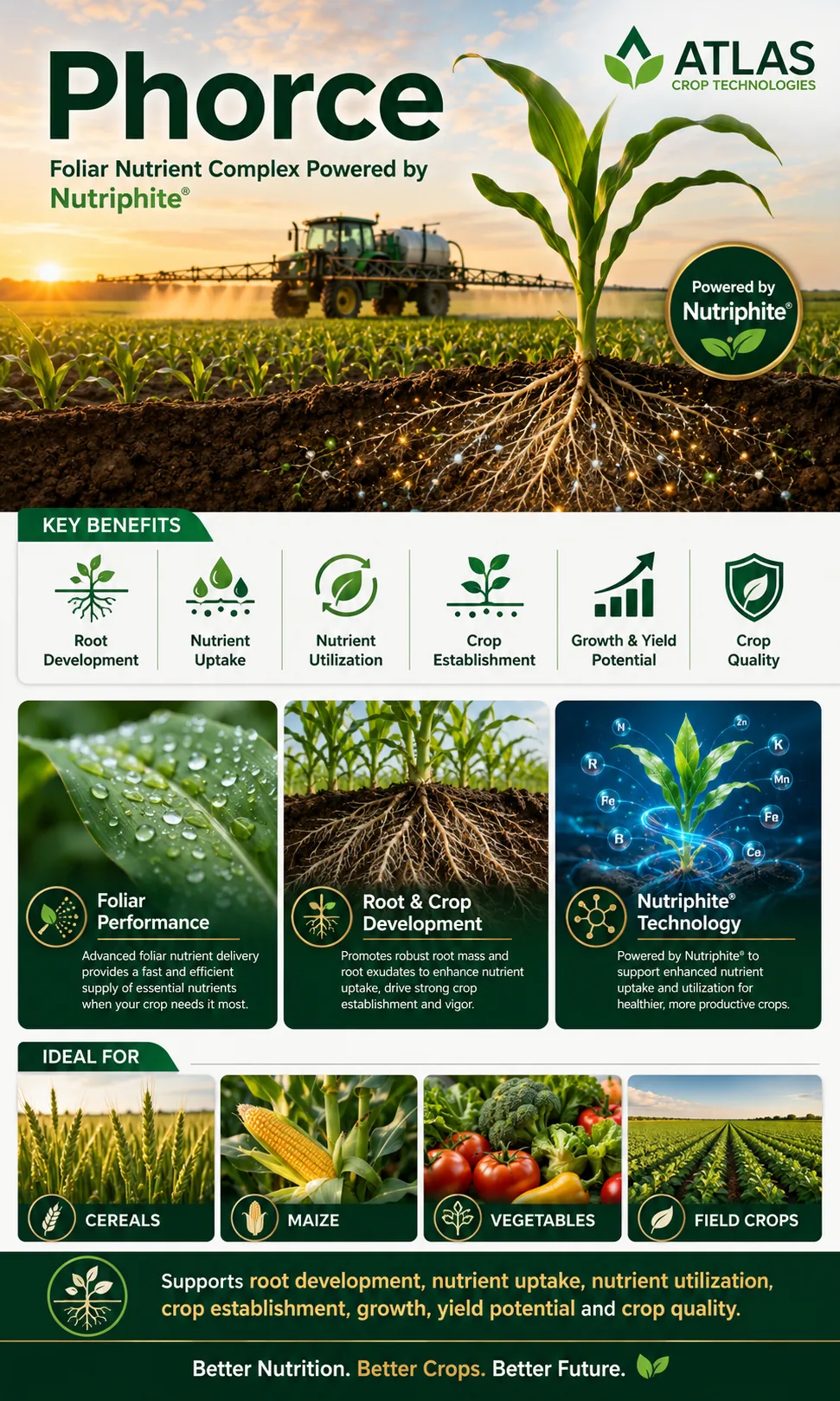
Linking foliar nutrition with root-system performance
Crop nutrition is often discussed in terms of the quantity of fertiliser supplied to the field. Plant performance, however, ultimately depends on the crop's ability to acquire those nutrients and use them effectively within its metabolism.
Root architecture, soil moisture, nutrient availability, plant physiology and metabolic activity all influence the efficiency with which nutrients move from the growing environment into productive crop growth.
Phorce is positioned within this nutrient-management system as a foliar technology intended to influence plant processes associated with nutrient acquisition and utilization while supporting the development of a larger, more effective root system.
The manufacturer describes Phorce as a unique, patented nutrient complex powered by Nutriphite® and containing potassium phosphite.
Technical positioning
Designed to support the crop from leaves to roots
Phorce is positioned around several connected aspects of crop nutrient management rather than a single nutrient-response pathway.
Root Development
Manufacturer information associates Phorce with increased root mass, potentially giving the crop a larger below-ground system through which to explore soil and access water and nutrients.
Nutrient Uptake
A larger root system can create more contact between roots, soil water and dissolved nutrients. Phorce is positioned to support this nutrient-acquisition process.
Nutrient Utilization
Crop response depends on what the plant does with absorbed nutrients as well as on nutrient uptake itself. Manufacturer positioning includes increased nutrient synthesis and utilization.
Root–Soil Interaction
Phorce is also associated by the manufacturer with increased root exudation, potentially influencing the immediate rhizosphere around actively growing roots.
Crop Establishment
Efficient early nutrient acquisition and healthy root development are important components of establishment and the foundation for later crop growth.
Crop Quality
Manufacturer positioning links improved nutrient management with improved growth, yield potential and crop quality. Actual response depends on crop, environment and overall management.
Powered by Nutriphite®
Current manufacturer information describes Phorce as being powered by Nutriphite® technology.
Within the Phorce product positioning, Nutriphite® is associated with potassium phosphite and plant physiological responses linked with nutrient management and root development.
This makes Phorce distinct from a conventional foliar product that is positioned only as a direct source of mineral nutrients.
The exact nutrient analysis and formulation supplied in your market must be taken from the current local label and technical data sheet. Do not infer composition or rate from another country's product.
Nutrient management beyond direct feeding
Nitrate reductase and nitrogen assimilation
Nitrate reductase is an important plant enzyme involved in the assimilation of nitrate nitrogen.
Nitrate absorbed by plant roots cannot be incorporated directly into amino acids and proteins without first undergoing biochemical conversion. Nitrate reductase participates in the initial reduction of nitrate as part of this assimilation pathway.
Current Verdesian information states that studies associated with Phorce's potassium phosphite component showed increased production of nitrate reductase.
Why enzyme activity matters
Crop nutrient efficiency depends on several stages:
A technology positioned around nutrient utilization therefore addresses a different agronomic concept from simply supplying additional fertiliser.
Why greater root mass can matter
Roots are the crop's primary interface with soil, water and the majority of mineral nutrients.
Greater soil exploration
A larger or more highly branched root system can explore a greater volume of soil and potentially encounter nutrient reserves that would otherwise remain outside the root's immediate zone of influence.
More root surface
Manufacturer information specifically links increased root mass with a higher surface-area-to-volume relationship and increased contact with soil water.
Contact with soil water
Many nutrients reach roots through soil water. Root distribution and soil moisture therefore strongly influence nutrient uptake.
Nutrient interception
Expanding the root network increases the number of locations at which roots can interact with dissolved and exchangeable nutrients.
Early crop foundation
Strong early roots can provide the physical foundation required for above-ground growth as crop demand for water and nutrients increases.
Broader resource access
A developed root system can improve access to spatially variable soil resources, although it cannot eliminate drought, compaction or other severe stresses.
Root exudates: the crop's chemical interface with soil
Plant roots do not function as passive absorptive structures. They release a variety of compounds into the narrow zone of soil surrounding the root, known as the rhizosphere.
These released compounds are collectively referred to as root exudates and can include organic acids, sugars, amino acids and other metabolites.
Root exudates can influence nutrient chemistry, microbial activity and interactions between roots and the surrounding soil environment.
Manufacturer-described increase in root exudation
Current manufacturer information states that Phorce increases the production of root exudate secreted by the root.
Verdesian positions this response as helping break down or mobilise nutrition in the soil so that it can be taken up more effectively by the plant.
Nutrient availability remains dependent on nutrient chemistry, soil pH, moisture, root activity, microbial processes and the original nutrient supply. Root exudation does not create nutrients that are absent from the production system.
From soil supply to plant uptake
Nutrient supply
The nutrient must first be present within the soil, substrate, irrigation water or fertiliser program.
Nutrient availability
Soil chemistry determines how much of the total nutrient pool is present in a form that can participate in root uptake.
Movement to roots
Nutrients reach roots through combinations of mass flow, diffusion and direct root interception.
Root absorption
Active roots absorb nutrients through specialised transport processes across root membranes.
Internal transport
Absorbed nutrients must move to tissues where metabolic demand exists.
Assimilation and utilization
Nutrients must ultimately be incorporated into metabolic, structural or regulatory functions within the crop.
More than fertiliser rate
Nutrient use efficiency describes how effectively the production system converts nutrient inputs and existing nutrient reserves into productive crop growth.
It is influenced by fertiliser source, rate, timing and placement, but also by root development, soil chemistry, moisture, microbial activity and plant metabolism.
Phorce is positioned primarily on the plant side of this system: supporting root growth, nutrient uptake and nutrient utilization.
Efficient nutrition requires several pieces to work together
Why apply through the leaf?
Foliar application delivers a product directly to above-ground plant surfaces and can provide an efficient method of integrating nutritional or physiological technologies into an in-season crop program.
This approach can be particularly useful where application timing is aligned with an important crop-development stage or where growers want to supplement the root-zone nutrient program without disturbing soil.
Current manufacturer information identifies foliar application for Phorce.
Application quality matters
Match Phorce to crop demand and development
Exact timings are crop- and label-specific. The framework below explains how agronomists typically think about foliar nutrient timing.
Early vegetative growth
During establishment, the crop is rapidly developing roots and leaf area. Supporting nutrient acquisition during this stage can help build the physiological foundation for later growth.
Rapid canopy development
High rates of vegetative expansion increase demand for nitrogen, mineral nutrients, water and assimilates.
Pre-reproductive stages
Nutrient status before flowering or reproductive transition can influence the crop's ability to sustain the next stage of development.
Reproductive growth
Certain crops may use foliar nutrient technologies during reproductive stages when nutrient demand and yield-component formation are important.
Do not infer application timing from general crop physiology alone. The current approved Phorce label must define the permitted crops, timings, rates, number of applications and intervals.
Factors that influence foliar application quality
Temperature
Extreme heat can increase evaporation, shorten droplet life and increase crop-safety concerns for some foliar mixtures.
Humidity
Relative humidity influences drying time and the period during which spray deposits remain hydrated on the leaf surface.
Wind
Excessive wind can reduce coverage and increase the potential for off-target movement.
Rainfast period
Rain shortly after spraying may remove or dilute foliar deposits. Follow label guidance on rainfall and drying intervals where provided.
Leaf condition
Leaf age, waxiness, dust, disease and plant stress can influence retention and interaction of foliar treatments with the crop canopy.
Coverage
Appropriate nozzle selection, pressure, droplet spectrum, speed and carrier volume contribute to uniform foliar coverage.
Water is part of the tank mix
Foliar products are frequently applied in mixtures in which water represents the largest component by volume.
Water chemistry can influence solubility, pH, stability and interaction among nutrients, pesticides, adjuvants and other spray materials.
For that reason, water quality should be considered when developing a Phorce application program.
Parameters to review
Integrating Phorce into an existing spray program
Foliar applications are often combined operationally with other crop inputs to reduce passes through the field. However, convenience should never be assumed to equal compatibility.
Physical incompatibility can produce precipitation, separation, excessive foaming or nozzle blockage. Chemical incompatibility may alter product stability, while biological or crop compatibility may affect plant safety or product performance.
Compatibility checklist
Root growth also depends on the growing environment
Phorce can support root-development objectives, but no foliar technology replaces the physical and chemical conditions required for healthy roots.
Soil structure
Compaction, hardpans and poor aggregation can physically restrict root penetration regardless of crop nutrient status.
Oxygen
Waterlogged soils restrict oxygen availability to roots and can impair root respiration and nutrient uptake.
Moisture
Severe drought restricts root activity and nutrient movement through the soil solution.
Soil temperature
Cold soil slows root growth and nutrient acquisition during early crop establishment.
Salinity
High soluble-salt concentrations can reduce water uptake and create physiological stress around active roots.
Root disease
Soilborne pathogens and root-feeding pests can damage the root system and limit its ability to acquire nutrients.
Identify the real crop limitation
Poor growth or nutrient uptake can result from nutritional, physical, biological or environmental causes.
Soil analysis
Soil testing helps establish nutrient supply, pH, salinity and other factors relevant to nutrient availability.
Tissue analysis
Plant tissue testing can provide information about the nutrient status of the crop during a specific growth stage.
Root inspection
Carefully examining roots can reveal compaction, disease, insect feeding, waterlogging, restricted architecture or other problems.
Field pattern
Symptom distribution across soil types, drainage patterns, irrigation zones or management areas can help identify the source of the limitation.
Nutrient uptake is only valuable when the nutrient supply is balanced
A larger root system cannot compensate indefinitely for a nutrient that is missing from the soil or fertiliser program.
Similarly, increasing the uptake of one nutrient does not remove the need to manage the others in suitable proportions.
Phorce should therefore be integrated into a complete crop-nutrition strategy based on testing, crop removal, soil conditions and yield objectives.
Consider the complete nutrient package
Phosphite and phosphate are not identical
Current manufacturer information describes Phorce as containing potassium phosphite.
In crop nutrition terminology, phosphite and phosphate are chemically different phosphorus-containing ions and should not automatically be treated as interchangeable sources of plant phosphorus.
Phorce should therefore be used according to its registered nutrient-complex positioning and label rather than being assumed to substitute directly for a conventional phosphate fertiliser program.
Maintain the base fertility program
Phorce is positioned around nutrient management, plant physiology and nutrient utilization. Phosphorus fertiliser recommendations should continue to be based on crop requirements, soil testing and locally appropriate agronomic guidance.
Nutrition and environmental stress
Crop nutrient efficiency can decline during drought, heat, cold, salinity, waterlogging and other environmental stresses because these conditions influence root activity, transpiration and metabolism.
Maintaining an effective nutrient-management program can help avoid adding nutrient deficiency to an already stressed crop.
Phorce should not, however, be described as eliminating abiotic stress unless such a claim is explicitly supported by the current local product registration.
Address the underlying constraint
Situations where Phorce may warrant evaluation
Product fit should be determined from crop requirements, registered uses and the overall nutrient-management strategy.
Root-development programs
Phorce may fit production systems where increasing root mass and root-zone nutrient interaction are important agronomic objectives.
Nutrient-efficiency programs
Growers seeking to improve the crop's ability to acquire and use nutrients may evaluate Phorce alongside their existing fertility strategy.
Intensive crop systems
High-yield or high-value systems often require close management of nutrient supply, root health and physiological demand.
Foliar nutrition programs
Phorce can be integrated into foliar programs where the product label and crop-stage recommendations support its use.
Establishment-focused management
Root development and nutrient acquisition are particularly relevant when establishing the crop's early growth potential.
Crop-quality programs
Manufacturer positioning includes crop quality as one of the downstream objectives of improved nutrient management.
Phorce performs inside a complete production system
Plant physiology cannot be separated from agronomy. Even a highly effective foliar technology operates within the constraints created by soil, climate, water, crop genetics and management.
The best Phorce program should therefore complement — not replace — fundamental practices required for healthy crop development.
Review alongside Phorce
Measuring crop response
Well-designed field comparisons provide more useful information than relying only on visual impressions.
Root assessment
Carefully excavated plants can be compared for root mass, branching, root distribution and overall root condition.
Tissue analysis
Representative tissue samples may help assess nutrient status when comparing treated and untreated crop areas.
Canopy development
Crop uniformity, leaf area and vegetative development can provide useful contextual observations.
Yield components
Where appropriate, evaluate crop-specific yield components rather than waiting only for final harvest weight.
Harvest yield
Replicated or well-managed strip comparisons can provide useful information on whether an observed response translated into yield.
Quality parameters
For specialty crops, relevant quality metrics may be as important as total yield and should be defined before the field evaluation.
Information that helps us evaluate Phorce for your program
The more agronomic context you provide, the more useful the technical discussion can be.
Country and region
Location determines product registration and provides important context on climate, soils and production practices.
Crop and variety
Include crop, cultivar where relevant, planting date and intended production system.
Growth stage
Foliar nutrient recommendations depend strongly on crop developmental stage and canopy size.
Fertility program
Include nitrogen, phosphorus, potassium, secondary nutrient and micronutrient products already being applied.
Soil information
Soil type, pH, organic matter, salinity and recent fertility results provide valuable root-zone context.
Tissue analysis
Include recent plant-analysis results with sampling stage and laboratory interpretation where available.
Tank-mix partners
Identify pesticides, fertilisers, biostimulants and adjuvants intended for the same spray operation.
Water quality
Water pH, hardness and salinity can be useful when reviewing a complex foliar tank mix.
Commercial requirement
For distribution enquiries, include expected product volume, customer segment, region, season and technical positioning.
Phorce product profile
Avoid common nutrient-program mistakes
Treating Phorce as a complete fertiliser
Phorce should complement a balanced nutrient program rather than replace the crop's fundamental nitrogen, phosphorus, potassium and other nutrient requirements.
Assuming bigger roots solve every problem
Root development cannot compensate for severe nutrient deficiency, compaction, disease, waterlogging or prolonged drought.
Ignoring application conditions
Poor spray timing, inadequate coverage or unsuitable weather can reduce the quality of a foliar treatment.
Assuming universal tank compatibility
Every proposed tank mix should be checked against current labels and product-specific compatibility guidance.
Treating phosphite as conventional phosphate fertiliser
Phosphite and phosphate are chemically different. Do not use Phorce as a basis for reducing required phosphate fertiliser unless supported by appropriate agronomic and local label guidance.
Using another country's rate
Formulation, concentration and registration may differ between markets. Use only the current local label rate.
Explore related technologies
Combine foliar nutrient technologies with phosphorus-efficiency, micronutrient and biological products according to crop requirements and local registration.
Phree-Up®
A phosphorus availability enhancer designed to help crops access tied-up phosphorus more effectively in the root zone.
View Product → MicronutrientsPolyAmines
A range of amino-acid-chelated micronutrients designed to support trace-element nutrition, rapid uptake and plant development.
View Product → InoculantPre-Vail®
A clay-based pre-inoculant for selected legumes, developed to support early root development, nodulation and seedling vigor.
View Product →Build Phorce into your crop-nutrition strategy
Tell us your country, crop, growth stage, fertility program, soil or tissue information, intended foliar timing and tank-mix partners. Atlas Crop Technologies can help evaluate how Phorce may fit your technical or commercial program.
Frequently Asked Questions
These answers combine current manufacturer-described product information with general crop-nutrition context. The current approved local label remains the definitive source for product use.
Phorce is a foliar nutrient complex powered by Nutriphite® and positioned to support nutrient management, root development, nutrient uptake, nutrient synthesis and utilization, crop establishment, productive growth and overall crop quality.
Current Verdesian information describes Phorce as a unique, patented nutrient complex. Intellectual-property status can be jurisdiction-specific, so commercial references should follow current manufacturer terminology.
Nutriphite® is the technology platform identified by Verdesian as powering Phorce. Current manufacturer information links the Phorce formulation with potassium phosphite and plant physiological responses associated with nutrient utilization and root development.
Yes. Current manufacturer information states that Phorce contains potassium phosphite. The exact product analysis and concentration should be confirmed from the locally approved label.
No. Phosphite and phosphate are chemically different phosphorus-containing forms and should not automatically be treated as equivalent plant-phosphorus fertiliser sources. Maintain the base phosphorus program according to soil testing, crop demand and local agronomic recommendations.
Current manufacturer information associates Phorce with increased nitrate reductase production and increased root mass. Greater root mass can increase the surface area through which roots interact with soil water and nutrients.
Nitrate reductase is an enzyme involved in the biochemical pathway through which plants assimilate nitrate nitrogen. Manufacturer information states that studies associated with Phorce's potassium phosphite component showed increased production of this enzyme.
Current Verdesian product information references studies at Nottingham and Kiel Universities in relation to potassium phosphite and nitrate reductase production. The manufacturer page should be consulted for its current description of this work.
A larger and more highly distributed root system can explore a greater volume of soil, potentially increasing contact with water and dissolved nutrients. Actual crop response still depends on nutrient availability, soil structure, moisture, root health and other growing conditions.
Root exudates are compounds released from roots into the rhizosphere. They may include organic acids, sugars, amino acids and other compounds capable of influencing nutrient chemistry, microorganisms and root–soil interactions.
Current manufacturer information states that Phorce increases root exudate production and positions this response as helping break down or mobilise soil nutrition so it can be taken up more effectively by the crop.
Phorce is a formulated nutrient complex, but its positioning emphasises plant physiology, root development and nutrient utilization. It should not be considered a replacement for the complete soil or fertiliser nutrient requirement.
No. Increased nitrate reductase activity should not be interpreted as eliminating the crop's nitrogen requirement. Nitrogen rates should continue to follow soil supply, yield target, crop demand and locally appropriate recommendations.
No universal replacement should be assumed. Potassium phosphite should not automatically be treated as equivalent to conventional phosphate fertiliser. Maintain the crop phosphorus program according to soil testing and agronomic requirements.
Current manufacturer information identifies Phorce for foliar application. The exact application rate, crop stage, spray volume, number of applications and interval must follow the current approved local label.
Use only the rate stated on the current approved product label for your country and crop. Do not transfer application rates from another market because product concentration, crops and registration can differ.
Application timing is crop-specific. In general, foliar nutrient programs are timed around crop-development stages and periods of nutrient demand, but the actual Phorce timing must come from the approved crop label.
Compatibility cannot be assumed for every crop-protection product. Check all current labels and technical compatibility information for the exact mixture, crop, rate and water source.
Potential compatibility depends on the nutrient formulations, concentrations, water chemistry and complete tank mixture. Confirm label compatibility before mixing.
A small compatibility test can be useful for a previously unused tank mix where all labels permit the combination. A jar test can identify some physical incompatibility but does not prove crop safety or biological compatibility.
Yes. Water pH, hardness, dissolved salts and bicarbonates can influence foliar mixtures. Water quality becomes especially important when several crop inputs are combined in the same tank.
Phorce is positioned to support root development, but a foliar treatment cannot physically remove severe compaction or a hardpan. The root-zone constraint should also be addressed using appropriate soil-management practices.
No foliar nutrient product can replace adequate soil aeration and drainage. Waterlogging restricts oxygen around roots and can substantially reduce root function and nutrient uptake.
Current manufacturer positioning includes improved crop quality among the outcomes associated with enhanced nutrient management. Actual quality response depends on crop, nutrient status, environment, genetics and management.
No. Product use cannot guarantee a yield increase. Crop response is influenced by fertility, soil conditions, weather, genetics, disease, irrigation, application timing and many other factors.
Where practical, use a well-designed untreated comparison and evaluate representative root development, tissue nutrient status, crop growth, yield components, final yield and relevant crop-quality measurements.
No. Product registration, formulation, guaranteed analysis, approved crops, rates, timing, pack sizes and permitted claims can vary by market.
Include your country, crop and variety, crop stage, soil type, soil and tissue results if available, current fertiliser program, irrigation system, intended foliar timing, spray-water information and proposed tank-mix partners.
Use the contact form on this page or email contact@fertilizercoatingproducts.com with your country, company, target crops, expected requirement, customer segment and distribution objective.
This page provides general product and crop-nutrition information only. Phorce formulation, guaranteed nutrient analysis, potassium phosphite concentration, registered crops, application rates, application timing, number of applications, spray-volume requirements, tank-mix directions, pack sizes and permitted performance claims may differ between countries.
Manufacturer-described effects relating to nitrate reductase, root mass, root exudation, nutrient uptake, nutrient utilization, growth, yield potential and crop quality should be interpreted within the complete crop-management system and do not represent a guarantee of individual-field performance.
Phorce should not be interpreted as a universal replacement for nitrogen, phosphorus, potassium or other crop nutrients. Fertiliser programs should remain based on soil testing, tissue analysis, crop demand, yield target, nutrient removal and locally appropriate agronomic recommendations.
Phosphite and phosphate are chemically different forms. Do not infer that potassium phosphite replaces a crop's requirement for conventional phosphate fertiliser unless this is explicitly supported by current locally approved guidance.
Always read and follow the current approved product label and applicable local regulations. Consult a qualified agronomist, crop adviser or Atlas Crop Technologies representative where crop-specific recommendations, tank-mix assessment or local registration confirmation is required.