Trademark Notice: All products featured on this website are registered trademarks of Verdesian Life Sciences.

Atlas Crop Technologies · Our Values

Useful technology. Clear advice. Long-term relationships.

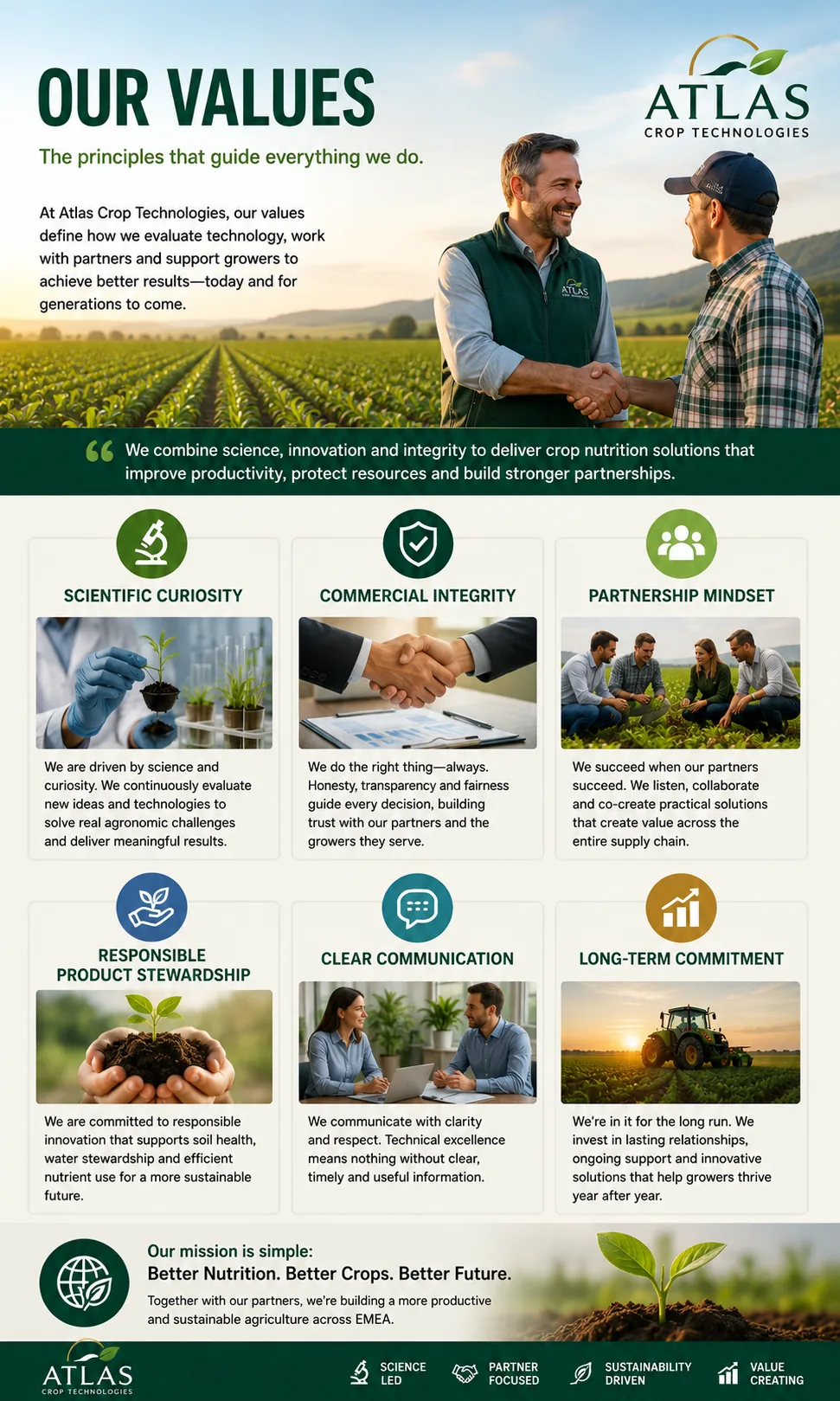
Our values shape how we evaluate products, communicate with customers, support partners and build business across regions.

Crop nutrition is technical, local and commercially complex. A technology that is useful in one crop, soil, application system or market may require very different positioning in another. That reality shapes the way Atlas Crop Technologies approaches both products and partnerships.

We aim to understand how technologies work, communicate accurately about where they fit, respect local product requirements and build relationships that create value beyond a single transaction. Scientific curiosity, commercial integrity and partnership mindset are the three principles at the centre of that approach.

Explore Products
Atlas Crop Technologies values: useful technology, clear advice and long-term relationships
Global crop technology. Local commercial support. Rotterdam · Istanbul · Dubai · Casablanca · Nairobi · Johannesburg
Core Values

Three principles guide how we work.

Our values are intended to influence everyday decisions: which technologies we investigate, how we describe them, how we work with partners and how we respond when the answer is more complicated than a simple sales message.

01

Scientific curiosity

We ask how and why technologies work, what agronomic process they are intended to influence, where the evidence is strongest and where local validation still matters.

Curiosity means looking beyond a product name or marketing claim. We want to understand the mechanism, the intended application route, the crop and soil context, and the conditions under which a technology is most likely to be relevant.

02

Commercial integrity

We communicate clearly about product fit, market availability, label requirements, registration, application conditions and limitations. Trust grows from accuracy and consistency.

Commercial integrity also means avoiding the assumption that every technology belongs in every program. If a product does not match the agronomic objective or local application system, adding it simply creates unnecessary complexity.

03

Partnership mindset

We work for durable relationships with growers, distributors, fertiliser manufacturers, blenders, seed businesses and agronomic partners—not one-off transactions.

Long-term partnerships depend on understanding the partner's market, customers, operations and technical requirements, then supporting the relationship as those needs evolve.

Scientific Curiosity

Understand the problem before promoting the solution.

A useful agricultural technology should have a clear purpose. We therefore start with the crop, nutrient, soil, application system and intended outcome before considering whether a product belongs in the program.

01

Start with the agronomic question

Is the challenge nitrogen management, phosphorus availability, micronutrient nutrition, root development, crop establishment, biological nitrogen fixation, crop quality or another clearly defined objective?

02

Understand the mechanism

A technology should be connected to a credible process such as nutrient availability, fertiliser interaction, biological activity, root-zone function, nutrient delivery or plant physiological support.

03

Ask where evidence is strongest

Product data should be interpreted in context. Crop, soil, climate, management, application timing and experimental design can all affect how results should be understood.

04

Respect variability

Agriculture is biologically and environmentally variable. A response observed in one environment should not automatically be assumed to occur under every soil, climate or management system.

05

Value local validation

Local trials, demonstration work and practical field experience can help determine where a technology is most relevant and how it should be positioned in a specific market.

06

Keep learning

Crop nutrition continues to evolve as agronomy, formulation science, biological technologies, nutrient-management tools and application systems develop. Curiosity means remaining open to new information.
Technology Evaluation

We look for more than an interesting product story.

A technology can be scientifically interesting without being commercially practical. Our values require us to consider both agronomic relevance and real-world application.

01

Relevant problem

The technology should address a meaningful crop nutrition or operational need rather than create a problem that customers did not previously have.

02

Understandable function

We want to understand what the technology is intended to influence and why that function matters within the crop or fertiliser program.

03

Evidence in context

Data should be evaluated against crop, soil, environment, application method, comparison treatment and the objective of the work performed.

04

Practical application

A technology should fit realistic manufacturing, blending, seed-treatment, foliar, fertigation, in-furrow or field-application systems as appropriate.

05

Responsible positioning

Product communication should remain consistent with the available evidence, approved claims and current market-specific label requirements.

06

Commercial relevance

A technology should ultimately create useful value for the customer, distributor, manufacturer, blender, adviser or grower using it.

Commercial Integrity

Clear communication is part of product quality.

Customers should be able to understand what a product is intended to do, where it fits, what information still needs to be confirmed and what conditions may affect its use.

01

Say what the product is

Product descriptions should make the technology category and intended application route understandable without unnecessary ambiguity.

02

Say where it fits

A product should be positioned against a defined agronomic or commercial objective rather than described as a universal solution.

03

Say where information varies

Availability, registration, formulation, pack format, approved crops, claims, application rates and directions may differ by country and should be confirmed locally.

04

Avoid unsupported certainty

Agricultural response varies. We believe communication should recognise that variability rather than imply that every product will produce the same result in every field.

05

Respect the current label

The current approved product label and local directions remain the primary reference for application rates, crops, use patterns, precautions and permitted claims.

06

Correct information when needed

Markets, registrations and product information can change. Maintaining integrity means updating communication when more current or accurate information becomes available.

Integrity in Practice

Trust is built through repeatable behaviour.

Commercial integrity becomes meaningful only when it influences daily decisions and partner communication.

01

We distinguish general information from local directions

Portfolio-level information helps customers understand technology categories, while current local labels determine actual approved use.

02

We do not assume compatibility

Physical, chemical or biological compatibility can depend on the exact products, concentrations, fertiliser, water quality and application system.

03

We do not assume identical crop response

Soil, climate, crop genetics, nutrient status, irrigation and management can all influence product performance.

04

We distinguish technology from agronomy

Product technology can support a crop program, but it does not replace responsible nutrient rates, timing, placement, soil management or irrigation.

05

We make room for difficult answers

Sometimes the correct recommendation is to gather more information, validate locally or decide that a particular technology is not the right fit for the problem being discussed.

06

We value consistency

Customers and partners should receive the same fundamental technical message regardless of whether the conversation is commercial, agronomic or operational.

Partnership Mindset

We want relationships that become more useful over time.

Agricultural markets are built on repeated seasons, repeated decisions and repeated interactions. We therefore value continuity, technical understanding and shared commercial development.

01

Understand the partner's business

A fertiliser manufacturer, distributor, seed company, adviser and grower operate very different businesses. Product support should reflect those differences.

02

Build around local markets

Crop priorities, soil conditions, application systems, buying patterns, registration and commercial channels vary significantly between countries.

03

Share technical understanding

Strong partnerships depend on more than product supply. Partners need to understand the technology, application route, intended use and relevant limitations.

04

Support practical implementation

Commercial success may depend on manufacturing, blending, storage, application equipment, seed-treatment processes, logistics and training as much as on product chemistry.

05

Learn from the market

Partners working directly with growers, advisers and customers provide valuable local insight. A productive relationship allows that information to improve future product positioning.

06

Think beyond the next order

A durable relationship is measured across seasons and product cycles, not only by the outcome of one transaction.

Who We Work With

The same values, applied to different partners.

Our principles stay consistent, but the form of support changes according to the role each partner plays in the crop nutrition value chain.

01

Fertiliser manufacturers

Manufacturers may need to understand technology integration, treatment systems, fertiliser compatibility, process requirements, product positioning and market fit.

02

Fertiliser blenders

Blenders may focus on product compatibility, operational simplicity, local crop demand, nutrient formulations and integration into existing blend programs.

03

Distributors

Distributors need clear technical positioning, market-specific information, customer relevance and confidence that a technology belongs in their portfolio.

04

Seed companies

Seed-applied programs may require attention to treatment quality, compatibility, handling, product fit and the operational realities of treating and distributing seed.

05

Agronomists and advisers

Advisers need useful technical information that helps them understand where a product may fit within a complete crop nutrition program.

06

Growers

Growers need technology to solve a real problem within the economics, equipment, crop system and field conditions they actually manage.

Long-Term Relationships

Partnership is a process, not a transaction.

Agricultural markets change over time. Crops, regulations, product portfolios, customers and application practices evolve, so a useful commercial relationship has to evolve with them.

01

Initial understanding

We begin by understanding the market, crop, technology requirement, application system and commercial objective.

02

Portfolio fit

The next step is identifying which technology category or product, if any, is relevant to the defined opportunity.

03

Technical alignment

Product positioning, use pattern, compatibility and local requirements should be understood before commercial expansion.

04

Market development

Local trials, customer conversations, demonstrations and commercial learning can help refine how a technology is positioned.

05

Feedback

Product experience, operational issues and customer response provide information that can improve future support and decision-making.

06

Continuation

Strong relationships are maintained through responsiveness, accurate information and a shared interest in sustainable long-term business.

Global Perspective, Local Relevance

The same values must work across very different agricultural markets.

Atlas serves Europe, the Middle East and Africa. These regions differ significantly in climate, soils, irrigation, crop systems, regulations, infrastructure and market structure.

EU

Europe

European markets can combine advanced fertiliser systems, intensive agronomy, diverse regulation and strong expectations around nutrient efficiency and responsible input use.

Our values require us to respect local technical and regulatory context rather than assume that the same commercial message fits every European market.

ME

Middle East

Irrigated agriculture, high temperatures, salinity, calcareous soils, fertigation and water quality can make crop nutrition highly dependent on local application conditions.

Clear technical positioning and practical local support are therefore important to responsible technology use.

AF

Africa

African agriculture includes large commercial farms, specialty crops, irrigated production and smallholder systems across highly diverse soils, climates and supply chains.

Technology must fit the realities of each market, including logistics, affordability, application equipment and access to technical support.

Regional Presence

Relationships are stronger when support is close to the market.

Atlas supports customers through regional offices positioned across Europe, the Middle East and Africa.

01

Rotterdam

Regional presence supporting European crop nutrition customers and commercial relationships.

02

Istanbul

Regional connection point supporting Türkiye and surrounding European, Mediterranean and neighbouring agricultural markets.

03

Dubai

Commercial support for Middle Eastern markets and regional agricultural partners.

04

Casablanca

Regional presence supporting crop nutrition opportunities and commercial relationships in African markets.

05

Nairobi

Regional support for East African crop production and agricultural markets.

06

Johannesburg

Regional presence supporting commercial partners and crop nutrition markets across Southern Africa.

Product Stewardship

Responsibility continues after a product is selected.

The way a product is stored, handled, mixed, applied and communicated influences whether the technology is used as intended.

01

Follow local labels

Approved crops, rates, application methods, directions and precautions can differ by market and should be checked before use.

02

Store products correctly

Storage temperature, moisture, shelf life and handling requirements may influence product quality, particularly for biological technologies.

03

Check compatibility

Fertilisers, pesticides, biologicals, micronutrients, seed treatments and other partners may interact. Compatibility should not be assumed.

04

Apply accurately

Correct equipment calibration, dosing, mixing and application quality help ensure that technology is used consistently.

05

Train users

Product knowledge is more useful when operators, commercial teams and advisers understand how the technology should be handled and positioned.

06

Keep records

Recording product, rate, application date, crop, conditions and outcome can support both stewardship and future agronomic learning.

Decision Principles

Questions we believe should be asked before recommending technology.

These questions reflect the values behind our approach to crop nutrition and commercial partnerships.

01

What problem are we solving?

The objective should be clear before a product is selected.

02

Why should this technology help?

The intended function should make sense relative to the identified agronomic or operational constraint.

03

What evidence supports the fit?

Available evidence should be relevant to the crop, use pattern or technology mechanism being discussed.

04

What still needs local confirmation?

Registration, compatibility, crop fit, rate, application method or local response may require additional validation.

05

Can the customer apply it properly?

Product value depends partly on whether the required equipment, process and operating conditions are practical.

06

Does it create lasting value?

The best commercial opportunities are those that create meaningful value for both the customer and the long-term partnership.

Shared Expectations

Strong partnerships work in both directions.

We value partners who are equally interested in building responsible, technically credible and commercially sustainable crop nutrition businesses.

01

Technical curiosity

We value partners who want to understand why a technology belongs in a program rather than simply adding another product to a catalogue.

02

Accurate communication

Product claims and recommendations should remain aligned with current product information and local requirements.

03

Market knowledge

Local partners provide essential knowledge of crops, customers, competitors, regulations and agronomic practice.

04

Feedback

We value clear feedback about product experience, operational issues, customer questions and market response.

05

Consistency

Long-term market development requires consistent product positioning and support across sales, agronomy and operations.

06

Long-term perspective

Sustainable partnerships grow through repeated seasons, shared learning and gradual market development.

Values & Sustainability

Responsible crop nutrition requires disciplined decisions.

Our values connect directly with how we think about sustainable nutrient management: understand the problem, use the right tool, apply it correctly and avoid making claims that exceed the evidence.

01

Efficiency before excess

Better nutrient management is not simply about applying more input. Source, rate, timing, placement and supporting technology should fit the crop and local conditions.

02

Diagnose before adding technology

Soil, crop, fertiliser and environmental information can help determine whether an additional product addresses the actual constraint.

03

Respect local resources

Soil, water and fertiliser resources differ by region. Responsible technology should fit the conditions in which it is used.

04

Measure meaningful outcomes

Crop establishment, nutrient status, yield, quality, nutrient efficiency, operational performance and economic value may all be relevant depending on the objective.

05

Avoid universal claims

Agricultural systems vary. Responsible product positioning recognises that product response can depend on soil, crop, climate and management.

06

Learn across seasons

Sustainable improvement comes from repeated observation, measurement and refinement rather than from treating one season as the final answer.

What This Means for Customers

Values should change the experience of working with us.

Our principles are intended to translate into practical expectations for customers and partners.

01

You can ask technical questions

We welcome questions about intended use, application route, product fit and the conditions that may affect technology performance.

02

You can expect market-specific answers

Registration and product availability vary, so we aim to route enquiries to the relevant regional market rather than provide one generic answer.

03

You can expect limitations to be discussed

Product suitability depends on context. We believe limitations and uncertainties should be part of responsible technical communication.

04

You can expect a long-term perspective

We are interested in technologies and partnerships that create repeatable value across seasons and markets.

05

You can expect local relevance

Crop nutrition differs across regions. Our support is intended to account for local agronomy, regulation and commercial reality.

06

You can expect a conversation

Good product selection often requires more than a catalogue. Tell us what you are trying to achieve and we can begin from there.

Values in Action

How our principles influence common business situations.

Values become practical when they guide decisions under real commercial and agronomic conditions.

01

A distributor asks for a new product

We first want to understand the target crops, customers, agronomic need, current portfolio, application system and local registration environment before assuming which product category fits.

02

A fertiliser company wants an enhancer

The conversation should include fertiliser source, manufacturing or blending process, treatment route, target agronomic objective, storage and commercial market.

03

A grower sees inconsistent response

We would want to look at crop, soil, weather, fertiliser practice, application timing and other management factors rather than assuming one universal explanation.

04

A partner wants to combine products

Compatibility should be confirmed using product-specific information rather than assumed from the fact that two products share an application route.

05

A new market opportunity appears

Market size alone is not enough. We also consider product registration, crop fit, distribution capability, technical support and long-term commercial relevance.

06

Evidence is incomplete

The responsible response may be to gather additional information, validate locally or limit the claim rather than present uncertainty as certainty.

Work With Atlas

Start with the opportunity. Build the relationship from there.

Tell us about your crop, fertiliser program, market, distribution opportunity or technology requirement. Our team will route your enquiry to the appropriate regional contact and begin with the information needed to understand the fit.

Values FAQ

Frequently Asked Questions

More detail on how our values influence technology evaluation, communication and partnerships.

Our three core values are scientific curiosity, commercial integrity and partnership mindset.

Scientific curiosity influences how we investigate technology and evidence. Commercial integrity shapes how we communicate product fit, requirements and limitations. Partnership mindset guides us toward long-term relationships rather than one-off transactions.

It means asking how and why a technology works, what agronomic problem it addresses, what mechanism is relevant, where supporting evidence is strongest and where local validation still matters.

We believe understanding the problem is more useful than beginning with a product name.

Commercial integrity means communicating accurately about product fit, market availability, registration, approved claims, application directions and limitations.

It also means recognising when a particular technology is not the best answer for a customer's objective.

Partnership mindset means working toward durable relationships with customers and channel partners rather than focusing only on individual transactions.

We want to understand our partners' markets, technical needs, operational requirements and long-term commercial objectives.

We believe a technology should address a meaningful agronomic or commercial need, have an understandable function, fit a realistic application system and be capable of responsible product positioning.

Evidence, local relevance, product stewardship and commercial practicality all contribute to the evaluation.

No. Agriculture is variable. Product response can be influenced by crop, soil, weather, irrigation, application timing, fertiliser practice, nutrient status and many other factors.

We therefore value locally relevant evidence and responsible product positioning.

Product communication should remain consistent with the current approved label, relevant evidence and market-specific registration.

Availability, approved uses, claims, rates and directions can differ by country, so portfolio-level descriptions should not be treated as a substitute for the local label.

Soil, climate, crop genetics, water availability, fertiliser systems and management differ between locations.

Local validation can help determine where a technology is most relevant and how its positioning should be adapted to the market.

Yes. We welcome enquiries from fertiliser manufacturers interested in crop nutrition and fertiliser technologies.

Discussions may include the fertiliser source, intended technology function, application or treatment route, commercial market and operational fit.

Yes. Blenders are important partners in crop nutrition markets. Product discussions may involve nutrient efficiency, micronutrients, compatibility, application practicality and local crop positioning.

Yes. We welcome distributor enquiries across Europe, the Middle East and Africa.

Tell us your country, crop focus, customer segments and product or technology area of interest so the enquiry can be routed to the appropriate regional contact.

Agronomists need clear information about technology function, intended use, application route and local product requirements.

Our values encourage a technical discussion that begins with the agronomic objective rather than assuming that every field problem requires another product.

We mean relationships that develop across seasons and changing commercial conditions.

Over time, product knowledge, local evidence, operational experience and customer feedback can make the relationship more useful to both parties.

Commercial growth matters, but our values emphasise growth built on useful technology, accurate communication and relationships that can be sustained over time.

We believe long-term commercial value is stronger when the product solves a real problem and partners understand how to position it.

Commercial integrity means product fit should not be forced. If the agronomic objective, application route or market requirements do not match a technology, the responsible response may be to recommend further diagnosis, another technology category or no additional product.

Sustainable crop nutrition requires the same discipline as our core values: understand the agronomic problem, use technology for a clear reason, communicate responsibly, respect local conditions and evaluate meaningful outcomes.

You can read more on our Sustainability page.

We support customers through offices in Rotterdam, Istanbul, Dubai, Casablanca, Nairobi and Johannesburg, serving markets across Europe, the Middle East and Africa.

Our portfolio includes nitrogen and phosphorus efficiency technologies, biostimulants, micronutrients, inoculants, seed treatments and related crop nutrition solutions.

Contact us with your country and product of interest. Availability, registration, label directions and approved claims can differ by market.

Include your country, company or organisation type, crop or market focus, technology or product interest and the agronomic or commercial objective you want to discuss.

For fertiliser programs, details about the nutrient source and application system can also be useful. For distribution enquiries, include the market and customer segments you serve.

Atlas Crop Technologies

Useful technology is only the beginning.

We believe strong crop nutrition businesses are built on technical understanding, accurate communication and relationships that create value over time. If that approach aligns with what you are looking for, start a conversation with our regional team.

Explore Products

Trademark Notice: All products featured on this website are registered trademarks of Verdesian Life Sciences.

Thank you — your message has been sent.