Trademark Notice: All products featured on this website are registered trademarks of Verdesian Life Sciences.

Atlas Crop Technologies · Sustainable Crop Nutrition

Productivity and stewardship should advance together.

Efficient crop nutrition can help growers get more value from applied nutrients while supporting responsible management of soil, water, fertiliser and other farm resources.

For Atlas Crop Technologies, sustainable crop nutrition is not simply about using less input. It is about using inputs more intelligently: selecting an appropriate nutrient source, applying an agronomically justified rate, placing nutrition where roots can access it, aligning availability with crop demand and using supporting technologies where they address a clearly defined efficiency constraint.

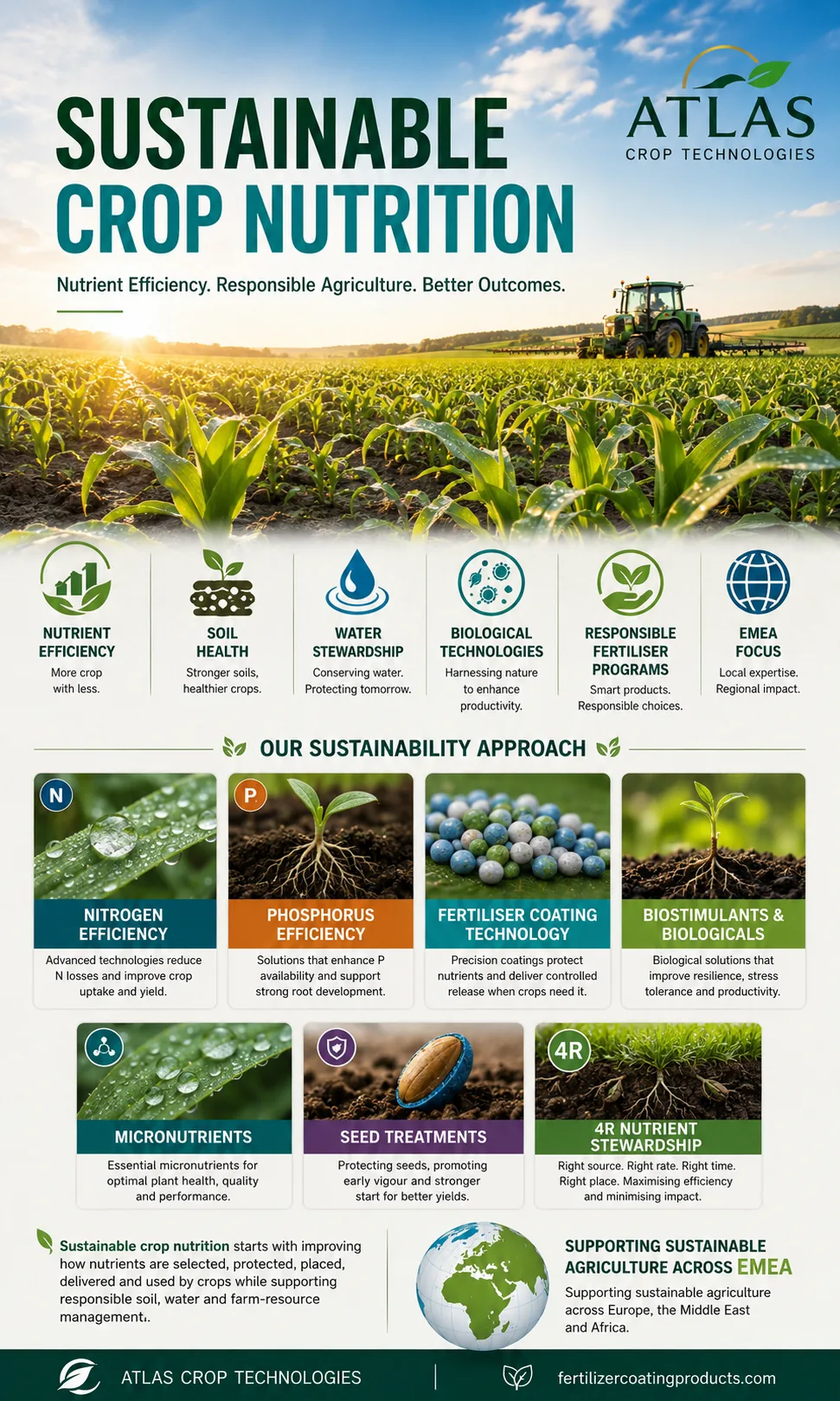
Our technology portfolio spans nitrogen and phosphorus efficiency, fertiliser enhancement, biostimulants, micronutrients, biological inoculants and seed-applied technologies. These tools can form part of practical nutrient-management strategies designed around local crops, soils, climates, irrigation systems, regulations and commercial realities across Europe, the Middle East and Africa.
Explore Products
Sustainable crop nutrition supporting productivity, nutrient efficiency, soil and water stewardship
Global crop technology. Local commercial support. Rotterdam · Istanbul · Dubai · Casablanca · Nairobi · Johannesburg
Our Approach

Sustainability begins with agronomic efficiency.

Sustainable agriculture has environmental, agronomic, operational and economic dimensions. Crop-nutrition technology is most useful when it helps a production system achieve a defined agronomic objective while using nutrients and other resources responsibly.

01

Nutrient efficiency first

Nutrient inputs create value only when crops can access and use them. Technologies that help manage nutrient availability, root-zone access or selected loss pathways can support more efficient fertiliser programs when used in the appropriate agronomic situation.

02

Better fit, not simply more input

The objective is not to add technology for its own sake. We focus on matching nutrient source, technology, crop, soil, application method and timing so each component has a clearly defined function within the crop program.

03

Productivity remains essential

Resource efficiency must coexist with productive agriculture. Crop yield, marketable quality, establishment, resilience and economic viability remain important when evaluating a sustainability strategy.

04

Protect the resource base

Soil, water, nutrients and biological resources support agricultural production. Responsible nutrient programs should seek to avoid unnecessary losses and work alongside practices that maintain productive soils and efficient water use.

05

Measure meaningful outcomes

Sustainability claims are most useful when connected to measurable agronomic, operational or environmental outcomes. Indicators should match the technology mechanism and the management objective being evaluated.

06

A regional perspective

Water availability, soil chemistry, crop systems, fertiliser practices, infrastructure and regulation vary widely across EMEA. Sustainability strategies must work under local field and commercial conditions, not only in theory.

Nutrient Use Efficiency

Getting more agronomic value from the nutrients already applied.

Nutrient use efficiency describes the relationship between nutrient supply, nutrient recovery and productive crop output. It is shaped by agronomy, soil, weather, crop demand and application technology rather than by any single product.

01

Nutrient source

Different nutrient sources behave differently after application. Solubility, chemical form, granule characteristics, compatibility and soil reactions should be considered before selecting a supporting efficiency technology.

02

Application rate

Nutrient rates should reflect crop demand, realistic yield expectations, soil nutrient supply, previous management, local recommendations and applicable regulation. Efficiency technology should complement, not replace, responsible rate selection.

03

Timing

Crop nutrient demand changes throughout the season. Applying nutrients too early, too late or under unfavourable conditions can increase the period during which they are exposed to loss or become inaccessible before peak crop demand.

04

Placement

Broadcast, incorporated, banded, in-furrow, fertigation, foliar and seed-applied programs place inputs in very different environments. Placement should reflect nutrient mobility, crop rooting, soil properties and the intended mechanism.

05

Root access

Nutrients must ultimately reach an active root system. Root density, soil structure, compaction, moisture, salinity, temperature and root-zone chemistry influence how much of the available nutrient pool a crop can explore.

06

Crop utilisation

Uptake alone does not determine crop productivity. Nutrients must support photosynthesis, enzyme activity, protein formation, reproductive growth and other physiological processes that ultimately contribute to yield and quality.

Responsible Nutrient Management

Technology works best inside a disciplined nutrient program.

A practical sustainability strategy starts with fundamental fertiliser-management decisions. Supporting technologies can improve specific parts of the system, but they cannot compensate for an inappropriate nutrient source, unjustified rate, unsuitable timing or poor placement.

S

Choose an appropriate source

Nutrient chemistry, concentration, solubility, crop requirements, soil conditions, application system and product quality all influence source selection. Supporting technologies should be compatible with the chosen fertiliser.

R

Apply an agronomically justified rate

Soil analysis, crop requirement, expected nutrient removal, residual nutrient supply, organic sources and local recommendations can all inform rate decisions. The goal is an adequate nutrient supply without unnecessary application.

T

Time supply with crop demand

Splitting nutrient applications or adjusting application timing can help align availability with periods of active uptake while reducing unnecessary exposure to loss pathways.

P

Place nutrients effectively

The appropriate placement depends on crop, root distribution, nutrient mobility, soil conditions, fertiliser form, equipment and irrigation. Efficient placement can improve the probability of crop access.

+

Add technology for a reason

Stabilisation, fertiliser enhancement, biologicals, biostimulants, micronutrient delivery and seed-applied technologies solve different problems. A technology should be selected because its function matches a diagnosed constraint.

Validate locally

Crop response can change with soil, weather, genetics and management. Local product registration, approved labels, field evidence and agronomic experience remain important when determining how a technology should be positioned.

Nitrogen Efficiency

Managing a nutrient that changes rapidly after application.

Nitrogen is fundamental to proteins, enzymes, chlorophyll and crop growth, but nitrogen fertilisers can move through several chemical and biological forms after application. The appropriate efficiency strategy depends on fertiliser source, soil, weather, application method and crop demand.

01

Surface-applied urea

Urea undergoes hydrolysis following application. Under conditions that favour ammonia loss, management of the period after surface application can be important. Product-specific technologies may be used where approved and agronomically appropriate.

02

Ammonium transformations

Ammonium can be transformed through soil microbial processes. Managing the rate of selected transformations may have value in particular fertiliser systems, provided the technology, soil and environmental conditions are suitably matched.

03

Nitrate movement

Nitrate is mobile in soil water. Soil texture, drainage, rainfall, irrigation, rooting depth and application timing can therefore influence how long nitrate remains within the active root zone.

04

Synchronisation

A key objective of nitrogen management is to improve the alignment between available nitrogen and active crop uptake. Timing, split applications, placement and supporting technologies can all contribute to this objective.

05

Fertiliser treatment

Selected nitrogen technologies can be incorporated into fertiliser-treatment or coating systems. Application quality, dose accuracy, coverage, handling and compatibility are important to commercial implementation.

06

Whole-program evaluation

Nitrogen technology should be assessed together with source, rate, application date, incorporation, irrigation and expected weather rather than being evaluated as an isolated input.

Phosphorus Efficiency

Improving crop access to a relatively immobile nutrient.

Phosphorus supports energy transfer, root development and many metabolic processes. In soil, however, applied phosphorus can interact strongly with minerals and local chemistry. Efficient phosphorus management therefore depends on source, placement, soil properties and root access.

01

Soil pH

Phosphorus availability can be strongly influenced by soil reaction. The nature of phosphorus interactions changes across acidic, neutral and alkaline or calcareous environments.

02

Mineral interactions

Calcium, iron, aluminium and other soil components can affect phosphorus availability. Soil mineralogy and the chemistry around fertiliser particles or bands are therefore important parts of phosphorus strategy.

03

Placement

Because phosphorus is relatively immobile in many soils, placement near the developing root system can be important. Banding, starter placement and incorporation may be relevant depending on crop and soil conditions.

04

Early crop demand

Young crops have limited rooting volume. Maintaining access to phosphorus around the developing root zone can therefore be particularly important during crop establishment.

05

Root development

Root architecture affects the amount of soil explored by the crop. Healthy, extensive rooting can complement phosphorus management by increasing contact between roots and nutrient-supplying soil.

06

Soil testing

Phosphorus technologies do not replace soil analysis. Soil-test phosphorus, historical fertilisation, crop removal, placement strategy and local agronomic guidance remain central to responsible phosphorus management.

Soil Stewardship

Efficient nutrition depends on a functioning root-zone environment.

Fertiliser performance cannot be separated from soil condition. Soil physical, chemical and biological properties influence water movement, rooting, nutrient transformations and nutrient availability throughout the crop cycle.

01

Soil structure

Aggregation, porosity and compaction influence root penetration, oxygen exchange, water movement and the volume of soil available for nutrient exploration.

02

Soil organic matter

Organic matter contributes to multiple soil functions, including nutrient cycling, water-holding behaviour, biological activity and structural stability. Its role differs with soil type and management system.

03

Soil pH

Soil pH affects the chemical environment in which roots and nutrients interact. It can influence nutrient solubility, biological activity and the availability of several macro- and micronutrients.

04

Salinity

Salinity can constrain root activity and water uptake and may influence crop response to fertilisation. Nutrient programs in salt-affected environments should therefore consider water quality and total salt loading.

05

Soil biology

Soil microorganisms participate in decomposition, nutrient transformations and plant-root interactions. Biological function is influenced by moisture, temperature, organic inputs, pH and management.

06

Root-zone diagnosis

Soil testing, field observations, root examination and knowledge of historical management can help identify whether nutrient limitation is caused by nutrient supply, physical conditions, chemistry or several interacting constraints.

Water Stewardship

Water and nutrient efficiency are closely connected.

Water dissolves, transports and redistributes nutrients, supports root uptake and drives crop growth. Too little, too much or poor-quality water can therefore change the efficiency of a fertiliser program.

01

Rainfall timing

Rainfall after fertiliser application can influence dissolution, incorporation, nutrient movement and the exposure of applied nutrition to different soil processes.

02

Irrigation uniformity

Uneven irrigation can create uneven water and nutrient availability. Improving distribution uniformity can therefore support both water productivity and fertiliser efficiency.

03

Water quality

Salinity, bicarbonates, hardness, pH and dissolved ions can affect soil chemistry, fertigation compatibility and crop performance. Water analysis can be an important part of intensive nutrition programs.

04

Fertigation

Fertigation provides an opportunity to divide nutrient supply across the crop cycle and position soluble nutrition in the wetted root zone. Injection accuracy, water quality and irrigation management remain critical.

05

Drainage and excess water

Prolonged saturation can restrict root oxygen, alter soil chemistry and affect nutrient transformations. Drainage and irrigation scheduling are therefore part of nutrient-management strategy.

06

Root-zone moisture

Active roots require an appropriate moisture environment. Maintaining adequate but not excessive root-zone water can improve the opportunity for crops to access supplied nutrients.

Root-System Efficiency

The root system is the crop's nutrient-acquisition infrastructure.

Fertiliser can only contribute to crop performance if plants can access it. Root-system development, distribution and activity therefore sit at the centre of efficient water and nutrient acquisition.

01

Root length

Greater effective root length can increase contact with soil and expand the area from which relatively immobile nutrients can be acquired.

02

Root branching

Branching and fine-root development influence soil exploration and the number of active interfaces between root surfaces, microorganisms, water and nutrients.

03

Rooting depth

Deeper rooting can increase access to water and nutrients located below the surface layer, provided soil structure and chemistry allow roots to penetrate.

04

Early establishment

Early-season root development establishes the crop's capacity to explore the soil during later periods of rapid growth and nutrient demand.

05

Rhizosphere activity

The rhizosphere is a biologically and chemically active zone surrounding roots. Root exudates, microorganisms, soil chemistry and nutrient forms interact within this environment.

06

Balanced nutrition

Root development depends on the overall crop environment. Balanced nutrition, suitable soil moisture and management of physical constraints are all important alongside any root-support technology.

Biostimulants & Plant Performance

Supporting crop processes that influence nutrient productivity.

Depending on composition, registration and approved use, biostimulant technologies may support selected plant or rhizosphere processes associated with nutrient acquisition, root development, crop establishment, quality or tolerance to certain abiotic stresses.

01

Nutrient acquisition

Products positioned around root development or rhizosphere activity may complement balanced fertilisation by helping the crop make more effective use of the nutrient environment around its roots.

02

Plant metabolism

Crop productivity depends on many interconnected physiological processes. Product-specific technologies may be designed to support defined aspects of plant performance when used at the appropriate growth stage.

03

Crop establishment

Strong establishment can improve canopy development and root exploration. Seed-applied, soil-applied or early foliar technologies may be considered where their approved use aligns with this objective.

04

Abiotic stress context

Heat, drought, salinity, cold or other non-living environmental stresses can affect plant growth and nutrient use. Any stress-related product positioning should be based on the specific technology and approved claims.

05

Crop quality

In high-value crops, sustainability can include producing a greater proportion of marketable output. Nutritional and biostimulant programs may therefore be evaluated using crop-specific quality criteria as well as total yield.

06

Integrated management

Biostimulants should complement appropriate nutrition, irrigation, soil management and crop protection. They should not be treated as a replacement for the basic requirements of crop production.

Biological Technologies

Using beneficial microorganisms with appropriate technical discipline.

Biological inoculants use selected microorganisms for defined agricultural functions. Because living organisms can respond strongly to storage, application and environmental conditions, biological technologies require careful handling and local positioning.

01

Biological nitrogen fixation

Appropriate inoculation is an important part of many legume-production systems. Effective crop-microbe association depends on crop host, microorganism, treatment quality, soil conditions and establishment.

02

Rhizosphere functions

Depending on organism and approved claims, biological technologies may be positioned around nutrient mobilisation, root interaction or other defined rhizosphere functions.

03

Seed application

Seed treatment can position microorganisms close to emerging roots. Uniform treatment, compatibility and the interval between inoculation and planting may be important.

04

Storage

Temperature, shelf life and exposure conditions can affect the viability of living products. Product-specific storage instructions should therefore be treated as a technical requirement.

05

Compatibility

Fertilisers, pesticides, micronutrients, water chemistry and other treatment components may affect microorganisms. Compatibility should be checked rather than assumed.

06

Environmental fit

Soil moisture, temperature, salinity, pH, crop host and competing microbial populations can influence biological performance, reinforcing the need for locally appropriate product selection.

Balanced Nutrition

Efficiency is limited when one essential nutrient is missing.

Sustainable nutrient management requires attention to the complete crop requirement. Applying more nitrogen, phosphorus or potassium cannot necessarily compensate for a limiting secondary nutrient or micronutrient.

Zn

Zinc

Zinc contributes to enzyme activity and plant development. Soil pH, phosphorus status and underlying soil zinc supply can influence availability.

B

Boron

Boron is involved in growing points, cell-wall functions and reproductive processes. Accurate diagnosis and careful rate selection are especially important because crop requirements and tolerance can differ significantly.

Fe

Iron

Iron is involved in important plant metabolic functions. Availability can be limited by soil chemistry even where total soil iron is substantial.

Mn

Manganese

Manganese contributes to photosynthetic and enzyme processes. Soil pH, aeration and oxidation-reduction conditions can affect crop availability.

Cu

Copper

Copper is required for several plant enzyme systems. Soil organic matter, texture and pH can influence its availability to crops.

Mo

Molybdenum

Molybdenum is associated with nitrogen metabolism and biological nitrogen fixation. It illustrates why nutrient balance and crop-specific requirements matter even where nutrient demand is very small.

Fertiliser Treatment & Coating

Efficiency technology must also work at commercial scale.

Applying a technology directly to fertiliser can provide a practical route for integrating nutrient-efficiency functionality into existing fertiliser programs. Sustainability benefits depend on agronomic relevance and reliable industrial application.

01

Accurate treatment rate

Metering systems should apply the intended dose consistently across fertiliser throughput. Calibration, pump performance and process control are important to treatment quality.

02

Uniform distribution

Spray pattern, mixing action, residence time and granule properties can all influence how evenly a treatment is distributed through the fertiliser stream.

03

Fertiliser integrity

Treatment should be evaluated for effects on flowability, dust, caking, handling, blending, storage and field-application characteristics.

04

Operational efficiency

Practical systems should integrate with manufacturing or blending operations without unnecessary complexity. Storage, pumping, dosing, cleaning and quality checks all matter.

05

Compatibility

Fertiliser chemistry, moisture, temperature and subsequent blend components can affect treatment behaviour. Compatibility should be assessed under representative commercial conditions.

06

Field delivery

Fertiliser treatment can simplify delivery by incorporating a technology into an existing fertiliser application. Its agronomic value still depends on correct fertiliser placement, rate and timing.

Application Efficiency

Good technology still requires accurate application.

Sustainable crop nutrition includes the practical quality of field and industrial application. Overlap, under-application, poor calibration and incompatible mixtures can reduce both agronomic performance and resource efficiency.

01

Equipment calibration

Spreaders, sprayers, seed treaters, fertigation injectors and fertiliser-coating systems should be calibrated to the product, rate, operating speed and material being applied.

02

Application uniformity

Uneven distribution can create areas of excess and deficiency within the same field. Uniform application supports both crop consistency and responsible input use.

03

Weather awareness

Wind, rainfall, temperature and humidity may affect application quality or nutrient behaviour. Operational decisions should follow product labels and local agronomic guidance.

04

Water volume and spray quality

Foliar and soil-applied liquid technologies can depend on correct dilution, droplet characteristics, coverage and water chemistry.

05

Mixing sequence

Correct addition order, dilution and agitation can reduce physical incompatibility in tank mixes. Product-specific mixing instructions should be followed.

06

Records and traceability

Recording product, batch, field, rate, application date, weather and operator information can support quality control, agronomic evaluation and responsible product stewardship.

Diagnosis Before Intervention

Better information supports better nutrient decisions.

Sustainable input management starts by understanding the constraint. Diagnostic information can help distinguish between insufficient nutrient supply, poor root access, soil chemistry, water stress, physical limitations and other factors.

01

Soil analysis

Soil testing can provide information on nutrient status, pH, salinity and other chemical properties that influence fertiliser planning.

02

Plant tissue analysis

Tissue testing can provide a snapshot of plant nutrient status when samples are collected at the appropriate growth stage and interpreted against suitable reference values.

03

Root examination

Digging plants and examining rooting depth, branching, density and visible constraints can reveal problems that are not obvious from above-ground symptoms.

04

Water analysis

Irrigation-water chemistry can affect soil salinity, nutrient availability, compatibility and fertigation performance, particularly in intensive irrigated systems.

05

Field history

Previous crops, fertiliser use, organic inputs, liming, irrigation, drainage and historical yield patterns provide useful context for current nutrient decisions.

06

Local comparison

Strip trials, untreated comparisons and standard-practice treatments can help determine whether an observed problem responds to the selected intervention under local conditions.

Measuring Progress

Sustainability should be connected to relevant indicators.

No single metric describes every aspect of sustainable crop nutrition. The right indicators depend on whether the objective is nutrient recovery, productivity, crop quality, water efficiency, operational improvement or another defined outcome.

01

Crop yield

Harvested yield remains an important productivity indicator, but results should be interpreted together with nutrient rate, crop quality, weather and economic context.

02

Marketable production

For many crops, marketable yield can be more meaningful than total biomass. Quality standards, size, uniformity or other crop-specific criteria may affect resource productivity.

03

Nutrient productivity

Comparing crop output with nutrient input can provide one perspective on fertiliser efficiency, although soil nutrient supply and changes in soil fertility should also be considered.

04

Plant nutrient status

Tissue analysis and other diagnostic tools may help determine whether nutrient supply is adequate and whether a technology changes crop nutrient status.

05

Water productivity

In irrigated or water-limited systems, crop output relative to irrigation or available water can provide useful context for integrated nutrient and water management.

06

Economic return

A practical sustainability program must remain economically workable. Input cost, application cost, operational savings, yield, quality and risk all contribute to commercial evaluation.

Evidence & Evaluation

Reliable conclusions require appropriate comparisons.

Crop response varies naturally from field to field and season to season. Technology evaluation is stronger when comparisons are designed around a clearly defined question and the intended mechanism of the product.

01

Define the objective

Establish in advance what the technology is expected to influence and which measurements are relevant to that mechanism.

02

Use an appropriate control

Comparison with untreated or locally standard practice helps separate technology effects from normal crop variability.

03

Replicate where possible

Replication improves confidence by reducing the influence of spatial variability, especially in field-scale agronomic evaluation.

04

Record conditions

Soil, weather, crop variety, application timing and management practices provide essential context when interpreting results.

05

Measure the relevant response

Depending on the objective, measurements may include establishment, roots, nutrient status, crop development, yield, quality or operational performance.

06

Avoid overgeneralisation

A result observed under one set of conditions should not automatically be assumed to apply to every crop, soil, climate or management system.

Integrated Crop Management

Nutrition is one part of a larger production system.

Sustainable crop production depends on interactions between genetics, soil, nutrition, water, crop protection, rotations, field operations and environmental conditions. Nutrient technologies perform best when the wider production system is functioning effectively.

01

Crop genetics

Varieties and hybrids differ in maturity, rooting, nutrient demand, yield potential and environmental adaptation. Nutrient programs should reflect the crop being grown.

02

Crop rotation

Previous crops influence residue, nutrient cycling, rooting conditions and biological processes. Rotation history therefore contributes to fertiliser planning.

03

Residue management

Crop residues influence soil cover, nutrient cycling, moisture and field operations. Their effects vary by crop system and climate.

04

Crop protection

Nutrient uptake is limited when weeds, insects, diseases or other constraints substantially reduce crop growth. Nutrition and crop protection should therefore be considered together.

05

Irrigation

Water supply affects crop growth, nutrient movement and root activity. Intensive nutrition is unlikely to reach its potential where irrigation distribution or scheduling is poorly matched to crop requirements.

06

Field operations

Planting date, traffic, compaction, cultivation, application timing and harvest operations all influence the environment in which crop nutrition must function.

Product Stewardship

Responsible technology extends from selection to application.

Sustainable product use requires appropriate storage, handling, mixing, application, documentation and compliance with current local labels and regulations.

01

Read the current label

Approved crops, rates, timing, mixing instructions, safety requirements and claims can vary between countries and product registrations.

02

Store correctly

Temperature, moisture, light and storage duration can affect product quality, particularly for biological and formulation-sensitive technologies.

03

Protect application quality

Accurate dosing, suitable equipment, correct mixing and uniform application help ensure that the product is used as intended.

04

Check compatibility

Physical, chemical and biological compatibility should be verified before combining products, particularly in concentrated fertiliser, seed-treatment or biological systems.

05

Train operators

Clear procedures for measuring, transferring, mixing, application, cleaning and recordkeeping can improve operational consistency and responsible use.

06

Follow local requirements

Registration, classification, handling, transport, packaging and application requirements differ by jurisdiction. Local compliance should be confirmed before commercial use.

Commercial Sustainability

A solution must be agronomically useful and commercially workable.

Agricultural technologies are adopted when they solve a meaningful problem at a practical cost and fit the customer's operations. Sustainability therefore includes commercial durability as well as technical performance.

01

Operational fit

A technology should fit existing fertiliser plants, blending systems, seed treatment equipment, irrigation systems or field operations whenever practical.

02

Input value

Evaluation should consider product cost in relation to the agronomic constraint, expected benefit, crop value and alternative management options.

03

Logistics

Pack size, transport, storage, shelf life, application rate and seasonal demand can materially influence the practicality of commercial deployment.

04

Ease of use

Products that integrate smoothly into normal farm or fertiliser-industry operations can reduce complexity and improve application consistency.

05

Repeatability

Long-term value depends on whether a technology is positioned in situations where its mechanism is consistently relevant rather than being used indiscriminately.

06

Partner support

Technical guidance, application knowledge, local product information and responsive commercial support can improve implementation throughout the supply chain.

Across the Value Chain

Sustainability decisions occur before the fertiliser reaches the field.

Fertiliser manufacturers, blenders, distributors, seed companies, agronomists and growers each influence how crop technologies are selected, handled and ultimately used.

01

Fertiliser manufacturers

Manufacturing decisions influence product quality, granule characteristics, treatment integration, storage, handling and the consistency of the final fertiliser product.

02

Fertiliser blenders

Blenders can help create locally adapted nutrient programs while managing physical compatibility, segregation, treatment quality and accurate formulation.

03

Distributors

Distributors connect technology with local crops, agronomy and customers. Correct positioning and technical communication are important to responsible use.

04

Seed businesses

Seed companies may integrate inoculants, micronutrients, biostimulants or other approved technologies into seed-treatment programs where application quality and seed safety are essential.

05

Agronomists

Advisers help translate soil, crop and diagnostic information into practical nutrient programs and determine where a technology has a justified role.

06

Growers

Growers integrate the complete system: nutrient source, rate, placement, timing, irrigation, equipment, field conditions, labour and crop economics.

Sustainability Across EMEA

Different regions require different solutions.

Atlas Crop Technologies serves markets across Europe, the Middle East and Africa. These regions contain highly diverse climates, production systems and resource constraints, so sustainability programs must be adapted rather than standardised blindly.

EU

Europe

European crop systems include cereals, oilseeds, maize, potatoes, sugar crops, vineyards, orchards, vegetables, protected crops and many specialised production systems. Nutrient efficiency, precision, regulation and responsible resource use are increasingly interconnected.

ME

Middle East

Irrigated production, high temperatures, calcareous soils, salinity and intensive fertigation can make water quality, root-zone chemistry and nutrient availability central to sustainability strategy.

AF

Africa

African agriculture encompasses large commercial farms, high-value irrigated crops and smallholder production across very different soil, rainfall, infrastructure and fertiliser-access conditions. Practicality and local fit are essential.

01

Rotterdam

Regional support presence for European crop nutrition customers and international fertiliser-market engagement.

02

Istanbul

Regional connection point serving agricultural markets across Türkiye and surrounding European, Mediterranean and neighbouring regions.

03

Dubai

Commercial support for Middle Eastern markets and regional agricultural and fertiliser partners.

04

Casablanca

Regional presence supporting crop nutrition opportunities across North and West African markets.

05

Nairobi

Regional support for crop nutrition customers and agricultural systems across East Africa.

06

Johannesburg

Regional presence supporting commercial partnerships and crop nutrition markets across Southern Africa.

Local Constraints

The sustainability challenge changes from field to field.

Soil, climate, infrastructure and production objectives determine which resource constraints matter most. Understanding the local context is therefore the first step toward meaningful technology selection.

01

Low rainfall

In water-limited systems, nutrient availability and crop uptake can be strongly constrained by moisture. Nutrient timing and placement should reflect realistic rainfall and rooting conditions.

02

High rainfall

High-rainfall environments can create different nutrient-management challenges, particularly where soils are freely draining or where nutrient application is poorly synchronised with crop demand.

03

Calcareous soils

High-carbonate soil environments can influence the availability of phosphorus and several micronutrients, requiring locally appropriate nutrient forms and placement strategies.

04

Acidic soils

Acidity can affect root growth, soil biology and nutrient availability. Liming strategy and soil chemistry may therefore be central to efficient fertiliser use in suitable systems.

05

Saline conditions

Salinity can reduce water uptake and alter nutrient balance. Fertiliser strategy should therefore consider both crop requirement and the salt contribution from irrigation water and applied inputs.

06

Limited input access

Where fertiliser access or affordability is constrained, technology must deliver practical value and fit available application methods, logistics and farmer economics.

Selecting a Sustainable Technology

Begin with the problem you are trying to solve.

Sustainability is strengthened when technology is targeted rather than applied indiscriminately. Atlas starts with the agronomic or operational constraint before discussing a specific product category.

01

Define the objective

Is the priority nitrogen efficiency, phosphorus availability, root development, micronutrient management, biological nitrogen fixation, establishment, crop quality or another clearly defined outcome?

02

Understand the crop

Crop species, variety, yield objective, growth stage and rooting pattern help determine nutrient demand and application timing.

03

Characterise the soil

Soil pH, texture, nutrient status, organic matter, salinity, drainage and physical condition provide context for technology selection.

04

Review the fertiliser system

Nutrient source, formulation, application rate, placement, timing, blending and irrigation determine how a technology can be incorporated.

05

Consider environmental exposure

Temperature, rainfall, irrigation, soil moisture and the interval between application and incorporation can influence nutrient behaviour.

06

Confirm local fit

Product registration, approved uses, evidence, application equipment, market economics and distributor or grower requirements should all be checked before final selection.

Sustainability Checklist

Questions to ask before adding another crop input.

A disciplined review can help determine whether an additional technology has a meaningful role or simply adds complexity to the crop program.

01

What constraint exists?

Identify the agronomic, operational or resource-efficiency problem that needs to be solved.

02

Is it diagnosed?

Use soil, plant, water, field-history or crop observations where appropriate to confirm the likely cause.

03

Can agronomy solve it first?

Rate, timing, placement, irrigation, soil correction or other management changes may address some problems without additional technology.

04

Does the technology match the mechanism?

The proposed product should have a clearly relevant function for the diagnosed constraint.

05

Can it be applied accurately?

Equipment, compatibility, formulation and application conditions should allow reliable use at the approved rate.

06

How will success be measured?

Decide whether the important outcome is establishment, nutrient status, crop development, yield, quality, operational efficiency or another measurable result.

Working With Atlas

From sustainability objective to practical crop-nutrition program.

Atlas supports crop-nutrition partners with technology discussions that consider agronomic purpose, commercial application, regional conditions and local product requirements.

01

Fertiliser manufacturers

Discuss fertiliser-treatment objectives, nutrient-efficiency positioning, coating-system requirements, product compatibility and target markets.

02

Blenders

Evaluate technologies that can fit local fertiliser programs and existing blending or treatment operations.

03

Distributors

Build crop- and market-specific portfolios around local agronomic needs, commercial channels and regulatory conditions.

04

Seed companies

Discuss biological, micronutrient, biostimulant and related seed-applied technologies together with treatment practicality and compatibility.

05

Agronomic partners

Evaluate technology fit by crop, soil, nutrient program, application method and intended agronomic outcome.

06

Growers

Discuss practical crop challenges and determine which technology category, if any, deserves further evaluation under local conditions.

A Practical Definition

What responsible crop nutrition looks like in practice.

Responsible crop nutrition is a continuous management process rather than a single product decision. It combines diagnosis, planning, accurate application, monitoring and adjustment.

01

Know the soil

Build nutrient plans using current information on fertility, pH and relevant physical or chemical constraints.

02

Know the crop

Understand crop demand, yield target, critical growth stages and crop-specific quality requirements.

03

Know the fertiliser

Understand nutrient form, concentration, physical quality, compatibility and how the product behaves in the intended application system.

04

Know the environment

Consider rainfall, irrigation, temperature, soil moisture and other conditions that influence nutrient movement and crop demand.

05

Monitor response

Observe crop development and use suitable diagnostic tools where appropriate to identify whether the nutrient strategy is performing as intended.

06

Adjust the program

Use field experience, analysis and crop response to refine future nutrient decisions instead of repeating the same program automatically.

Sustainable Crop Nutrition

Start with your crop, fertiliser program and efficiency objective.

Tell us your country, crop, nutrient source, application method and the agronomic or commercial challenge you want to address. Our team can route your enquiry to the appropriate regional contact and technology discussion.

Sustainability FAQ

Frequently Asked Questions

General information about sustainable crop nutrition, nutrient efficiency, responsible fertiliser management and working with Atlas Crop Technologies.

Sustainable crop nutrition means supplying crops with appropriate nutrition while seeking to improve nutrient-use efficiency, support productive agriculture and manage soil, water and fertiliser resources responsibly.

It is not simply a question of reducing inputs. Applying too little nutrition can also limit productivity and resource efficiency. The objective is to match nutrient supply and supporting technology to the crop and local production environment.

Nutrient use efficiency describes how effectively nutrients supplied by fertiliser, soil and other sources contribute to productive crop growth, yield or quality.

It is influenced by nutrient source, rate, timing, placement, crop demand, root development, soil chemistry, soil moisture, rainfall, irrigation and many other interacting factors.

Depending on the product and use pattern, fertiliser technologies may be positioned to help manage nutrient availability, particular nutrient transformations, fertiliser handling, root-zone access or crop utilisation.

Technology is most useful when its mechanism addresses a clearly identified limitation within an otherwise sound nutrient-management program.

Nitrogen is required in substantial quantities by many crops and is central to proteins, enzymes, chlorophyll and plant growth. After fertiliser application, however, nitrogen can move through different chemical and biological forms.

Efficient management therefore seeks to improve the timing and location of nitrogen availability relative to crop uptake while considering source, soil, weather, irrigation and application method.

Phosphorus is important to energy transfer, root development and crop metabolism but is relatively immobile in many soils. It can also interact strongly with soil minerals and chemistry.

Phosphorus strategy therefore includes appropriate soil testing, source, rate and placement together with supporting technologies where a specific local constraint has been identified.

No. Technology should complement good agronomy rather than replace it. Soil testing, appropriate fertiliser rates, suitable placement, correct timing, water management, crop rotation and other management practices remain fundamental.

A fertiliser-rate reduction should not be assumed simply because a technology is used.

Nutrient rates should be determined using crop demand, soil nutrient supply, yield expectations, local recommendations, regulation and product-specific agronomic evidence. Any rate-related claim should be consistent with the approved product label in the relevant market.

Depending on composition, registration and approved use, biostimulants may support processes associated with nutrient uptake, root development, crop establishment, physiological performance, quality or tolerance to certain abiotic stresses.

They should be considered complementary tools within a complete crop-management system rather than replacements for essential nutrients, irrigation or sound agronomy.

Biological inoculants may introduce selected beneficial microorganisms for specific approved functions. A familiar example is crop-specific inoculation used to support biological nitrogen fixation in legumes.

Performance can depend on strain, crop host, storage, compatibility, treatment quality, soil temperature, moisture, salinity and other environmental conditions.

Soil physical, chemical and biological properties influence rooting, water movement, nutrient transformations and nutrient availability.

Compaction, pH, salinity, drainage, organic matter and other root-zone conditions can therefore affect whether the crop is able to benefit from an otherwise adequate fertiliser program.

Water influences fertiliser dissolution, nutrient movement, root activity and crop uptake. Irrigation scheduling, rainfall, drainage, water quality and soil moisture can therefore materially influence nutrient-use efficiency.

A healthy root system increases the volume of soil available for water and nutrient exploration. Root length, depth, branching and activity can therefore influence crop nutrient acquisition.

Root development itself depends on soil structure, moisture, temperature, salinity, oxygen and balanced crop nutrition, so root-support technologies should be positioned within this wider context.

No. Crop response depends on which nutrient is limiting, the amount already available from soil and other sources, crop demand and environmental conditions.

Once a nutrient is no longer limiting, additional application may provide limited agronomic benefit. Balanced nutrition and accurate diagnosis are therefore important.

Measurements should match the management objective. Depending on the program, useful indicators may include crop establishment, root growth, plant nutrient status, yield, marketable quality, nutrient productivity, fertiliser input, water productivity, operational efficiency or economic return.

No single metric describes every dimension of sustainability.

Soil type, weather, irrigation, crop genetics, fertiliser practice and the severity of a particular constraint can change product response.

Local evidence and appropriate comparison with current standard practice help determine where a technology is most relevant.

These regions contain highly diverse soils, rainfall patterns, temperatures, irrigation systems, crop types, fertiliser practices, infrastructure and regulatory frameworks.

A solution appropriate for an irrigated crop on a calcareous soil may be very different from one required in a rainfed cereal system or a high-rainfall tropical production environment.

Our portfolio includes nitrogen and phosphorus efficiency technologies, biostimulants, micronutrients, inoculants, seed treatments and related crop nutrition solutions.

Exact products, approved claims and application directions differ by market.

We support customers through offices in Rotterdam, Istanbul, Dubai, Casablanca, Nairobi and Johannesburg, serving markets across Europe, the Middle East and Africa.

Contact us with your country and product or technology of interest. Availability, registration, approved crops, claims, application rates and label directions can differ by market.

Yes. We welcome enquiries from distributors, fertiliser manufacturers and blenders, growers, seed companies, agronomists and other crop-nutrition partners.

Tell us your country, customer segment, crop focus and technology requirement so we can route the enquiry to the appropriate regional contact.

Atlas Crop Technologies

Build efficiency into the crop program from the beginning.

Sustainable crop nutrition starts with understanding the crop, soil, nutrient source, application system and resource constraint. Whether you are developing a fertiliser treatment, improving nutrient-use efficiency, building a biological portfolio or evaluating a crop-specific nutrition program, our regional team can help you start the technical discussion.

View Product Portfolio

Trademark Notice: All products featured on this website are registered trademarks of Verdesian Life Sciences.

Thank you — your message has been sent.