Trademark Notice: All products featured on this website are registered trademarks of Verdesian Life Sciences.

Atlas Crop Technologies · About Us

A crop technology company built across markets.

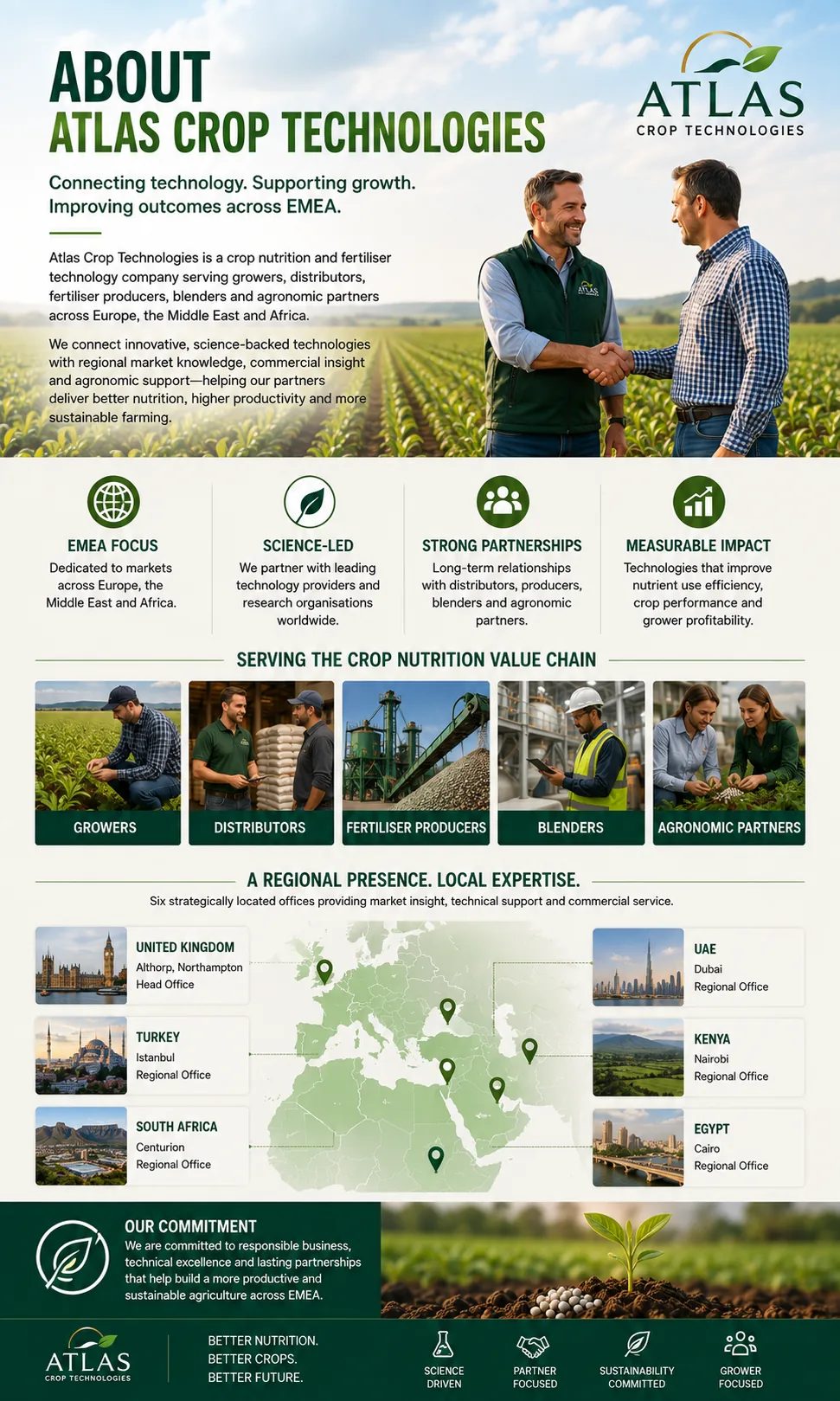
Atlas Crop Technologies serves the crop nutrition and fertiliser value chain from six strategic offices connecting Europe, the Middle East and Africa.

We work across an agricultural value chain that includes fertiliser producers and blenders, agricultural distributors, commercial growers, agronomy teams and market-development partners.

Our role is to connect useful crop nutrition technologies with the markets, organisations and agronomic programs where they are relevant. That requires more than supplying products. It requires technical positioning, regional market understanding, commercial coordination and communication that reflects local conditions.

With regional access points in Rotterdam, Istanbul, Dubai, Casablanca, Nairobi and Johannesburg, Atlas is structured to operate across diverse crops, fertiliser systems, distribution models and agricultural markets throughout EMEA.
Explore Products
Atlas Crop Technologies serving crop nutrition markets across Europe, the Middle East and Africa
Global crop technology. Local commercial support. Rotterdam · Istanbul · Dubai · Casablanca · Nairobi · Johannesburg
About Atlas Crop Technologies

Connecting crop technology, markets and partners.

Atlas operates within the crop nutrition and fertiliser value chain, connecting technical product understanding with regional market knowledge and commercial execution.

01

Who we serve

Our customers include fertiliser producers and blenders, agricultural distributors, commercial growers, agronomy teams and market-development partners.

Each group approaches crop technology from a different point in the value chain, so the questions around product fit, application, commercialisation and support can differ substantially.

02

How we work

We combine portfolio development, technical positioning, regional market knowledge and commercial execution to bring useful crop technologies closer to the people who apply them.

That means connecting product information with practical questions about crops, fertiliser systems, application methods, distribution channels and local market requirements.

03

Where we are

Our network spans Rotterdam, Istanbul, Dubai, Casablanca, Nairobi and Johannesburg, giving partners multiple regional access points.

Together, these offices support Atlas's presence across Europe, the Middle East and Africa.

What We Do

We operate where crop technology meets the market.

Bringing a crop technology closer to commercial use involves a sequence of technical, agronomic and market questions. Atlas brings those conversations together.

01

Portfolio development

We work with a crop nutrition portfolio spanning nutrient-efficiency, biostimulant, micronutrient, inoculant, seed-treatment and related technologies.

Portfolio development begins by understanding which agricultural needs and application pathways the technology is intended to address.

02

Technical positioning

Technology has to be explained in the context of its intended use: crop, nutrient source, application route, agronomic objective and market-specific directions.

Clear technical positioning helps partners understand where a technology fits and where additional validation may be needed.

03

Regional market knowledge

Crop systems, fertiliser practices, irrigation, soil conditions, distribution channels and regulatory environments differ across EMEA.

Regional market knowledge helps place product conversations within the agricultural reality of each market.

04

Commercial execution

Commercialisation can involve questions around distribution, product availability, portfolio placement, market development and partner support.

Our regional structure helps connect those commercial requirements with the appropriate market context.

05

Partner communication

Different partners require different levels and types of information. A fertiliser manufacturer may focus on integration, while a distributor may focus on market fit and an agronomy team on crop use.

We aim to make those conversations relevant to the partner's role.

06

Regional coordination

The six-office network gives Atlas multiple access points for connecting customers with the appropriate regional discussion.

Market, product and technology enquiries can therefore be considered with the geography of the opportunity in mind.

Who We Serve

Across the crop nutrition and fertiliser value chain.

Atlas serves organisations at different points between technology development, fertiliser production, distribution, agronomic recommendation and crop application.

01

Fertiliser producers

Fertiliser producers operate at the manufacturing end of the crop nutrition value chain.

Technology discussions can centre on nutrient-efficiency objectives, fertiliser treatment, product integration, target markets and the agronomic purpose of the final fertiliser program.

02

Fertiliser blenders

Blenders combine nutrient sources into products designed for particular crop or market requirements.

Relevant considerations can include nutrient composition, application route, compatibility, physical handling and local crop demand.

03

Agricultural distributors

Distributors connect crop-input technology with growers, agronomists and local markets.

Portfolio fit, crop focus, product positioning, market availability and technical understanding are important elements of that relationship.

04

Commercial growers

Growers apply crop technologies within real production systems where agronomy, economics, equipment and operational practicality all matter.

Product selection should therefore begin with the crop and defined agronomic objective.

05

Agronomy teams

Agronomists and technical advisers help translate product technology into practical crop recommendations.

They require clear information about intended use, application route, product positioning and relevant limitations.

06

Market-development partners

Market-development work connects technology with local commercial opportunity.

Understanding crop priorities, distribution channels, regulatory requirements and partner capability helps determine how a technology should be approached in a market.

Crop Nutrition Value Chain

Different partners. One connected system.

Crop technology moves through several stages before it reaches a field. Understanding how those stages connect helps explain Atlas's position in the market.

01

Technology

Crop nutrition technologies begin with a defined function or intended agronomic role.

Understanding that role is the foundation for responsible technical and commercial positioning.

02

Product positioning

A technology has to be connected to a crop, nutrient system, application route or other practical use environment.

03

Market access

Product availability and permitted use depend on local market and registration conditions.

04

Commercial partners

Producers, blenders and distributors connect technology with commercial crop-input channels.

05

Agronomic recommendation

Growers and advisers determine whether the technology fits a specific crop nutrition objective.

06

Field application

Technology ultimately has to be applied correctly within the crop, fertiliser or seed-treatment program for which it is intended.

Technology Focus

A portfolio spanning several crop nutrition pathways.

Atlas's portfolio includes multiple technology categories rather than relying on one approach to crop nutrition.

N

Nitrogen efficiency

Nitrogen-management technologies are intended to support more deliberate management of nitrogen fertiliser programs or, in selected biological systems, nitrogen acquisition through inoculation.

P

Phosphorus efficiency

Phosphorus-oriented technologies can be positioned around fertiliser enhancement, nutrient availability or phosphorus-use efficiency, depending on the product and application route.

BIO

Biostimulants

Biostimulant technologies within crop nutrition programs may be positioned around processes such as nutrient uptake, crop establishment, root development or plant performance according to product-specific information.

µ

Micronutrients

Micronutrient technologies can be delivered through different application pathways, including fertiliser, foliar, root-zone and seed-applied programs.

MIC

Inoculants

Biological inoculants provide a distinct technology pathway for selected crop systems and require product-specific handling and application.

ST

Seed treatments

Seed-applied technologies place the product at the earliest stage of crop establishment and can include nutrient, biostimulant or biological approaches.

How We Work

From technical understanding to market execution.

The original Atlas model combines portfolio development, technical positioning, regional market knowledge and commercial execution. In practice, those areas connect to one another.

01

Understand the technology

The starting point is understanding what the technology is, how it is intended to be used and what agronomic or operational objective it is designed to address.

02

Understand the market

Country, crop, fertiliser system, distribution model and local requirements influence whether a technology belongs in a market.

03

Identify product fit

Product fit depends on matching technology with the relevant crop, application pathway and intended outcome.

04

Position clearly

Technical and commercial communication should explain where a product fits and where market-specific information must still be confirmed.

05

Connect the right partners

The route to market may involve manufacturers, blenders, distributors, agronomy teams and growers.

06

Support long-term development

Market development can continue as commercial experience, technical knowledge and customer feedback accumulate.

Regional Model

Global crop technology. Local commercial support.

Atlas's six-office network is designed around a simple reality: agriculture changes significantly from one market to another.

01

Local crop systems

Crop priorities differ between countries and regions, influencing which technology categories are most relevant to local partners.

02

Different fertiliser practices

Fertiliser sources, blending practices, irrigation systems and application methods vary across markets.

03

Different distribution channels

Crop-input markets can be structured around different combinations of manufacturers, importers, distributors, retailers and agronomic organisations.

04

Different regulatory environments

Product availability, registration and label requirements can differ between countries.

05

Different commercial needs

A product opportunity in one market may require a different route, partner model or technical emphasis in another.

06

Regional access

Multiple offices give customers and partners several regional access points into the Atlas network.

Regional Offices

Six offices connecting Europe, the Middle East and Africa.

Our office network supports Atlas's regional crop nutrition and commercial market approach.

Rotterdam Netherlands
Istanbul Türkiye
Dubai United Arab Emirates
Casablanca Morocco
Nairobi Kenya
Johannesburg South Africa
Regional Access Points

One connected network across multiple agricultural regions.

Each office forms part of the wider Atlas regional network rather than operating as an isolated market.

01

Rotterdam

The Rotterdam office provides Atlas with a regional access point in the Netherlands and European market context.

02

Istanbul

Istanbul provides a regional access point in Türkiye within the wider Europe, Middle East and Mediterranean geography.

03

Dubai

Dubai provides a regional access point in the United Arab Emirates and the Middle Eastern market environment.

04

Casablanca

Casablanca provides an Atlas regional presence in Morocco and an access point into African agricultural markets.

05

Nairobi

Nairobi provides an Atlas regional presence in Kenya and an access point into East African agricultural markets.

06

Johannesburg

Johannesburg provides an Atlas regional presence in South Africa and an access point into Southern African agricultural markets.

EMEA Perspective

One region label. Many agricultural realities.

Europe, the Middle East and Africa encompass highly diverse crop systems, climates, market structures and nutrient-management practices.

EU

Europe

European crop nutrition markets include diverse field, horticultural and specialty crop systems along with varied fertiliser practices and local requirements.

Regional product conversations therefore need to consider the specific market rather than treating Europe as one uniform system.

ME

Middle East

Middle Eastern crop production can involve irrigated systems, intensive nutrient management and operating conditions very different from rain-fed agricultural regions.

Local application systems and market requirements remain important when positioning technology.

AF

Africa

African agriculture includes diverse commercial structures, crop systems, production scales and distribution models.

Product and market development therefore depend on understanding the practical agricultural and commercial context of each country.

Partnership Approach

Built for relationships across the value chain.

Atlas's position between technology, markets and commercial partners means relationship quality matters alongside product quality.

01

Understand the partner

The first step is understanding whether the partner manufactures, blends, distributes, recommends or applies crop technology.

02

Understand the market

Country, crop focus, customer base and local product environment shape commercial opportunities.

03

Understand the need

The technology discussion should begin with the crop nutrition or commercial objective rather than simply with a product name.

04

Match the technology

Product fit depends on whether the technology category and application pathway match the defined objective.

05

Build market understanding

Partner feedback, commercial experience and local technical knowledge can improve how technologies are positioned over time.

06

Develop long-term value

Strong agricultural partnerships develop through repeated seasons, clear communication and shared commercial understanding.

How We Think

Useful technology. Clear advice. Long-term relationships.

Our wider company approach is built around understanding technology, communicating clearly and developing durable relationships with customers and partners.

01

Scientific curiosity

We believe technology should be understood in terms of how it works, where it fits and what evidence or local context is relevant.

02

Commercial integrity

Product fit, availability, registration and market-specific directions should be communicated clearly.

03

Partnership mindset

Our business is built around relationships with the organisations that manufacture, distribute, recommend and apply crop technology.

Sustainability

Crop productivity and responsible nutrient management belong together.

Crop nutrition technology sits within a wider agricultural system that includes soil, water, fertiliser use, crop demand and operational efficiency.

01

Nutrient efficiency

Crop nutrition programs should consider how applied nutrients are positioned, made available and used by the crop.

02

Appropriate technology

Adding technology makes most sense when it addresses a defined agronomic or operational objective.

03

Responsible use

Products should be handled and applied according to current approved labels and local use directions.

Why Regional Structure Matters

Agricultural technology has to work in a real market.

A strong product proposition requires alignment between technology, local agriculture and commercial execution.

01

Crop relevance

The crops grown in a market influence which nutrient challenges and technology categories are commercially relevant.

02

Application relevance

Broadcast fertiliser, foliar application, fertigation, in-furrow placement and seed treatment require different technologies and operational approaches.

03

Channel relevance

Product positioning should take account of whether technology reaches the grower through a manufacturer, blender, distributor or another market channel.

04

Regulatory relevance

Registration, claims, application directions and availability vary between markets.

05

Commercial relevance

A technology must fit a market's customer needs and commercial structure in addition to its technical purpose.

06

Relationship relevance

Local and regional relationships help connect technical information with practical market requirements.

Working With Atlas

Start with your market, crop or commercial objective.

The most useful first conversation is usually the one that explains what you are trying to achieve.

01

Tell us your country

Country helps determine regional routing, product availability and market-specific information.

02

Tell us who you are

Let us know whether you are a fertiliser producer, blender, distributor, grower, agronomist or market-development partner.

03

Tell us your crop or market

Crop and customer focus help define the agronomic and commercial context.

04

Tell us the technology area

If known, identify whether your interest relates to nitrogen, phosphorus, micronutrients, biostimulants, inoculants, seed treatments or another crop nutrition area.

05

Tell us the application

Fertiliser treatment, broadcast, foliar, fertigation, in-furrow, inoculant and seed-treatment pathways require different discussions.

06

Tell us the objective

Explain the technical or commercial outcome you want to investigate so the enquiry can be directed appropriately.

Product Availability

Portfolio information is global. Product use is local.

Product availability, registration and label directions can differ by market. Contact Atlas with your country and product of interest when local information is required.

01

Availability

Confirm whether the product is commercially available in the intended market.

02

Registration

Product regulatory status can differ between countries.

03

Label directions

Always use the current local label for approved application information.

04

Approved crops

Crop uses can vary between product registrations and markets.

05

Application

Rates, timing and application route should be taken from current market-specific directions.

06

Local confirmation

Contact Atlas before relying on information from a different market.

Connect With Atlas

Tell us about your crop, market or commercial opportunity.

Whether you are a fertiliser producer, blender, distributor, commercial grower, agronomy team or market-development partner, share your country, crop or customer focus and the technology objective you want to discuss. Our team will route your enquiry to the appropriate regional contact.

About Atlas FAQ

Frequently Asked Questions

General information about Atlas Crop Technologies, the organisations we serve, our regional structure and crop nutrition portfolio.

Atlas Crop Technologies is a crop nutrition and fertiliser technology company serving the crop nutrition value chain across Europe, the Middle East and Africa.

The company combines portfolio development, technical positioning, regional market knowledge and commercial execution.

Atlas serves fertiliser producers and blenders, agricultural distributors, commercial growers, agronomy teams and market-development partners.

Atlas combines portfolio development, technical positioning, regional market knowledge and commercial execution to bring useful crop technologies closer to the people who manufacture, distribute, recommend and apply them.

Atlas supports customers through offices in Rotterdam, Istanbul, Dubai, Casablanca, Nairobi and Johannesburg, serving markets across Europe, the Middle East and Africa.

The six-office network gives partners multiple regional access points across Europe, the Middle East and Africa.

It supports a market approach that recognises differences in crops, fertiliser systems, distribution channels and local requirements.

Atlas has regional offices in Rotterdam, Netherlands; Istanbul, Türkiye; Dubai, United Arab Emirates; Casablanca, Morocco; Nairobi, Kenya; and Johannesburg, South Africa.

The portfolio includes nitrogen and phosphorus efficiency technologies, biostimulants, micronutrients, inoculants, seed treatments and related crop nutrition solutions.

Yes. Fertiliser producers are among the core customer groups Atlas serves.

Enquiries can relate to crop nutrition technologies, fertiliser treatment, nutrient efficiency and market opportunities.

Yes. Fertiliser blenders are included among the customers Atlas Crop Technologies serves.

Yes. Agricultural distributors are an important part of the crop nutrition value chain served by Atlas.

Distribution enquiries can include product availability, portfolio fit and market-development opportunities.

Yes. Commercial growers are included among the customers and partners Atlas serves.

Yes. Agronomy teams are among the groups served by Atlas Crop Technologies.

Technical discussions can focus on crop, nutrient source, application method, product positioning and the agronomic objective being considered.

Portfolio development involves bringing together technologies that address different crop nutrition objectives and application pathways.

Atlas's portfolio includes nutrient-efficiency technologies, biostimulants, micronutrients, inoculants and seed treatments.

Technical positioning means explaining what a technology is intended to do, which application pathway it fits and what crop or nutrient objective it is designed to address.

Local product labels and registration requirements remain important when moving from general portfolio information to market-specific use.

Crops, fertiliser systems, climate, distribution channels and regulatory environments differ between countries.

Regional market knowledge helps put a technology into the appropriate agricultural and commercial context.

Contact Atlas with your country and product of interest.

Product availability, registration and label directions can differ by market.

Yes. Atlas welcomes enquiries from distributors, fertiliser manufacturers and blenders, growers and agronomic partners.

No. Atlas describes its regional footprint as serving Europe, the Middle East and Africa, supported by six offices distributed across those regions.

Start by providing your country, company type, crop or customer focus and the product, technology or commercial opportunity you want to discuss.

Use the contact page, open the contact form on this website or email contact@fertilizercoatingproducts.com .

Include your country or target market so your enquiry can be routed to the appropriate regional contact.

Atlas Crop Technologies

A crop technology company built across markets.

Our network connects crop nutrition technology with fertiliser producers, blenders, distributors, growers, agronomy teams and market-development partners across Europe, the Middle East and Africa. If you are exploring a product, crop program, distribution opportunity or commercial partnership, start a conversation with our team.

Explore Products

Trademark Notice: All products featured on this website are registered trademarks of Verdesian Life Sciences.

Thank you — your message has been sent.