Phree-Up®
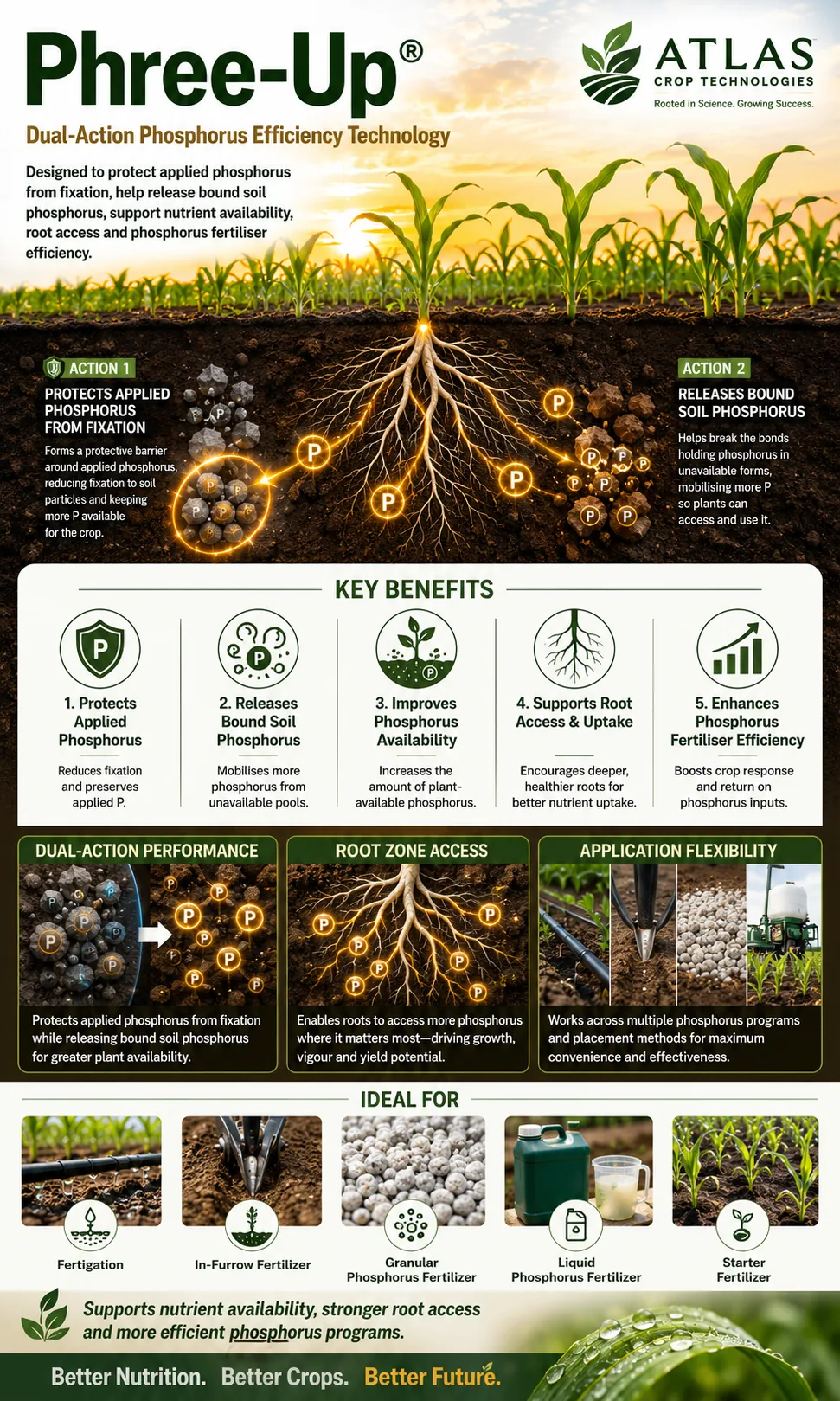
A phosphorus-efficiency technology designed to help protect applied phosphate from tie-up while also helping mobilise phosphorus already bound in the soil — increasing the opportunity for crop roots to access this essential nutrient.
Phree-Up® approaches phosphorus efficiency from two complementary directions. Manufacturer information describes a proprietary exchange resin designed to reduce phosphorus fixation together with a proprietary biostimulant designed to stimulate biological processes associated with releasing mineral-bound phosphorus.
Registration, formulation, application rates, fertiliser sources, crop uses and permitted claims can vary by country. Always follow the current approved local product label.
Getting more agronomic value from phosphorus
Phosphorus is essential for crop development, but applying phosphorus fertiliser does not mean every unit remains immediately available to plant roots. Once phosphate enters the soil, it can react rapidly with mineral surfaces and positively charged ions.
Those reactions may convert soluble phosphate into less readily available forms. The result is a familiar nutrient-management challenge: phosphorus may be present in the fertiliser program or soil test, yet the crop may have access to only part of that phosphorus at the time it needs it.
Phree-Up® is designed to improve that availability equation. Rather than functioning as a simple additional phosphorus source, it is positioned as a phosphorus-efficiency technology intended to help maintain applied phosphorus in a more accessible environment while increasing biological mobilisation of phosphorus already present in the soil.
Technical positioning
Why phosphorus matters to crop development
Phosphorus participates in fundamental biological processes from the beginning of plant development through reproduction and maturity.
Energy transfer
Phosphorus forms part of compounds involved in energy transfer within living cells. Adequate phosphorus nutrition therefore supports many energy-demanding processes associated with plant growth.
Root development
Phosphorus is particularly important during early crop development when establishing roots are expanding into the soil and the plant is building the foundation for later nutrient and water acquisition.
Cellular function
Phosphorus is a structural component of nucleic acids and phospholipids and therefore contributes to cell division, membranes and normal plant development.
Reproductive development
Adequate phosphorus nutrition contributes to processes associated with flowering, seed formation, maturation and productive crop growth.
Soil phosphorus is not the same as plant-available phosphorus
Soil can contain a substantial total quantity of phosphorus while only a fraction of that pool is immediately accessible to plant roots.
Phosphate is chemically reactive in soils. Depending on soil pH, mineralogy and the dominant cations present, soluble phosphate can become associated with calcium, iron, aluminium or mineral surfaces in forms that are less readily available for crop uptake.
This is why phosphorus management is not only a question of how much phosphorus exists in the soil. It is also a question of how much is present in a form and location that roots can access during periods of crop demand.
Availability, placement and timing
Understanding phosphorus fixation
"Fixation" is a practical agronomic term for reactions that reduce the immediate availability of soluble phosphate to plant roots.
Calcium-related reactions
In calcareous or alkaline soils, abundant calcium can react with soluble phosphate and contribute to formation of less soluble calcium-phosphate forms.
Iron and aluminium interactions
In more acidic soils, phosphorus availability can be limited by reactions involving iron and aluminium minerals and surfaces.
Adsorption
Phosphate can attach strongly to mineral surfaces. The strength and extent of this interaction depend on soil mineralogy, phosphorus concentration and environmental chemistry.
Progressive tie-up
Fertiliser phosphorus can move through several chemical pools after application, with some fractions becoming progressively less available over time.
Two complementary approaches to phosphorus availability
Manufacturer information differentiates Phree-Up® from a single-mechanism phosphorus enhancer by combining a chemical phosphorus-protection component with a biological mobilisation component.
Help protect applied phosphorus
The first component is described by Verdesian as a proprietary exchange resin.
Manufacturer information states that the exchange resin attracts soil cations. By interacting with cations that would otherwise participate in phosphorus-fixation reactions, the technology is designed to help reduce the immediate tie-up of applied phosphate.
The agronomic objective is to extend the opportunity for applied phosphorus to remain in a form that can be accessed by developing roots.
Help mobilise bound soil phosphorus
The second component is described as a proprietary biostimulant designed to increase native microbial activity in the soil.
Manufacturer information specifically associates this biological effect with increased acid phosphatase activity.
Phosphatase enzymes participate in processes that release phosphate from certain phosphorus-containing compounds. The manufacturer positions this activity as helping release phosphorus from mineral-bound or otherwise less available soil reserves.
From fertiliser application to root uptake
Phosphate fertiliser is applied
Phosphorus enters the root zone through the grower's normal fertiliser program using an approved granular or liquid phosphate source.
Fixation reactions begin
Soluble phosphate encounters soil minerals and cations capable of reducing its availability.
Exchange resin targets cations
Manufacturer information describes the proprietary resin as attracting cations involved in phosphorus-fixation reactions.
Soil biology is stimulated
The proprietary biostimulant is positioned to increase microbial activity associated with phosphorus cycling.
More phosphorus remains potentially available
The combined objective is to maintain a larger pool of phosphorus that can remain accessible in the crop root zone.
Roots access phosphorus
Final crop uptake still depends on root growth, soil conditions, moisture, temperature, crop demand and overall agronomic management.
Designed to make phosphorus work harder
Improve phosphorus availability
The central objective of Phree-Up® is to increase the opportunity for phosphorus to remain in forms accessible to the crop.
Reduce phosphorus tie-up
The proprietary exchange resin is designed to reduce fixation reactions involving applied phosphate.
Mobilise existing phosphorus
The biostimulant component is positioned to stimulate soil biological processes associated with making bound phosphorus more available.
Support nutrient use efficiency
Increasing the availability of existing and newly applied phosphorus can improve the efficiency of the overall phosphorus program.
Support root-zone access
Phosphorus must ultimately reach active roots. Maintaining availability near the root zone can help the crop make more effective use of its phosphorus supply.
Improve fertiliser investment efficiency
The technology is positioned to help growers obtain greater agronomic value from phosphorus fertiliser already included in the crop-management plan.
Field-performance context
The figures below reflect current Verdesian marketing and manufacturer data. They are not guarantees of performance and should only be used commercially where permitted by local registration.
85% manufacturer-reported win rate
Current manufacturer materials report an 85% win rate across the referenced Phree-Up® field-trial dataset.
Trial design, locations, crop, soils, statistical analysis and treatment comparisons should be reviewed before drawing conclusions.
Up to 4.7 bu/A reported yield gain
Verdesian currently reports yield increases of up to 4.7 bushels per acre in referenced field trials.
Individual field response can differ substantially according to soil fertility, weather, crop, application quality and management.
Manufacturer trial results describe specific experimental or commercial conditions and do not predict the response of an individual field. Yield response may be positive, neutral or variable depending on soil phosphorus status, crop demand, environment, fertiliser placement, soil chemistry and other factors.
Phosphorus and root development
Early crop growth is particularly sensitive to phosphorus supply because young root systems explore only a limited volume of soil.
Phosphorus moves comparatively slowly through soil, so root proximity, placement and early nutrient availability can influence how quickly a crop establishes access to adequate phosphorus.
Improving phosphorus availability close to developing roots may therefore be particularly relevant during establishment and other periods of rapid crop development.
Availability can matter even when soil tests are adequate
Cool soils commonly reduce root growth and nutrient diffusion. Therefore, early crops can sometimes show temporary phosphorus limitation even when total soil phosphorus is not exceptionally low.
A phosphorus-efficiency strategy should still be based on the complete fertility program rather than assuming that every early growth symptom is caused by phosphorus availability.
Designed to work with phosphorus fertiliser programs
Current manufacturer information identifies compatibility with both granular and liquid phosphate fertilisers.
Granular phosphate fertilisers
Phree-Up® can be integrated with approved granular phosphate fertilisers according to current treatment, blending and application directions.
Uniform treatment or blending is important so the technology is distributed consistently through the fertiliser program.
Liquid phosphate fertilisers
Manufacturer information also identifies use with liquid phosphorus fertiliser, including liquid starter programs.
Water quality, fertiliser composition, concentration and physical compatibility should be considered before preparing concentrated mixtures.
Starter fertiliser
Phree-Up® can fit starter-fertiliser strategies where the approved label permits use with the selected phosphorus fertiliser.
Seed safety and placement remain governed by the complete starter fertiliser formulation and crop-specific recommendations.
Match the technology to the fertiliser application
Manufacturer information positions Phree-Up® for application at the time the fertiliser program is being implemented.
Before planting
Where phosphorus fertiliser is applied before planting, Phree-Up® can be incorporated according to the approved fertiliser-treatment or blending directions.
At planting
Starter, row or other at-plant phosphate applications can position phosphorus close to young roots during the establishment phase.
In-season fertiliser application
Manufacturer information also positions the technology for in-season use where the phosphorus fertiliser strategy and label support that timing.
In-furrow integration
The Atlas Crop Technologies product page identifies in-furrow application as one route for integrating Phree-Up® into nutrient programs.
In-furrow placement can position phosphorus and phosphorus-efficiency technology directly within the early root-development zone.
However, in-furrow fertiliser programs require careful attention to fertiliser salt concentration, ammonia potential, crop sensitivity, soil moisture and the physical separation between seed and fertiliser.
Confirm the complete program
Fertigation programs
The Atlas Crop Technologies page identifies fertigation as another application route for Phree-Up®.
Fertigation enables liquid nutrients to be delivered through an irrigation system, potentially allowing phosphorus placement to be coordinated with crop development and water management.
The suitability of Phree-Up® for a particular fertigation system, phosphorus source and crop must be confirmed from the locally approved directions.
Check water and fertiliser compatibility
Phosphorus availability changes with soil conditions
Acidic soils
In acidic conditions, phosphorus can become strongly associated with iron- and aluminium-containing soil minerals, reducing the proportion present in readily plant-available forms.
Calcareous soils
In high-pH, calcium-rich soils, phosphate can react with calcium and move into less soluble forms.
Soil mineralogy
Clay type, oxide content and mineral surfaces influence how strongly phosphate is adsorbed and retained.
Organic matter
Organic matter influences nutrient cycling, microbial activity, phosphorus mineralisation and interactions with soil minerals.
Moisture
Phosphorus moves to roots largely through diffusion, making soil moisture an important factor in nutrient movement and root access.
Temperature
Cool soil reduces root growth and biological activity and can restrict early phosphorus acquisition even where soil phosphorus levels appear adequate.
Phosphorus cycling is also biological
Soil phosphorus exists in several inorganic and organic pools. Microorganisms participate in cycling phosphorus among these pools through immobilisation, mineralisation and enzyme-mediated processes.
One group of enzymes associated with phosphorus cycling is phosphatases. These enzymes can release phosphate from certain phosphorus-containing compounds.
Phree-Up®'s biostimulant component is specifically positioned by the manufacturer around increasing native microbial activity, including acid phosphatase activity.
Biology complements soil chemistry
Phosphorus efficiency cannot be explained only by fertiliser chemistry. Root growth, microbial populations, soil organic matter, moisture and temperature also contribute to the nutrient-cycling system.
The dual-action concept behind Phree-Up® therefore combines a technology targeted at chemical fixation with another targeted at biological phosphorus mobilisation.
High soil-test P does not always mean identical availability
A high soil-test phosphorus level indicates that phosphorus reserves are present, but it does not imply that every fraction of those reserves is immediately available to crop roots.
Manufacturer information describes a specific Phree-Up® label use for certain high-phosphorus soil situations where phosphorus fertiliser is not being applied but another granular fertiliser is used.
This is a specialised use pattern and should only be considered where the current local label supports it.
Soil-test interpretation still matters
Soil-test phosphorus, crop-removal requirements, environmental regulations, fertiliser placement and local recommendations should remain the foundation of the phosphorus-management program.
Does Phree-Up® allow phosphorus rates to be reduced?
No universal phosphorus-rate reduction should be assumed.
Current manufacturer guidance specifically states that phosphorus fertiliser recommendations should be made locally because crop requirements, soil fertility, yield targets, production systems and environmental conditions differ widely.
Phree-Up® should therefore be positioned as a phosphorus-efficiency technology within a professionally designed nutrient-management program rather than as an automatic replacement for fertiliser.
Build the phosphorus recommendation first
Improving phosphorus efficiency
Nutrient use efficiency is not simply about applying less fertiliser. It is about aligning nutrient supply, availability, timing, placement and crop demand so that a greater proportion of the nutrient investment contributes to productive plant growth.
Phree-Up® is positioned within this framework by focusing on the availability of phosphorus already being supplied or already present in the soil.
Keep phosphorus in the productive system
Phosphorus is an essential crop nutrient but also an environmental management priority in many regions.
Sound phosphorus management should combine appropriate fertiliser rate, source, timing, placement, erosion control, runoff management and other locally recommended best-management practices.
Situations where phosphorus-efficiency technology may warrant evaluation
High phosphorus-fixation potential
Soils with chemistry or mineralogy that strongly reduce phosphate availability may warrant particular attention to phosphorus efficiency.
Calcareous soils
Calcium-rich soils can create conditions favourable to calcium-phosphate formation and reduced phosphorus solubility.
Acidic soils
Iron- and aluminium-related phosphorus reactions can become more important in acidic soil environments.
High-value starter programs
Where phosphorus is strategically placed near young roots, improving the availability of that nutrient investment may be a relevant program objective.
Intensive fertigation systems
Irrigated systems that apply phosphorus through fertigation may benefit from careful management of phosphorus chemistry, precipitation and root-zone availability.
High-P soil with availability concerns
Where soil-test phosphorus is high but crop or soil conditions indicate availability limitations, manufacturer-described high-P-soil use patterns may warrant local evaluation where registered.
Recognising possible phosphorus limitation
Phosphorus deficiency can restrict crop development and may contribute to poor early growth, limited root development and delayed crop progression.
Some crops may develop dark-green or purplish colouration under phosphorus stress, but visual symptoms alone are not sufficient to diagnose the problem.
Cold soil, root damage, compaction, disease, poor drainage and other stresses can produce symptoms that resemble or contribute to nutrient deficiency.
Confirm the limiting factor
Practical checks before treatment or blending
Confirm the phosphorus source
Identify the exact granular or liquid phosphate fertiliser that will be used and confirm it is compatible with the intended Phree-Up® application.
Verify the label rate
Use only the rate listed for the relevant formulation, fertiliser source, crop program and market.
Calibrate equipment
Treatment, blending or injection equipment should deliver the intended rate consistently across the fertiliser volume.
Check physical compatibility
Liquid mixtures should remain physically stable and granular treatment should maintain appropriate flowability and distribution.
Record treatment details
Maintain product lot, date, fertiliser source, rate and treated volume records for quality assurance and traceability.
Follow local storage guidance
Treat and store Phree-Up® and treated fertilisers according to current manufacturer and local label requirements.
Information that helps us evaluate program fit
Detailed soil, crop and fertiliser information allows a more useful technical discussion.
Country and region
Location determines product registration and provides useful context on soil types, cropping systems and fertiliser practices.
Crop
Include crop, variety where relevant, planting date and expected yield target.
Soil-test phosphorus
Provide the soil-test result together with the test method where available, since interpretation differs between analytical systems.
Soil pH
Soil pH provides important context for the types of phosphorus reactions likely to influence availability.
Soil type
Texture, carbonate status, organic matter and other soil characteristics influence phosphorus behaviour.
Phosphate fertiliser source
Identify the exact granular or liquid phosphorus fertiliser included in the program.
Fertiliser rate
Provide the current phosphorus rate and whether it is expressed as elemental P, P₂O₅ or another local convention.
Application timing
Indicate whether phosphorus is applied pre-plant, at planting, through fertigation or later in the season.
Placement
Describe broadcast, banded, starter, in-furrow, fertigation or other placement used in the crop system.
Phree-Up® product profile
Phree-Up® is one part of the phosphorus strategy
Phosphorus availability technology performs within a broader fertility system. It does not remove the need for soil testing, appropriate phosphorus rate, suitable fertiliser source or good placement.
Crop performance also depends on root health, nitrogen, potassium, sulphur, micronutrients, water supply, soil structure and the many other factors that determine yield potential.
Review the complete fertility plan
Explore related technologies
Combine phosphorus-efficiency tools with micronutrient, biological and crop-development technologies according to the crop's agronomic requirements.
PolyAmines
A range of amino-acid-chelated micronutrients designed to support trace-element nutrition, efficient uptake and plant development.
View Product → InoculantPre-Vail®
A clay-based pre-inoculant for selected legumes, developed to support early root development, nodulation and seedling vigor.
View Product → InoculantPreside Ultra®
A soybean inoculant developed to support early nodulation, root development and efficient nitrogen acquisition.
View Product →Build a more efficient phosphorus program
Tell us your country, crop, soil-test phosphorus, soil pH, phosphate fertiliser source, application rate, placement and timing. Atlas Crop Technologies can help evaluate how Phree-Up® may fit your nutrient-management or distribution program.
Frequently Asked Questions
These answers combine general phosphorus agronomy with manufacturer-described Phree-Up® positioning. The approved local label remains the definitive source for product use.
Phree-Up® is a dual-action phosphorus efficiency technology designed to reduce phosphorus fixation and help mobilise phosphorus already bound in the soil. Its objective is to help increase phosphorus availability and improve the efficiency of the phosphorus nutrition program.
Manufacturer information describes two complementary components. A proprietary exchange resin attracts soil cations associated with phosphorus fixation, while a proprietary biostimulant stimulates soil microbial activity associated with mobilising bound phosphorus.
No. Current Verdesian information specifically states that Phree-Up® is not simply the next generation of AVAIL®. Phree-Up® is positioned as a dual-component technology combining phosphorus-protection chemistry with a biostimulant component intended to increase phosphorus mobilisation.
Phosphorus fixation is an agronomic term describing soil reactions that reduce the availability of soluble phosphate to plant roots. Depending on soil conditions, phosphate can become associated with calcium, iron, aluminium or mineral surfaces and enter less readily available forms.
Phosphate is chemically reactive in soil. Once fertiliser dissolves, phosphate ions can interact with soil minerals and cations. Soil pH, mineralogy, carbonate content, iron and aluminium oxides and other factors influence how quickly and strongly these reactions occur.
Verdesian describes the proprietary exchange resin as attracting soil cations involved in phosphorus fixation. The purpose is to help reduce reactions that would otherwise move applied phosphate into less available forms.
Manufacturer information states that the proprietary biostimulant increases native microbial activity in soil and specifically identifies increased acid phosphatase activity. This biological activity is positioned as helping release phosphorus from bound soil forms.
Acid phosphatase is part of a group of phosphatase enzymes involved in phosphorus cycling. These enzymes can release inorganic phosphate from certain phosphorus-containing compounds, helping move phosphorus through the biologically active nutrient cycle.
Phree-Up® is positioned as a phosphorus-efficiency technology, not simply as a conventional phosphorus fertiliser source. Refer to the current local guaranteed analysis for the exact formulation supplied in your market.
No universal replacement should be assumed. Phree-Up® is intended to improve phosphorus efficiency. Fertiliser requirements should still be established from soil testing, crop demand, yield target, nutrient removal and local agronomic recommendations.
No. Manufacturer guidance explicitly recommends determining fertiliser rates locally because phosphorus requirements depend on soil fertility, crop, yield target and other site-specific conditions.
Yes. Current manufacturer information identifies use with granular phosphate fertilisers. Treatment or blending procedure and application rate must follow the approved product label.
Yes. Current manufacturer information identifies Phree-Up® for use with liquid phosphate fertilisers, including liquid starter blends where the label permits.
Manufacturer information states that Phree-Up® can be used with liquid phosphate fertilisers including starter blends. The complete starter program must still comply with crop-safety, placement and label requirements.
Manufacturer information positions Phree-Up® for application at the time of fertiliser application. This can include pre-plant, at-plant or in-season timing depending on the fertiliser program and local label.
The Atlas Crop Technologies page identifies in-furrow as an application route. Exact crop, fertiliser rate, Phree-Up® rate, placement and compatibility requirements must follow the current local label.
The Atlas Crop Technologies page identifies fertigation as an application route. Confirm local registration, phosphorus source, irrigation-system compatibility, water quality and application directions before use.
Current manufacturer information describes a specific label rate for certain high-phosphorus soil situations where phosphorus fertiliser is not being applied but another granular fertiliser is used. This use is market-specific and should not be assumed unless it appears on the current local label.
Soil-test phosphorus measures a particular extractable soil pool, but crop uptake also depends on root growth, temperature, moisture, soil chemistry, placement and the distribution of phosphorus relative to active roots. High total or extractable phosphorus therefore does not mean all soil phosphorus is immediately available.
Yes. In acidic soils, iron- and aluminium-related reactions can reduce phosphorus availability. In high-pH or calcareous soils, calcium-phosphate reactions can become more important.
Yes. Cool soil can slow root growth, nutrient diffusion and biological activity. Young crops may therefore experience temporary phosphorus limitation even where the soil contains adequate phosphorus reserves.
Phosphorus is important to early root development, and Phree-Up® is designed to improve phosphorus availability. Root response, however, also depends on crop genetics, soil structure, moisture, temperature, disease, nutrient balance and other agronomic factors.
Current manufacturer information describes Phree-Up® as containing a proprietary biostimulant that stimulates native soil microbial activity. It should not automatically be described as a live microbial inoculant unless the current local formulation and label specifically state that.
Current manufacturer marketing reports an 85% win rate and yield gains of up to 4.7 bushels per acre in referenced field trials. These figures are manufacturer-reported observations rather than guarantees of individual-field performance.
No. Response can vary with soil phosphorus status, pH, mineralogy, crop, phosphorus source, fertiliser placement, weather, soil biology, root health and overall management.
No. Registration, formulation, permitted fertiliser sources, application rates, crops, pack sizes and claims may differ by market.
Include your country and region, crop, yield target, soil-test phosphorus and test method, soil pH, soil type, phosphorus fertiliser source, phosphorus rate, application timing, placement, irrigation system where relevant and your specific agronomic objective.
Use the contact form on this page or email contact@fertilizercoatingproducts.com with your country, company, customer segment, expected product requirement, fertiliser application market and distribution objective.
This page provides general product, soil-fertility and agronomic information only. Phree-Up® formulation, active ingredients, concentration, registered crops, approved fertiliser sources, application rates, treatment methods, application timing, tank-mix compatibility, pack sizes and permitted performance claims may differ between countries.
Phree-Up® should not be interpreted as an automatic replacement for phosphorus fertiliser or as a universal justification for reducing phosphorus rates. Phosphorus recommendations should be based on locally appropriate soil testing, crop demand, yield target, nutrient removal, environmental requirements and professional agronomic guidance.
Soil phosphorus behaviour varies with pH, mineralogy, moisture, temperature, organic matter, fertiliser placement, soil biology and crop root development. Product performance can therefore vary materially among fields and seasons.
Always read and follow the current approved local product label and applicable fertiliser regulations. Consult a qualified agronomist, crop adviser or Atlas Crop Technologies representative where crop-specific recommendations, compatibility assessment or local registration confirmation is required.