Pre-Vail®
A clay-based pre-inoculant for alfalfa and selected clovers, developed to support early root development, effective nodulation, biological nitrogen fixation, seedling vigor and stand establishment.
Pre-Vail® is designed for seed-treatment programs that seek to position viable legume-compatible microorganisms directly around the seed before planting. Its pre-inoculant format allows the biological treatment to become part of a professionally designed seed coating or build-up process.
Supported legumes, formulation, inoculant strains, application rate, compatibility, pack size and permitted claims can vary by market. Always follow the current approved local product label.
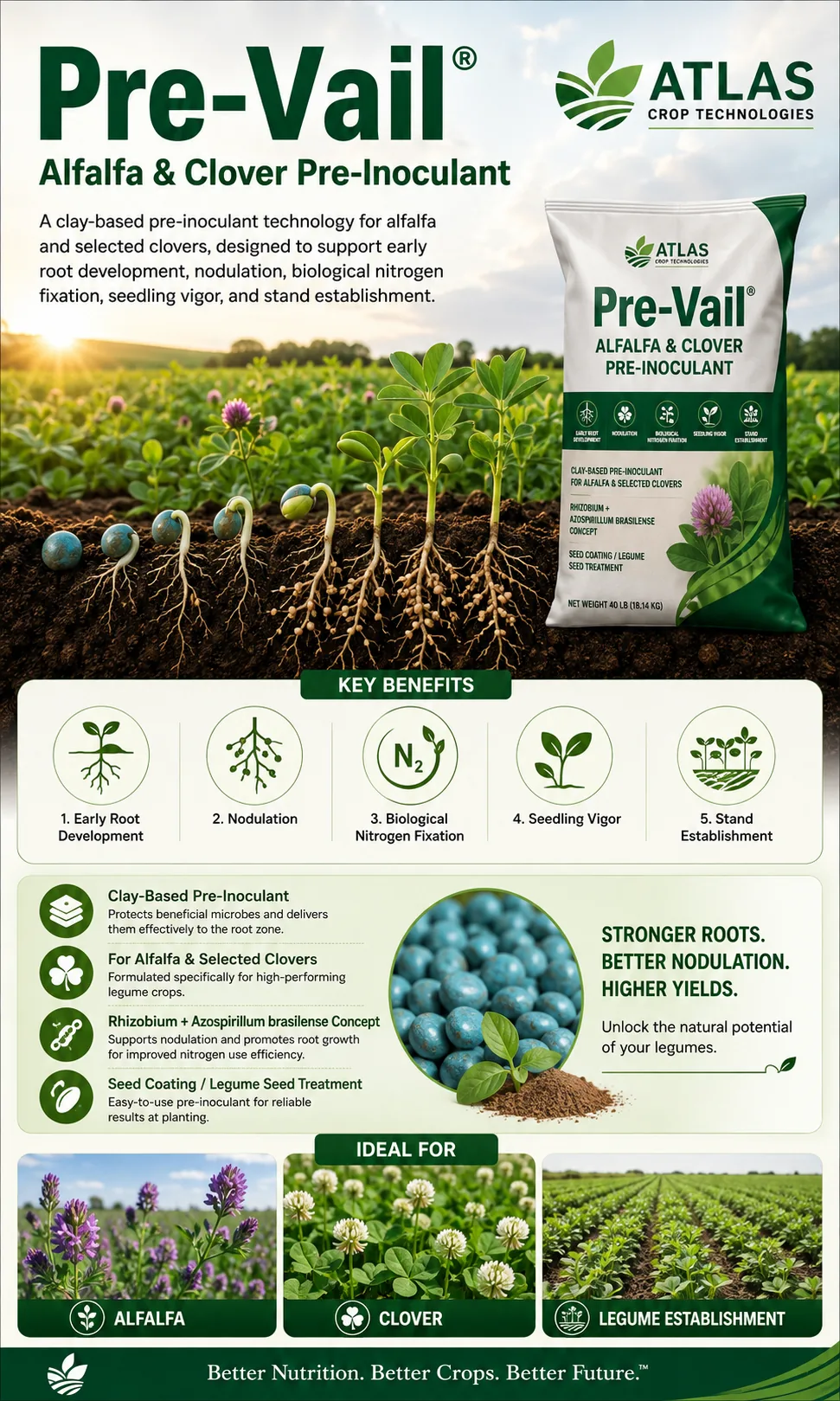
Pre-inoculation technology for forage-legume seed
Legume inoculation is based on one of agriculture's most important biological relationships: the symbiosis between legume plants and compatible nitrogen-fixing bacteria.
When appropriate rhizobia successfully colonise developing roots, they can initiate the formation of specialised structures known as nodules. Inside effective nodules, atmospheric nitrogen can be converted into forms that contribute to plant nitrogen nutrition.
Pre-Vail® is designed to help establish this biological process from the beginning of crop development by placing compatible inoculant organisms directly onto seed within a clay-based coating system.
Manufacturer information positions the product primarily for alfalfa and selected clovers and describes Pre-Vail® as combining rhizobial inoculant with additional biological activity from Azospirillum brasilense.
Technical positioning
Supporting the biological foundation of a productive stand
Pre-Vail® is positioned around several interconnected biological and establishment objectives rather than a single plant response.
Biological Nitrogen Fixation
Compatible rhizobia can form a symbiotic relationship with the legume crop and contribute biologically fixed nitrogen to plant nutrition after effective nodules have developed.
Effective Nodulation
Positioning appropriate inoculant organisms close to emerging roots is intended to support early root infection and development of functional nodules.
Root Development
A strong root system supports anchorage, water acquisition and nutrient uptake while providing additional root surface for productive biological interactions.
Seedling Vigor
Manufacturer positioning links Pre-Vail® with improved early seedling vigor, helping young forage-legume plants establish during the vulnerable early stages of development.
Stand Establishment
Uniform establishment is particularly important in perennial forage crops because early stand density and plant distribution can influence the productive potential of the field over time.
Seed-Treatment Integration
The clay-based pre-inoculant format is designed for integration into seed coating and build-up processes rather than being treated simply as a conventional liquid planting input.
Why legume inoculation matters
Legumes have the ability to obtain a substantial portion of their nitrogen through a biological partnership with compatible bacteria. This relationship is highly crop-specific: different legumes require appropriate rhizobial groups or strains for successful nodulation.
Simply having microorganisms somewhere in the soil does not necessarily guarantee efficient nodulation. Their population, compatibility, viability and ability to colonise young roots can all influence establishment of the symbiosis.
Seed inoculation provides a practical method of positioning a large population of compatible organisms immediately beside germinating seed, where the developing root system can interact with them during early growth.
From seed to nitrogen-fixing nodule
A combination of complementary microorganisms
Manufacturer information describes Pre-Vail® as a multi-component biological pre-inoculant designed around both nodulation and early plant development.
Rhizobial inoculant
Rhizobia are the microorganisms responsible for establishing the nitrogen-fixing symbiosis with compatible legumes. They colonise developing roots and stimulate formation of nodules in which biological nitrogen fixation can occur.
Manufacturer information describes Pre-Vail® as containing high levels of rhizobial inoculant. The exact strain or combination required depends on the legume being treated, which is why the current product label and crop-specific formulation must always be matched to the intended seed.
A rhizobial inoculant suitable for one legume should not automatically be assumed suitable for another. Use only the supported legumes and inoculant formulation stated on the current approved label.
Azospirillum brasilense
Manufacturer information also describes Pre-Vail® as being infused with Azospirillum brasilense, a plant-associated microorganism included to complement the rhizobial component of the formulation.
The manufacturer's product positioning links this component with plant health, early root development and stand establishment.
As with any biological product, performance is influenced by organism viability, storage, seed-treatment conditions, crop, environment and management practices.
Technical characteristics described by Verdesian
The following information reflects current manufacturer materials and is provided for technical context. Registration and specifications can vary by market.
High viable-cell loading
Verdesian's European product information describes Pre-Vail® as containing 100 million viable rhizobial cells per gram.
Confirm the guaranteed analysis or organism concentration on the current product label supplied in your market.
Additional biological component
Manufacturer information states that the product is additionally infused with 100 million Azospirillum brasilense cells per gram.
Local formulation specifications should always be verified before technical or commercial use of this figure.
Clay-based pre-inoculant
The dry clay-based format is designed for pre-inoculation within a seed coating or build-up process.
Alfalfa and clovers
Current manufacturer information identifies Pre-Vail® primarily for alfalfa and selected clovers, with supported crops determined by local registration and label.
Product specifications, microorganism counts, supported legumes and formulation may change or differ between registered products. Technical documentation supplied with the locally registered product is the definitive source.
Alfalfa establishment
Alfalfa is a perennial forage legume capable of developing an effective biological nitrogen-fixation system when compatible rhizobia successfully establish on the roots.
Because the productive stand may remain in the field for several seasons, achieving a healthy and uniform initial establishment is an important agronomic objective.
Pre-inoculation positions the appropriate biological organisms on the seed before sowing, helping ensure they are present near the developing root system during early establishment.
Clover establishment
Clover species also depend on compatible rhizobia for productive nodulation and biological nitrogen fixation.
Because different clovers may have specific inoculation requirements, seed-treatment programs should be matched carefully to the species and product label.
This is particularly important in mixed forage seed products where several legume species may be included in the final blend.
Designed for a seed build-up process
Pre-Vail® is described by the manufacturer as a pre-inoculant for use within a seed coating or build-up process.
In a professional seed-coating system, materials can be applied around the seed to produce a more uniform treated seed unit and to position biological organisms close to the seed surface.
The overall coating system must be designed carefully so that the biological organisms remain viable through processing, storage and planting.
Maintain oxygen permeability
Manufacturer application guidance specifically states that the seed coating should remain permeable to oxygen.
This is an important consideration because biological inoculants contain living microorganisms. Excessive sealing of the seed surface or an unsuitable coating system can create conditions that are not conducive to biological survival.
Coating polymers, binders, build-up materials, biological products, pesticides and other seed-treatment ingredients should be evaluated as a complete system rather than as independent products.
Where Pre-Vail® fits
Pre-Vail® is positioned as a dry biological seed-treatment component for professional or appropriately managed pre-inoculation programs.
Application procedures should be designed to provide uniform biological coverage while maintaining seed quality and microorganism viability.
Follow local product directions
Current Verdesian European product information lists a rate of 8 grams of Pre-Vail® per kilogram of seed.
This rate should not be transferred automatically between countries, formulations or crops. Always confirm the current locally approved product label before treatment.
8 g/kg is equivalent to 0.8% product relative to seed weight. This conversion is provided only to help interpret the manufacturer rate and does not replace the approved application instructions.
Practical considerations for a pre-inoculation program
Confirm crop compatibility
Identify the exact legume species and confirm that the Pre-Vail® formulation being used is approved for that crop.
Inspect seed quality
Start with seed that meets appropriate germination, purity, moisture and physical-quality specifications for the seed program.
Verify biological product condition
Check product identity, lot information, storage history and expiration date before introducing the inoculant into the seed treatment process.
Apply uniformly
Calibrate the seed-treatment process so the intended quantity of inoculant is distributed consistently across the treated seed lot.
Maintain a breathable coating
Ensure that any seed build-up coat remains compatible with biological survival and follows manufacturer guidance regarding oxygen permeability.
Store and handle correctly
Protect treated seed from environmental conditions or storage periods that exceed the requirements of the seed treatment and inoculant program.
Previously inoculated seed
Manufacturer guidance provides a process for re-inoculating seed that has previously received an inoculant treatment.
The guidance describes slowly screening the seed to remove excess inoculant material before re-inoculating with Pre-Vail® according to the current recommended application rate and expiration requirements.
Re-treatment decisions should consider seed quality, the original coating system, previous treatment history and whether the final seed-treatment combination remains suitable for planting and local regulatory requirements.
Information to check before re-treatment
Treat each legume correctly before blending
For mixed forage or pasture seed products, different legumes may require different compatible rhizobial inoculants.
Manufacturer guidance therefore recommends inoculating each legume component separately with the appropriate rhizobial strain before combining those treated components into the final mixture.
This approach helps ensure that inoculation requirements are matched correctly to each biological host rather than assuming that one treatment is appropriate for every legume in the blend.
Multi-species seed mixture
Biological viability should remain central
Seed-treatment programs may include inoculants alongside fungicides, insecticides, micronutrients, polymers, colorants or other treatment materials.
Because Pre-Vail® contains living microorganisms, compatibility should be evaluated with the complete treatment system rather than inferred from the compatibility of individual ingredients.
Factors such as chemistry, concentration, moisture, treatment sequence, coating materials, drying and storage duration can affect biological viability.
Dry-treatment compatibility
Current manufacturer information states that Pre-Vail® is compatible with most fungicide seed treatments when applied dry.
This general statement should not be interpreted as universal compatibility with every fungicide or treatment combination.
Verify compatibility for the exact fungicide, formulation, rate, application sequence, coating system, seed species and storage interval before treating commercial seed.
Protecting microorganism viability
Biological inoculants are living technologies. Handling practices before and after treatment can therefore influence their quality.
Observe expiration dates
Biological inoculant populations can decline over time. Do not assume an expired product retains the microorganism population required by the label.
Follow storage instructions
Store the product only under the conditions specified by the manufacturer and current label.
Avoid excessive heat
High temperatures can be detrimental to living microorganisms and may also affect seed quality and coating materials.
Protect treated seed
Once inoculated, seed should be managed according to the permitted storage duration and environmental requirements of the complete treatment system.
Prevent contamination
Treatment equipment should be maintained and cleaned according to professional seed-treatment procedures to minimise cross- contamination between products and seed lots.
Maintain traceability
Record product lot, treatment date, treated seed lot, application quantity and other information required for quality assurance and commercial traceability.
Evaluating nodulation after establishment
Successful inoculation should ultimately be considered in the field, where crop establishment and root development can be examined under actual growing conditions.
Representative plants can be carefully excavated so that roots and nodules remain attached. Pulling plants aggressively from the soil can break off fine roots and nodules and make assessment less reliable.
Nodulation should be interpreted together with plant development, soil conditions, crop history and any environmental stresses.
Root and nodule observations
Conditions that can influence biological performance
Soil pH
Soil reaction affects both the crop and soil microorganisms. Unsuitable pH can restrict root development, nutrient availability and establishment of the rhizobia–legume relationship.
Soil temperature
Temperature affects seed germination, root growth and microbial activity, particularly during the early establishment period.
Soil moisture
Very dry or waterlogged conditions can impair seedling growth and limit the biological processes required for successful nodulation.
Salinity
Elevated soluble salts may create stress for germinating seedlings, developing roots and associated microorganisms.
Seed-treatment chemistry
Some chemicals or treatment combinations can reduce viability of inoculant organisms depending on formulation, concentration and exposure time.
Seed storage
The length and conditions of storage after treatment can influence biological survival as well as seed quality.
Crop history
Fields without a recent history of the intended legume may contain lower or less reliable populations of compatible rhizobia.
Planting conditions
Seedbed preparation, planting depth, soil contact and early-season weather can influence emergence, root development and stand establishment.
Overall fertility
Biological nitrogen fixation does not remove the crop's requirement for balanced phosphorus, potassium, sulphur, micronutrients and other essential nutrients.
Situations where a pre-inoculated seed system can be valuable
Commercial seed preparation
Pre-inoculation allows biological treatment to be incorporated into professionally prepared seed before the product reaches the grower.
Seed coating operations
The clay-based format is particularly relevant where inoculant is incorporated into a controlled seed build-up process.
New legume fields
Where the intended legume has not previously been grown, resident populations of the appropriate compatible rhizobia may be limited.
Mixed forage seed
Professional pre-inoculation can allow individual legume components to receive their appropriate biological treatment before final blending.
Establishment-focused programs
Pre-Vail® may fit programs where early root development, seedling vigor and stand establishment are key management priorities.
Distribution-ready treated seed
Seed companies and distributors may evaluate pre-inoculation when supplying growers with a more complete professionally treated seed package, subject to regulatory requirements.
Inoculation is one part of successful establishment
Effective biological nitrogen fixation depends on more than the inoculant itself. The crop must also establish a healthy root system in a soil environment capable of supporting productive plant growth.
Seed quality, fertility, soil pH, drainage, seedbed preparation, planting depth, moisture, disease pressure and early weed competition can all influence stand establishment.
A high-quality inoculation program should therefore be considered as one component within the complete forage or pasture production system.
Review alongside inoculation
Useful quality-control points
Commercial seed-treatment operations can use process controls to improve consistency and traceability.
Product verification
Confirm product name, formulation, crop compatibility, lot number, expiry date and storage history before treatment.
Equipment calibration
Confirm seed flow and treatment output so the intended application rate is delivered consistently.
Coverage uniformity
Examine representative samples throughout the seed-treatment run for consistent physical coating and product distribution.
Seed-flow characteristics
Confirm that the finished coating does not create unacceptable bridging, dusting or handling problems in subsequent packaging or planting equipment.
Germination quality
Ensure the complete coating process and storage program remain compatible with required seed-quality specifications.
Lot traceability
Maintain treatment records that link biological product lots, treated seed lots, treatment dates and relevant process parameters.
Registration varies by country
Current manufacturer information indicates European registration and availability for particular Pre-Vail® formulations, including products for alfalfa and true clovers.
Registration status should never be inferred from availability in another country. Agricultural biological products can differ in permitted crops, organism declaration, directions, claims and packaging from one jurisdiction to another.
Verify current certification before use
Manufacturer information currently identifies Pre-Vail® as having organic-status listing through FiBL in Germany.
Organic approval is market-specific and can change. Growers, certifiers and seed-treatment businesses should verify the current listing and requirements applicable to the intended certification scheme before use.
An organic-status listing in one jurisdiction does not automatically establish approval under another national or private organic standard.
Pre-Vail® product profile
Information that helps us evaluate product fit
Supplying detailed information allows our team to give a more relevant technical or commercial response.
Country and region
Location helps determine current registration, formulation, documentation and commercial availability.
Legume species
Specify whether the seed is alfalfa, a particular clover or part of a multi-species forage mixture.
Seed-treatment process
Describe treatment equipment, coating system, build-up materials and production capacity.
Other seed treatments
List fungicides, insecticides, polymers, nutrients, biologicals and other ingredients that will be used on the seed.
Storage requirement
Indicate the expected period between treatment and planting and the planned storage conditions.
Commercial requirement
For distribution or seed-company enquiries, include expected seed volume, product requirement, market, season and delivery timing.
Explore related technologies
Explore complementary biological, inoculant and plant-nutrition technologies within the Atlas Crop Technologies portfolio.
Preside Ultra®
A soybean inoculant developed to support early nodulation, root development and efficient nitrogen acquisition.
View Product → FoliarprimacyALPHA®
A foliar nutrient and biostimulant technology intended to support nutrient assimilation, crop quality and reproductive performance.
View Product → InoculantPrimo R1
A multi-strain soybean inoculant formulated to support consistent nodulation, root development and crop establishment.
View Product →Discuss Pre-Vail® with our team
Tell us your country, intended legume, seed-treatment process, coating system, expected seed volume or distribution requirement. Our team will route your enquiry to the appropriate regional or technical contact.
Frequently Asked Questions
The answers below provide general technical guidance. The current approved product label remains the definitive source for supported crops, formulation, application rate and directions.
Pre-Vail® is a clay-based biological pre-inoculant designed for use on supported legume seed. Manufacturer information positions it primarily for alfalfa and selected clovers and links the technology with early root development, nodulation, biological nitrogen fixation, seedling vigor and stand establishment.
A pre-inoculant is a biological inoculant applied to seed before the seed reaches the field. In the case of Pre-Vail®, the manufacturer describes a clay-based product used within a seed coating or build-up process.
Current manufacturer information identifies alfalfa and selected clovers. Only crops specifically listed on the current approved label for the Pre-Vail® formulation in your country should be treated.
Compatible rhizobia establish a symbiotic relationship with legume roots and form nodules in which biological nitrogen fixation can occur. The correct biological partner is important because rhizobial compatibility differs among legume species.
Current manufacturer information describes Pre-Vail® as containing high levels of rhizobial inoculant together with Azospirillum brasilense. The exact organism declaration and strain information should be confirmed from the local label.
Compatible rhizobia can colonise young legume roots and initiate nodule formation. Functioning nodules provide the biological environment in which atmospheric nitrogen can be fixed and contribute to plant nutrition.
Manufacturer information describes Azospirillum brasilense as an additional biological plant-growth-promoting component intended to complement the product's rhizobial inoculation and establishment positioning.
Manufacturer guidance describes Pre-Vail® as a dry pre-inoculant applied during a seed-coating or seed build-up process. Follow the current label for detailed treatment procedure and application rate.
Current European manufacturer information lists 8 grams of product per kilogram of seed. Rates can differ between formulations, registrations and crops, so the current local product label must be checked before treatment.
Manufacturer guidance states that the seed build-up coat should remain permeable to oxygen. This is particularly relevant because the inoculant contains living microorganisms whose viability must be maintained through treatment and storage.
Manufacturer guidance includes a re-inoculation procedure. It describes slowly screening previously inoculated seed to remove excess inoculant material before applying Pre-Vail® according to the current recommended rate and expiry instructions.
Manufacturer guidance recommends inoculating each legume species separately using the correct rhizobial treatment before blending the individual treated components into the final seed mixture.
Current manufacturer information states that Pre-Vail® is compatible with most fungicide seed treatments when applied dry. Compatibility should nevertheless be confirmed for the exact fungicide, formulation, application sequence and storage period.
Do not assume compatibility. Biological viability can be affected by treatment chemistry, formulation and exposure time. Check the current compatibility information for the exact seed-treatment combination before commercial application.
No. Inoculation positions appropriate microorganisms on the seed, but successful nodulation also depends on organism viability, crop compatibility, soil pH, temperature, moisture, seed treatment, planting conditions and other environmental factors.
No single crop characteristic guarantees yield. Productive nodulation is an important component of legume nitrogen nutrition, but final crop performance also depends on stand density, fertility, moisture, disease pressure, genetics, weather and overall crop management.
No. Biological nitrogen fixation contributes to nitrogen nutrition, but legumes still require adequate phosphorus, potassium, sulphur, micronutrients and suitable soil conditions for healthy growth and productive stands.
Carefully excavate representative plants so roots and nodules remain intact. Examine nodule presence, distribution, size, internal colour, root development and overall crop vigor. Consult local agronomic guidance when interpreting results.
Manufacturer information currently identifies an organic-status listing through FiBL in Germany. Organic approval is jurisdiction-specific, so verify current certification with the relevant certification body before use in an organic system.
No. Registration, supported crops, formulation, claims, microorganism specifications, application rate, pack sizes and commercial availability can vary by country.
Include your country, legume species, seed volume, current seed treatment, coating system, treatment equipment, intended storage period, planting market and the technical question you want to address.
Use the contact form below or email contact@fertilizercoatingproducts.com with your company, country, expected requirement, customer segment and intended application.
This page provides general product and agronomic information only. Product registration, supported crops, inoculant organisms, microorganism concentration, formulation, application rate, application procedure, treatment-to-planting interval, compatibility, expiration period, pack size and permitted performance claims can vary between countries.
Biological products contain living microorganisms whose viability may be influenced by storage, seed-treatment chemistry, temperature, moisture, seed coating, treatment process and time between treatment and planting.
Always read and follow the current approved product label, seed treatment instructions and applicable local regulations. Where necessary, consult a qualified agronomist, seed-treatment specialist, certification body or Atlas Crop Technologies representative before making a technical or commercial recommendation.