Trademark Notice: All products featured on this website are registered trademarks of Verdesian Life Sciences.

Atlas Crop Technologies · Crop Nutrition · EMEA

Make every nutrient work harder.

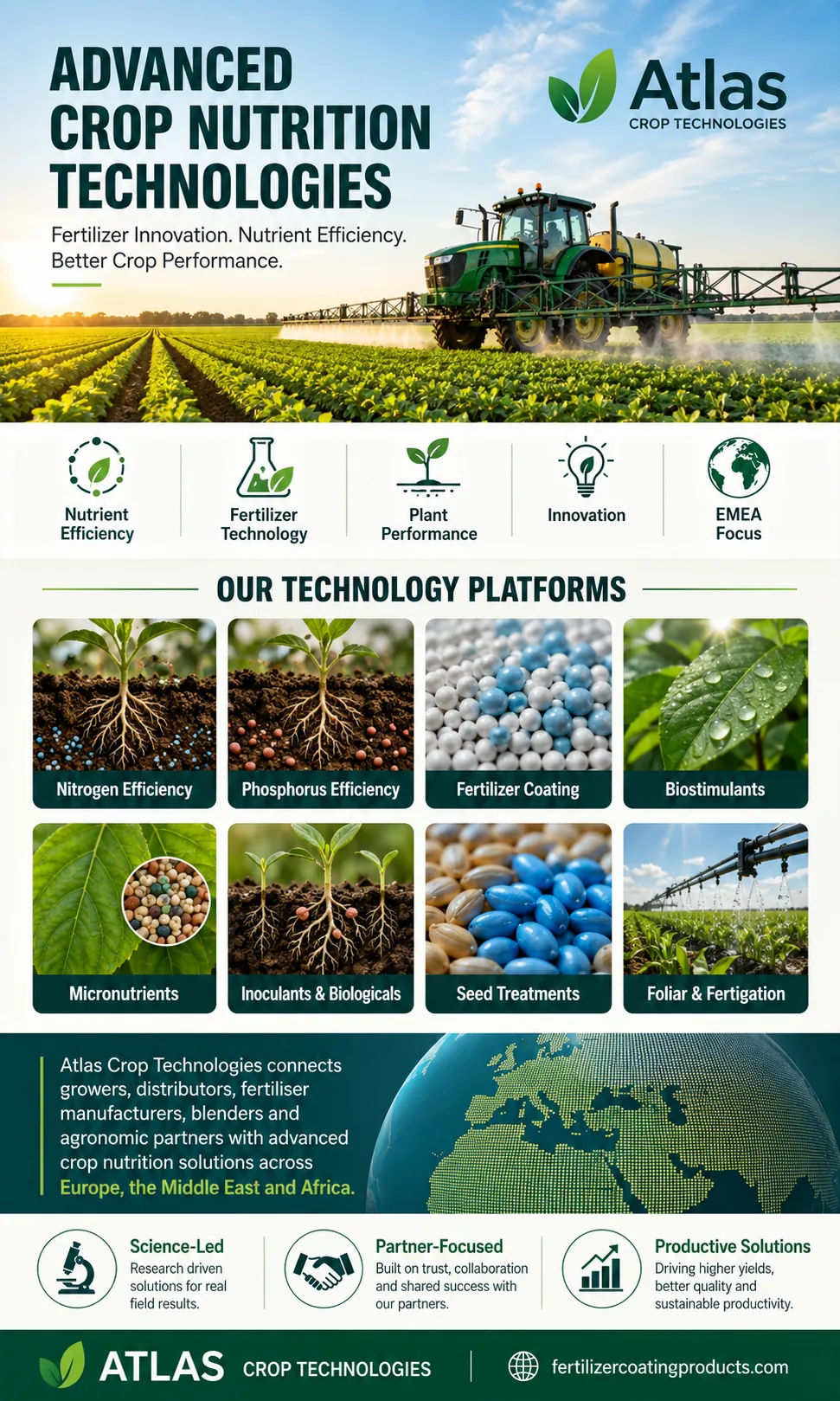
Atlas Crop Technologies connects growers, distributors, fertiliser manufacturers, blenders and agronomic partners with advanced nutrient-use, fertiliser-enhancement, biological and crop-performance technologies across Europe, the Middle East and Africa.

Modern crop nutrition is about more than the amount of fertiliser applied. Performance also depends on nutrient form, availability, placement, timing, root access, plant uptake, biological activity and the environmental conditions surrounding the crop.

Our portfolio brings together technologies for nitrogen and phosphorus efficiency, biostimulation, micronutrient nutrition, biological inoculation, seed treatment, fertigation, foliar programs and fertiliser enhancement. Our role is to help partners identify where those technologies fit and how they can be integrated into practical crop nutrition programs.
Explore Products
Advanced crop nutrition and fertiliser technologies from Atlas Crop Technologies
Global crop technology. Local commercial support. Rotterdam · Istanbul · Dubai · Casablanca · Nairobi · Johannesburg
Why Atlas Crop Technologies

A focused portfolio for modern crop nutrition.

From nitrogen and phosphorus efficiency to micronutrients, inoculants, seed treatments and biostimulants, our portfolio is built around one practical goal: helping crop nutrition programs perform with greater precision.

01

Focused crop nutrition portfolio

Our portfolio spans multiple stages of the crop nutrition system, including fertiliser-associated technology, root-zone nutrition, biological inoculation, seed-applied technology and foliar crop support.

This allows customers to investigate technologies according to the agronomic objective and application route rather than relying on a single product category.

02

Regional reach. Commercial agility.

With offices in Rotterdam, Istanbul, Dubai, Casablanca, Nairobi and Johannesburg, we support customers across diverse crops, climates, regulatory environments and distribution channels.

Local conditions matter. Product availability, registration, crop positioning and commercial requirements can vary substantially between markets.

03

Built around agronomy, logistics and long-term value

We combine technical product understanding with responsive commercial support so partners can select, position and integrate the right technologies for their markets.

A useful technology must fit both the agronomic objective and the practical realities of manufacturing, distribution, application and customer support.

30 Crop nutrition products
6 Regional offices
7 Website languages
EMEA Europe · Middle East · Africa
Technology Areas

Technologies for different nutrient and crop-performance objectives.

No single technology solves every crop nutrition challenge. Our portfolio covers distinct mechanisms and delivery systems so the starting point can be the problem that needs to be addressed.

N

Nitrogen efficiency

Nitrogen is essential to crop growth but can move through several chemical and biological forms after application.

Our portfolio includes nitrogen fertiliser-enhancement and nitrogen management technologies, together with biological inoculant products associated with nitrogen fixation in selected legume programs.

P

Phosphorus efficiency

Phosphorus availability can be influenced by soil pH, mineralogy, fertiliser placement, root development and interactions around the fertiliser application zone.

Atlas offers technologies positioned around phosphorus fertiliser enhancement, phosphorus availability and phosphorus-use efficiency.

BIO

Biostimulants

Our portfolio includes biostimulant technologies positioned around plant metabolism, root development, nutrient uptake, crop establishment, crop quality and other product-specific objectives.

Individual product positioning and approved claims should always be confirmed for the relevant market.

µ

Micronutrients

Micronutrients support essential plant functions even though they are required in relatively small quantities.

Atlas lists granular, foliar, in-furrow and seed-applied micronutrient technologies across the portfolio.

MIC

Biological inoculants

Biological inoculants introduce selected microorganisms for defined crop applications.

Our portfolio includes peat, liquid, clay-based pre-inoculant and multi-strain approaches for selected legume programs.

ST

Seed treatments

Seed application places technology at the earliest stage of crop establishment.

Atlas seed-treatment products include nutrient, micronutrient and biostimulant technologies, while several inoculants are also positioned for seed application.

From Fertiliser to Crop

Crop nutrition performance depends on the entire nutrient journey.

Nutrient efficiency is shaped by what happens before, during and after application. The technology must match the point in that journey where improvement is needed.

01

Fertiliser selection

Nutrient source, grade, physical form and chemistry influence how a fertiliser behaves during handling, application and after it reaches the soil or crop.

02

Technology integration

Supporting technologies may be incorporated into fertiliser treatment, foliar programs, irrigation systems, in-furrow applications, seed treatments or biological inoculation.

03

Application quality

Accurate rate, uniform distribution, correct timing and appropriate equipment are fundamental to getting value from both fertiliser and supporting technologies.

04

Nutrient availability

Soil chemistry, nutrient transformations, moisture and biological activity influence the pool of nutrition available to plant roots.

05

Root access

Nutrients must be within reach of an active root system. Root distribution, soil structure, moisture, salinity and placement can all affect crop access.

06

Plant utilisation

Once absorbed, nutrients support plant metabolism, growth, reproductive development and crop quality. Crop response is therefore the result of the entire system rather than one isolated input.

Application Routes

One portfolio. Multiple pathways into the crop program.

Atlas products are listed across six principal application categories, allowing technology to be integrated at different points in the fertiliser and crop-management system.

01

Broadcast

Broadcast products include technologies associated with broad-acre fertiliser application, granular nutrition and nitrogen or phosphorus efficiency programs.

02

Foliar

Foliar products include nutrient complexes, biostimulants and nutrient-focused technologies applied to above-ground crop surfaces.

03

Fertigation

Fertigation technologies are designed for integration into irrigation and soluble nutrient programs, subject to product-specific compatibility and use directions.

04

In-Furrow

In-furrow applications place technology close to the developing root zone and can be relevant to phosphorus, micronutrient or other root-zone programs.

05

Inoculant

Inoculant products introduce selected biological technologies into defined crop programs, particularly selected legume systems.

06

Seed Treatment

Seed treatment places technology directly on seed, creating an early application point for nutrient, biostimulant or biological functions.

Nitrogen Management

Helping position nitrogen more deliberately.

Nitrogen is fundamental to crop growth, but nitrogen fertilisers can undergo multiple transformations following application. Effective management considers fertiliser source, application route, soil, moisture, weather and crop demand.

01

Urea-based fertilisers

Surface-applied urea behaves differently from incorporated fertiliser or liquid nitrogen systems. Technologies developed for urea programs should therefore be matched to the intended fertiliser source and application method.

02

Liquid nitrogen programs

Liquid nitrogen fertilisers create different handling and application conditions. Atlas includes nitrogen-management technology listed for liquid systems such as UAN.

03

Biological nitrogen fixation

In selected legume systems, biological inoculation provides a different nitrogen-management pathway by supporting the crop-microbe relationship associated with biological nitrogen fixation.

Phosphorus Management

Supporting crop access to a relatively immobile nutrient.

Phosphorus plays an important role in crop establishment, root development and plant metabolism, but its availability can be affected by soil chemistry, fertiliser placement and root-zone conditions.

01

Fertiliser-associated phosphorus technology

Products such as AVAIL® are positioned around phosphorus fertiliser enhancement and maintaining applied phosphorus availability.

02

Root-zone phosphorus technology

Products such as Phree-Up® are positioned around phosphorus availability in the root-zone environment through fertigation or in-furrow application.

03

Crop-focused phosphorus technology

Products such as Steric® P are positioned around phosphorus-use efficiency and crop performance in foliar and fertigation programs.

Biological & Seed-Applied Technologies

Start crop support where establishment begins.

Seed and biological technologies allow crop nutrition programs to begin at the earliest stage of crop development.

01

Biological inoculation

Atlas lists multiple inoculant technologies for selected legume programs, including peat, liquid, clay-based pre-inoculant and multi-strain approaches.

02

Seed-applied biostimulants

Seed-applied biostimulant technologies are positioned around early crop development, roots, nutrient use and crop establishment according to the individual product.

03

Seed-applied micronutrients

Micronutrient seed treatments provide another pathway for placing selected nutrition close to the emerging seedling.

04

Treatment compatibility

Seed-treatment compatibility should never be assumed. Biological, nutrient and other seed-applied products should be handled according to current product-specific directions.

05

Application quality

Accurate dose, uniform coverage, treatment equipment and seed handling all contribute to consistent commercial application.

06

Market-specific positioning

Crop registrations, application directions and availability can differ between markets, particularly for biological and seed-treatment products.

Foliar & Fertigation Programs

Technologies that integrate with intensive crop nutrition systems.

Foliar and fertigation pathways allow crop nutrition technology to be positioned during specific crop-development periods and within different production systems.

01

Foliar nutrient complexes

The Atlas portfolio includes foliar nutrient complexes positioned around nutrient uptake, roots, establishment, plant metabolism and crop quality.

02

Foliar biostimulation

Several products combine foliar application with biostimulant positioning, offering technologies intended to support crop physiological or nutrient performance.

03

Fertigation enhancement

Fertigation products can be incorporated into irrigation-based nutrition programs, subject to appropriate product and system compatibility.

04

Water quality

Water chemistry can influence fertigation and foliar compatibility. Product-specific instructions should be reviewed before preparing mixtures.

05

Application timing

Crop stage and intended objective should guide when a foliar or fertigation technology is positioned in the crop program.

06

Integrated nutrition

Foliar and fertigation technologies should complement the underlying fertility program rather than be treated as substitutes for balanced crop nutrition.

Who We Support

Technology support across the crop nutrition value chain.

The technical and commercial questions change depending on whether the customer manufactures fertiliser, blends products, distributes crop inputs, advises growers or manages crops directly.

01

Fertiliser manufacturers

Discuss nutrient-efficiency, fertiliser enhancement, treatment systems, compatibility, commercial positioning and market requirements.

02

Fertiliser blenders

Evaluate technologies for local nutrient programs while considering blending practicality, physical quality and application pathways.

03

Distributors

Build market-relevant crop nutrition portfolios around crop needs, customer segments, product registrations and local commercial demand.

04

Seed companies

Explore inoculant, micronutrient, nutrient and biostimulant technologies associated with seed-treatment programs.

05

Agronomists

Use crop, nutrient, soil, application and product information to determine where technologies fit within complete crop-management programs.

06

Growers

Start from the crop and agronomic objective, then identify which technology category may be relevant to the production system.

Technology Selection

Start with six questions before choosing a product.

Good technology selection begins with context. The more specific the information, the easier it is to narrow the portfolio.

01

Which crop?

Crop species, growth stage and production system influence nutrient requirements and product suitability.

02

Which objective?

Define whether the objective is nitrogen efficiency, phosphorus availability, micronutrient nutrition, roots, establishment, biological nitrogen fixation or another target.

03

Which fertiliser source?

Granular urea, liquid nitrogen, NPK, soluble fertiliser and other sources create different technical environments.

04

Which application method?

Broadcast, foliar, fertigation, in-furrow, inoculant and seed-treatment routes require different technologies.

05

Which market?

Country is important because product availability, registration, permitted claims and labels can differ.

06

Which commercial role?

Manufacturers, blenders, distributors, agronomists and growers may require different formats of technical and commercial support.

Our Technology Approach

Understand the problem before promoting the solution.

Product technology is most useful when its intended function matches an identified agronomic or operational constraint.

01

Define the mechanism

Understand whether the technology is intended to affect nutrient availability, fertiliser performance, crop physiology, root development, biological interaction or nutrient delivery.

02

Evaluate the evidence

Product data should be interpreted according to crop, soil, environment, application method and comparison treatment.

03

Check operational fit

A technology must be practical to manufacture, blend, store, transport or apply using the customer's actual systems.

04

Respect local variability

Crop response can differ between regions, soils, seasons and management systems.

05

Communicate accurately

Product positioning should remain consistent with the available evidence, current labels and local registrations.

06

Build long-term value

Technologies and partnerships are strongest when they create repeatable agronomic and commercial relevance over time.

Sustainable Crop Nutrition

Productivity and stewardship should advance together.

Efficient crop nutrition can help growers get more value from applied nutrients while supporting responsible management of soil, water, fertiliser and other farm resources.

01

Nutrient efficiency

Match source, rate, timing, placement and technology to crop demand and local agronomic conditions.

02

Soil stewardship

Soil chemistry, structure, organic matter, moisture and root-zone conditions all influence nutrient availability and crop response.

03

Water stewardship

Rainfall, irrigation, drainage and water quality can affect nutrient movement, root activity and crop uptake.

04

Balanced nutrition

Efficient crop production requires attention to the complete nutrient requirement rather than focusing on one nutrient in isolation.

05

Responsible product use

Technology should be stored, handled and applied according to current labels and relevant product-specific directions.

06

Practical economics

Agricultural sustainability also depends on whether technologies are operationally and economically workable for the businesses using them.

Our Values

Useful technology. Clear advice. Long-term relationships.

Our values shape how we evaluate technologies, communicate with partners and develop business across diverse agricultural markets.

01

Scientific curiosity

We ask how and why technologies work, where evidence is strongest and where local validation matters.

02

Commercial integrity

We communicate clearly about product fit, availability, label requirements and limitations.

03

Partnership mindset

We work for durable relationships with growers, distributors, blenders, manufacturers and agronomic partners rather than one-off transactions.

Regional Perspective

Crop nutrition changes with geography.

Europe, the Middle East and Africa include highly diverse agricultural systems. Our regional structure is intended to support technology discussions with that local context in mind.

EU

Europe

European markets include cereals, oilseeds, maize, horticulture, vineyards, orchards, specialty crops and intensive fertiliser programs operating across diverse soils and regulatory systems.

ME

Middle East

Irrigation, high temperatures, calcareous soils, salinity and fertigation can make water quality and root-zone nutrient availability especially important considerations.

AF

Africa

African agriculture spans large commercial operations, high-value crops and smallholder systems across widely different rainfall patterns, soils, infrastructure and fertiliser markets.

Regional Offices

Six offices. One connected regional network.

Our regional presence helps connect global crop nutrition technology with local commercial and agronomic context.

Rotterdam Netherlands
Istanbul Türkiye
Dubai United Arab Emirates
Casablanca Morocco
Nairobi Kenya
Johannesburg South Africa
Local Commercial Support

Regional presence for different agricultural markets.

Our six-office structure provides contact points across major EMEA agricultural regions.

01

Rotterdam

Regional presence supporting European crop nutrition customers and international fertiliser-market engagement.

02

Istanbul

Regional connection point for Türkiye and surrounding European, Mediterranean and neighbouring agricultural markets.

03

Dubai

Commercial support point for Middle Eastern markets and regional agricultural partners.

04

Casablanca

Regional presence supporting agricultural markets and commercial relationships in Africa.

05

Nairobi

Regional support for East African crop-production and crop-input markets.

06

Johannesburg

Regional presence supporting crop nutrition markets and partners across Southern Africa.

Multilingual Reach

Seven website languages for an international market.

The Atlas website supports seven language pathways to make portfolio information more accessible across the regions we serve.

EN

English

Primary international website language.

FR

Français

French-language site pathway for relevant markets and partners.

AR

العربية

Arabic-language site pathway for relevant Middle Eastern and regional audiences.

TR

Türkçe

Turkish-language site pathway.

ES

Español

Spanish-language site pathway.

DE / IT

Deutsch · Italiano

German and Italian site pathways complete the seven-language website structure.

From Enquiry to Market

A structured way to start a technology conversation.

Whether the requirement is agronomic or commercial, providing the right information early can make product evaluation more focused.

01

Define the opportunity

Identify the country, crop, customer segment, fertiliser program or agronomic need.

02

Identify the technology area

Determine whether the requirement relates to nitrogen, phosphorus, micronutrients, biostimulation, biologicals, seed treatment or another crop nutrition category.

03

Confirm application route

Broadcast, foliar, fertigation, in-furrow, inoculant and seed-treatment pathways lead to different product options.

04

Check market fit

Product availability, registration, label directions and commercial formats should be confirmed for the intended market.

05

Evaluate practical integration

Manufacturing, blending, storage, application, compatibility and customer support all influence commercial fit.

06

Build long-term support

Product positioning can continue to develop as local experience, customer feedback and market knowledge increase.

Responsible Product Use

Product value depends on correct use.

Portfolio information is intended to help customers understand technology categories. Current approved product labels remain the primary reference for market-specific use.

01

Confirm registration

Product legal status and approved uses can differ by country.

02

Read the current label

Follow approved rates, crops, application methods, precautions and directions.

03

Check compatibility

Do not assume that products can be combined simply because they share an application category.

04

Store correctly

Product-specific storage requirements should be followed, particularly for biological technologies.

05

Apply accurately

Correct equipment calibration, dose and distribution support consistent product use.

06

Ask when uncertain

Contact Atlas with the country and product of interest when market-specific information is required.

Start a Conversation

Tell us what you want your crop nutrition program to achieve.

Share your country, crop, fertiliser program, application route, product interest or distribution requirement. Our team can route your enquiry to the appropriate regional contact and help identify the most relevant technology category to explore.

FAQ

Frequently Asked Questions

General information about Atlas Crop Technologies, our crop nutrition portfolio, regional support and product availability.

Atlas Crop Technologies connects growers, distributors, fertiliser manufacturers, blenders and agronomic partners with advanced crop nutrition technologies across Europe, the Middle East and Africa.

Our portfolio spans nutrient-efficiency, fertiliser-enhancement, biostimulant, micronutrient, biological inoculant and seed-treatment categories.

Our portfolio includes nitrogen and phosphorus efficiency technologies, biostimulants, micronutrients, inoculants, seed treatments and related crop nutrition solutions.

The product portfolio presented on the Atlas website currently contains 30 products.

You can browse the complete portfolio on the Products page and filter products by application route.

Products are listed across Broadcast, Foliar, Fertigation, In-Furrow, Inoculant and Seed Treatment application categories.

Some technologies are associated with more than one application route.

Yes. The portfolio includes nitrogen fertiliser-enhancement and nitrogen-management technologies for different fertiliser systems.

Atlas also offers biological inoculants associated with nodulation and biological nitrogen fixation in selected legume programs.

Yes. The portfolio includes products positioned around phosphorus fertiliser enhancement, phosphorus availability and phosphorus-use efficiency.

Yes. Several Atlas products are described as biostimulant or nutrient-biostimulant technologies.

They are represented across foliar, fertigation and seed-treatment categories and have different product-specific positioning.

Yes. The portfolio includes granular, foliar, in-furrow and seed-applied micronutrient technologies.

Yes. Atlas lists inoculant products for selected legume programs, including peat, liquid, clay-based pre-inoculant and multi-strain approaches.

Yes. The portfolio includes seed-applied nutrient, micronutrient and biostimulant technologies.

Several biological inoculants are also positioned for seed treatment.

We support customers through offices in Rotterdam, Istanbul, Dubai, Casablanca, Nairobi and Johannesburg, serving markets across Europe, the Middle East and Africa.

Crop systems, soils, climate, irrigation practices, regulations and distribution structures differ across EMEA.

Regional presence helps connect the crop technology portfolio with local commercial and agronomic context.

The website provides language pathways for English, French, Arabic, Turkish, Spanish, German and Italian.

Yes. Atlas welcomes enquiries from fertiliser manufacturers interested in nutrient-efficiency, fertiliser-enhancement and related crop nutrition technologies.

Useful information includes the fertiliser source, treatment route, intended technology function and target market.

Yes. We welcome enquiries from fertiliser blenders looking to evaluate nutrient-efficiency, micronutrient and other crop nutrition technologies within local fertiliser programs.

Yes. Distributor enquiries are welcome.

Tell us the country, crop focus, customer segment and technology area you are interested in so the enquiry can be routed to the appropriate regional contact.

Yes. Start by providing your country, crop, fertiliser source, application method and intended agronomic objective.

That information helps determine whether the relevant part of the portfolio relates to nitrogen, phosphorus, micronutrients, biostimulation, biological inoculation, seed treatment or another technology area.

No. Product availability, registration, approved crops, claims, application directions, rates and pack formats can differ by market.

Contact us with the country and product of interest for local information.

No. Website content provides general portfolio and product information.

Always read and follow the current approved product label and local use directions for crops, rates, application methods, precautions and permitted claims.

Include your country, company or organisation type, crop or customer focus, fertiliser program or application method, product or technology interest and the agronomic or commercial objective you want to discuss.

The more specific the information, the easier it is to route the enquiry to the appropriate regional contact and relevant technology category.

Atlas Crop Technologies

Find the technology that fits the program.

Explore our 30-product crop nutrition portfolio or start a conversation with the regional Atlas team. Whether your focus is fertiliser efficiency, phosphorus availability, nitrogen management, micronutrients, biostimulation, biological inoculation, seed treatment, fertigation or distribution, begin with the crop and commercial objective.

View Product Portfolio

Trademark Notice: All products featured on this website are registered trademarks of Verdesian Life Sciences.

Thank you — your message has been sent.