Apply
Nitrogen enters the production system through fertiliser sources selected according to the crop, field, application equipment and nutrient-management strategy.
Trademark Notice: All products featured on this website are registered trademarks of Verdesian Life Sciences.
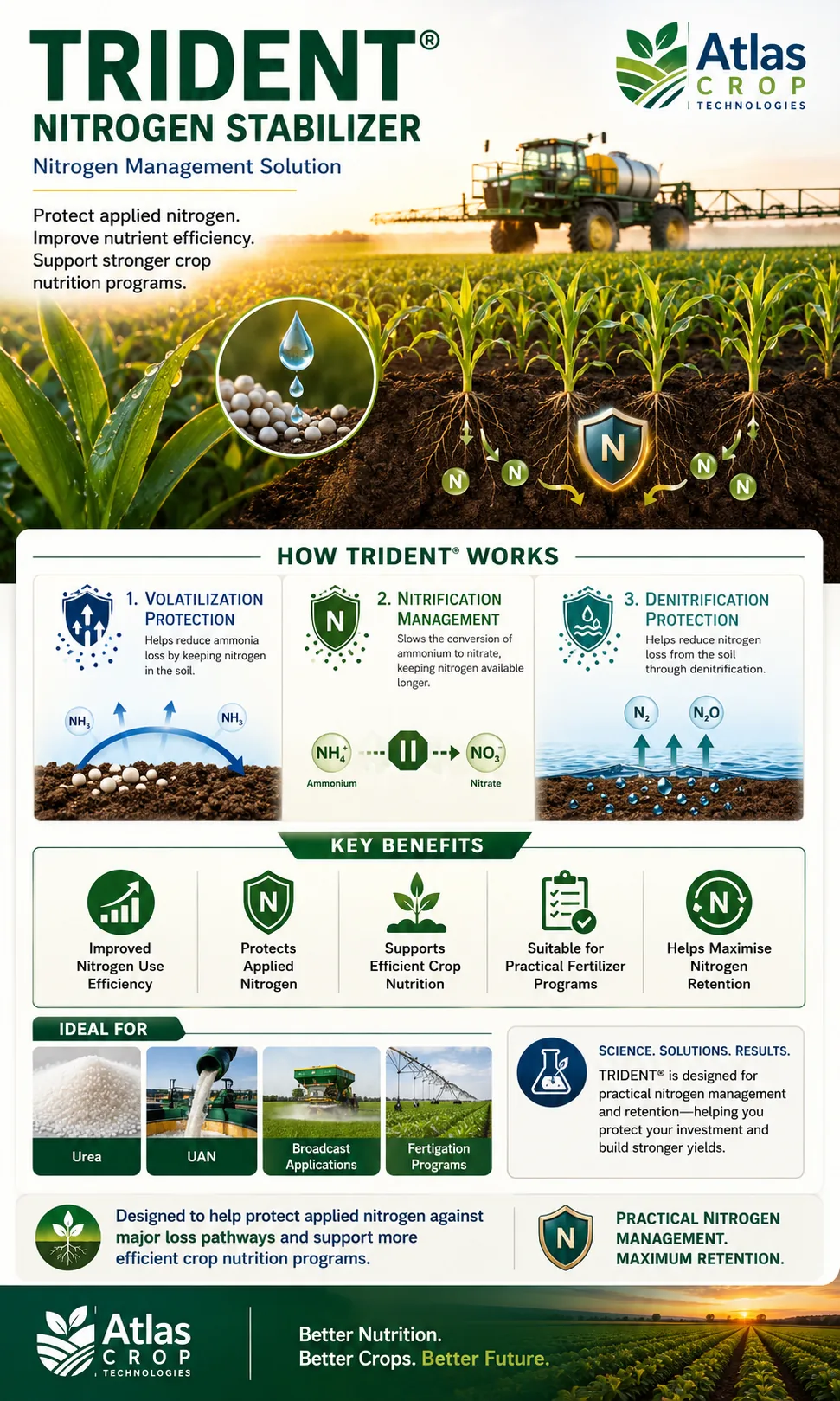
A nitrogen stabilization solution designed to help protect the nitrogen investment by addressing three important pathways of nitrogen loss: volatilization, nitrification and denitrification.
Trident® is positioned within professional nitrogen-management programs to help improve nitrogen use efficiency, retain more applied nitrogen within the crop production system and support practical nutrient-management strategies across changing soil and environmental conditions.
*Product formulation, fertilizer compatibility, registration, rate and application directions vary by country and Trident® formulation. Always confirm the current approved local label before use.
Nitrogen is fundamental to crop growth, but the nitrogen applied to a field does not remain in one chemical form indefinitely. After application, fertiliser nitrogen enters a dynamic soil system influenced by microorganisms, temperature, moisture, soil characteristics and weather.
Depending on the nitrogen source and field conditions, part of an applied nitrogen investment can be exposed to pathways that reduce the amount remaining available within the intended crop nutrition system. Nitrogen stabilizers are designed to help manage this risk.
Trident® is Verdesian Life Sciences nitrogen stabilization technology positioned around three major nitrogen-loss processes: volatilization, nitrification and denitrification. This multi-pathway approach is designed to support nitrogen retention and nitrogen use efficiency rather than focusing on only one potential loss mechanism.
The technology should be viewed as one component of a complete nitrogen program. Nitrogen source, rate, placement, timing and agronomic management remain fundamental decisions and should be matched to crop demand, local soils, production system, weather risk and regulatory requirements.
Nitrogen behaves differently from relatively immobile nutrients because nitrogen compounds can transform biologically and chemically after application. The practical goal of nitrogen management is to align nutrient availability with crop demand while reducing unnecessary opportunities for loss.
Nitrogen enters the production system through fertiliser sources selected according to the crop, field, application equipment and nutrient-management strategy.
Once in the soil environment, nitrogen compounds can change form through chemical and microbial processes influenced by moisture, temperature and soil.
Depending on conditions, nitrogen may become vulnerable to gaseous loss, conversion to more mobile forms or loss under saturated soil conditions.
Effective nutrient management seeks to maintain an appropriate supply of nitrogen for crop uptake during important growth and yield-development periods.
Nitrogen stabilizers can contribute to a more efficient program, but they do not replace fundamental agronomy. Nitrogen rate, source, timing and placement, together with irrigation, drainage, soil characteristics, crop demand and weather, continue to influence the performance of the overall nitrogen program.
Verdesian positions the Trident® platform around three important mechanisms associated with nitrogen loss. Their relevance varies according to nitrogen source, soil conditions, weather and application strategy.
Volatilization refers to loss of nitrogen to the atmosphere as ammonia gas. The risk can be particularly relevant when urea-containing nitrogen is surface applied and remains unincorporated under conditions favourable to ammonia loss.
Management decisions may include nitrogen source, treatment, incorporation, irrigation or rainfall timing and application conditions.
Nitrification is the microbial conversion of ammonium nitrogen toward nitrate. Nitrate is an important crop-available nitrogen form, but it is also more mobile in soil than ammonium.
When nitrate production occurs well ahead of crop uptake, changing moisture conditions can increase exposure to movement below the active root zone or denitrification.
Denitrification occurs when soil microorganisms convert nitrate nitrogen into gaseous forms under conditions that commonly include limited soil oxygen and elevated moisture.
Poor drainage, prolonged saturation, compaction and intense rainfall or irrigation can increase the agronomic importance of this pathway in susceptible situations.
The actual soil nitrogen cycle is complex, but the simplified pathway below helps explain why nitrogen-management technologies are considered alongside fertiliser source, placement and timing.
Urea undergoes enzymatic conversion after application. Under some surface application conditions, the chemistry around dissolving urea can favour ammonia volatilization before nitrogen moves sufficiently into the soil.
Technologies based on urease inhibition are designed to slow the relevant enzymatic process for a period of time, helping create a wider management window for incorporation by rainfall, irrigation or other means.
Ammonium nitrogen can be converted to nitrate through soil microbial activity. The rate depends on conditions including soil temperature, moisture, aeration and microbial activity.
Nitrification-management strategies are designed to influence this conversion process so that nitrogen remains in the ammonium pool for longer where agronomically appropriate.
Published Verdesian information describes the Trident® platform as combining established nitrogen-stabilization actives with proprietary co-polymer and formulation technology. Exact composition varies by product and registration.
Published Trident® information identifies NBPT within the technology platform. NBPT is used in nitrogen-management products to inhibit urease activity for a period after application.
This type of technology is particularly associated with management of ammonia volatilization risk from urea-containing fertilisers.
Published Verdesian information also identifies DCD within the Trident® platform. DCD is used in nitrification-management systems to influence microbial conversion of ammonium nitrogen toward nitrate.
Maintaining nitrogen in ammonium form for a longer period can help manage exposure to nitrate-related loss pathways under appropriate conditions.
Verdesian describes Trident® as incorporating proprietary co-polymer and solvent technology alongside traditional nitrogen-stabilization actives.
Formulation engineering is an important part of commercial stabilizer performance because active ingredients must remain stable, manageable and appropriately distributed within the intended fertiliser system.
Trident® is presented as a product platform rather than a single universal formulation. Different markets and nitrogen programs may therefore use different registered formulations.
For this reason, product selection should be based on the actual fertiliser source, intended application method, local registration and current technical documentation.
The value of nitrogen stabilization depends on the nitrogen source, environmental loss risk, crop demand, application timing and field conditions. Trident® should therefore be evaluated within the complete nutrient-management program.
A nitrogen investment creates value only when sufficient nitrogen remains available to contribute to crop nutrition. Stabilization aims to manage the biological and chemical processes that can create a mismatch between fertiliser application and crop uptake.
Nitrogen source influences the loss pathways that are agronomically relevant. Product selection and use must therefore start with the actual fertiliser being treated or applied.
Granular urea is widely used because of its high nitrogen concentration, handling characteristics and flexibility. When surface applied, however, nitrogen from urea may be vulnerable to volatilization before adequate incorporation under certain conditions.
Published Verdesian Trident® information includes use with urea fertiliser. The actual Trident formulation, treatment rate, mixing method, treated fertiliser handling and local use directions must be confirmed before use.
Urea-ammonium nitrate solutions contain nitrogen in more than one form. This means the management strategy may need to consider both urea-related volatilization risk and transformations involving ammonium and nitrate.
Published Verdesian information describes Trident® formulations for UAN. Use should be based on the formulation registered in the relevant country, local label directions, fertiliser analysis and application system.
Do not assume that a Trident® product registered for urea or UAN is automatically approved with every nitrogen source. Ammonium sulphate, ammonium nitrate, calcium ammonium nitrate, liquid speciality fertilisers and other nitrogen formulations can have different chemistry and regulatory directions. Confirm compatibility and label approval before treatment.
Atlas Crop Technologies positions Trident® for Broadcast and Fertigation applications subject to the product registered in the target market. Exact rates and procedures must come from the current approved label.
Confirm whether the program uses granular urea, UAN or another nitrogen source and verify that the specific Trident® formulation is approved for that fertiliser.
Consider placement, soil moisture, irrigation, rainfall forecast, temperature, residue, drainage and other conditions influencing the likely nitrogen-loss pathways.
Review the current product label for rate, mixing sequence, agitation, treatment procedure, permitted combinations and all handling directions.
Use properly calibrated equipment and appropriate operating procedures to achieve uniform treatment or distribution according to the approved application method.
Broadcast nitrogen applications offer operational efficiency across large crop areas, but surface placement can leave certain nitrogen sources exposed to environmental conditions before incorporation.
In urea-based programs, the interval between application and sufficient incorporation can be an important consideration. Weather conditions, crop residue, soil properties and temperature all influence potential volatilization risk.
Trident® can be evaluated as part of a broadcast nitrogen strategy where the current registered formulation and label support the planned fertiliser source and use.
Fertigation allows nitrogen to be delivered through irrigation systems, potentially providing flexibility to coordinate nutrient timing with crop development. The appropriate stabilization approach depends on the nitrogen source, irrigation system, injection method, water chemistry and registered use directions.
Trident® is listed by Atlas Crop Technologies for fertigation positioning, subject to the approved local formulation and label.
Before use, the complete mixture should be evaluated for compatibility, including other fertilisers, crop protection products, acids, biologicals or water-conditioning inputs that may be introduced through the same system.
Soil temperature influences biological activity and nitrogen transformation. Warmer conditions can accelerate several processes involved in the nitrogen cycle where moisture and other conditions are suitable.
Water can benefit nitrogen incorporation and crop uptake, but excessive rainfall or irrigation can also increase nitrogen movement and create saturated conditions associated with additional loss risk.
Soil saturation and restricted oxygen can create conditions more favourable to denitrification once nitrogen is present as nitrate.
Soil texture, organic matter, infiltration, compaction and drainage characteristics influence nitrogen movement, transformation and root access.
Crop residues can influence fertiliser-soil contact and the microenvironment surrounding surface-applied urea, affecting practical nitrogen-management decisions.
The closer nutrient availability is aligned with crop demand, the less time nitrogen may spend exposed to field-loss pathways before plant uptake.
A nitrogen stabilizer is not a substitute for sound nutrient-management decisions. Product use should complement appropriate decisions around source, rate, timing and placement.
Select a nitrogen fertiliser and stabilization strategy that fit the crop, soil, equipment, climate and application system.
Determine nitrogen requirement using realistic crop demand, soil and nutrient information, local recommendations and applicable regulation.
Coordinate nutrient availability with crop uptake while considering logistics, weather and the risk of nitrogen loss before crop demand.
Place nitrogen where it can effectively enter the crop production system while managing practical exposure to potential loss pathways.
Trident® can complement these decisions by adding nitrogen stabilization to an appropriately designed fertiliser program. The technology does not establish the correct nitrogen rate and should not be used to justify nitrogen applications beyond agronomic or regulatory requirements.
Where urea is broadcast and immediate incorporation is uncertain, potential volatilization is an important issue to evaluate when designing the nitrogen program.
Weather uncertainty can complicate nitrogen timing and create situations in which fertiliser remains exposed longer than planned or is subjected to unexpectedly wet soil conditions.
Fields susceptible to saturation may experience conditions associated with denitrification once sufficient nitrate is present in the soil.
When nitrogen is applied significantly ahead of peak crop demand, the period during which the nutrient is exposed to transformation and loss processes can become an important management consideration.
When nitrogen fertiliser represents a substantial portion of crop input expenditure, improving the efficiency and protection of that investment can become commercially important.
Stabilization can form part of a broader strategy incorporating soil testing, split application, variable-rate fertilisation, fertigation, tissue analysis and other nutrient-management practices.
Commercial fertiliser programs may contain several components, including nitrogen, phosphorus, potassium, sulphur, micronutrients, crop protection products, biologicals, adjuvants or water-conditioning materials.
A product being compatible with one nitrogen source does not automatically establish compatibility with every mixture. Concentration, temperature, water quality, mixing order, storage time and formulation chemistry can all influence physical compatibility.
Best practice: use the current Trident® label and technical documentation for mixing order, fertilizer compatibility and handling instructions. Where a combination is not specifically documented, obtain qualified technical guidance before preparing commercial quantities.
Start with realistic yield objectives, previous crop, available soil nitrogen, organic sources, irrigation water where relevant and local nutrient-management recommendations.
Select nitrogen source, placement, timing and stabilization strategy according to field-loss risks and operational requirements.
Crop scouting, tissue testing, canopy observations, weather records and other decision-support tools can help evaluate whether the planned nutrient program remains aligned with crop development.
Efficient nutrient management aims to increase the proportion of applied nutrients that contributes to productive crop growth while reducing unnecessary movement outside the intended production system.
Nitrogen stabilization can support this objective by helping manage specific processes associated with nitrogen loss. It should be combined with appropriate fertiliser rates, agronomic timing, responsible irrigation, soil management and other nutrient stewardship practices.
A detailed enquiry allows our team to understand the application and route your question to the most appropriate regional or technical contact.
Discuss nitrogen source, application timing, field-loss risk and where stabilization technology may fit within the complete crop program.
Review product compatibility, treatment workflow, storage considerations, market requirements and technical positioning.
Explore market access, product portfolio fit, commercial supply requirements and regional development opportunities.
Evaluate Trident® as part of broader nutrient use efficiency and advanced fertiliser programs for relevant crops and production systems.
Build nutrient-management programs around crop requirements, nutrient source, soil chemistry, application timing and regional agronomic objectives.
A micronutrient seed treatment designed to support early nutrient supply, emergence, root development and crop establishment.
View Product → FoliarA foliar biostimulant with chelated zinc designed to support nutrient use efficiency, root development and stronger crop establishment.
View Product → BroadcastA phosphorus fertiliser enhancer designed to reduce phosphorus fixation and keep more applied phosphorus available for crop uptake.
View Product →Tell us about your crop, nitrogen source, application method, market or distribution requirement. Atlas Crop Technologies will route your enquiry to the appropriate regional contact.
The information below explains general product positioning and nitrogen management. The current approved local label remains the authoritative source for legal product use.
Trident® is a nitrogen stabilization and nitrogen-management technology from Verdesian Life Sciences. It is designed for integration with nitrogen fertiliser programs to help protect applied nitrogen against important loss pathways and support nitrogen use efficiency.
A nitrogen stabilizer is used with nitrogen fertiliser to influence specific chemical or biological processes that can expose applied nitrogen to loss.
Different stabilization technologies address different mechanisms. Product selection should therefore be matched to the nitrogen source, application method and field-loss risks.
Verdesian positions the Trident® platform around three important nitrogen-loss pathways:
When urea-containing fertiliser is applied to the surface, nitrogen can under certain conditions be lost as ammonia gas before adequate incorporation occurs.
Temperature, moisture, soil conditions, crop residue and the timing of rainfall or irrigation can influence this risk.
Nitrification is the biological conversion of ammonium nitrogen toward nitrate nitrogen. Nitrate is readily available to crops but is also more mobile in soil than ammonium and can be vulnerable to other loss pathways when environmental conditions are favourable.
Denitrification is a microbial process in which nitrate is converted into gaseous nitrogen forms. It becomes particularly relevant under conditions of reduced soil oxygen, often associated with wet or saturated soils.
Published Verdesian information describes the Trident® platform as incorporating established nitrogen-management active ingredients including NBPT and DCD together with proprietary co-polymer and solvent technology.
Exact formulation and active ingredient concentrations depend on the specific Trident® product and registration. Always consult the current local label.
NBPT is used in urease-inhibitor technologies intended to manage the enzymatic process involved in urea conversion following application. This approach is associated with management of ammonia volatilization risk from urea-containing nitrogen fertilisers.
DCD is used in nitrification-management technologies to influence the microbial transformation of ammonium nitrogen toward nitrate.
The agronomic objective is to manage nitrogen transformation where maintaining more nitrogen in the ammonium pool for a period may reduce exposure to nitrate-related loss pathways.
Published Verdesian information describes Trident® formulations for use with urea. The exact formulation, treatment rate, mixing procedure and permitted use must be confirmed from the current label applicable in your market.
Published Verdesian product information includes Trident® formulations for UAN nitrogen fertiliser. Product selection, rate, mixing and application instructions can differ by market and formulation.
No such assumption should be made. Nitrogen fertilisers differ chemically, and Trident® formulations have specific approved uses.
Confirm that the exact nitrogen fertiliser source appears within the current approved product directions before treatment or mixing.
Atlas Crop Technologies lists Broadcast and Fertigation among the application routes for Trident®. The exact method depends on the formulation, nitrogen source and local registration.
There is no single universal Trident® rate that should be applied across all formulations and countries. Rates depend on the exact product, nitrogen fertiliser, application system and local registration.
Use only the application rate stated on the current approved label for the Trident® product supplied in your market.
Trident® is a nitrogen-management technology, not a substitute for determining an agronomically appropriate nitrogen rate.
Nitrogen rate decisions should be based on crop demand, soil nitrogen, expected yield, previous crop, organic nutrient sources, local recommendations and regulatory requirements.
Trident® is positioned as a nitrogen stabilizer used alongside nitrogen fertiliser. It is intended to help manage nitrogen-loss processes rather than replace the crop's nitrogen fertiliser requirement.
Risk depends on the nitrogen form and field conditions. Examples include surface-applied urea before incorporation, nitrogen exposed to warm and biologically active soils for extended periods, and nitrate present during excessive rainfall or saturated soil conditions.
Yes. Temperature influences microbial activity and the rate of many nitrogen transformation processes. Moisture, oxygen status and other soil conditions interact with temperature, so risk should be evaluated as part of the complete field environment.
Yes. Appropriate rainfall can help incorporate some surface-applied nitrogen, while excessive rainfall can increase nitrate movement or create saturated soil conditions associated with denitrification risk.
Poorly drained soils can experience periods of saturation associated with higher denitrification risk. Whether a particular Trident® use is appropriate depends on nitrogen source, timing, crop, field conditions and the approved local label.
Compatibility must be confirmed for the specific products and mixture. Fertiliser chemistry, concentration, water quality, temperature and mixing order can influence compatibility.
Follow all relevant product labels and obtain qualified technical advice for mixtures not specifically covered by product documentation.
Product registration and use directions vary by country. Suitability also depends on the crop's nitrogen program and the fertiliser source being treated.
Confirm the local registration and agronomic fit before use.
No. Registration, formulation, product claims, active ingredient concentration, fertiliser compatibility, pack size and directions can vary substantially between countries.
Contact Atlas Crop Technologies for current availability and documentation applicable to your market.
Include your country, crop, nitrogen source, fertiliser analysis, planned nitrogen rate, application timing, application method, irrigation system where relevant, field conditions and any additional products intended for the fertiliser mixture.
Use the enquiry form on this page or email contact@fertilizercoatingproducts.com . Include your country, company, intended market and approximate commercial requirement so the enquiry can be routed to the appropriate Atlas Crop Technologies regional contact.
Trademark Notice: All products featured on this website are registered trademarks of Verdesian Life Sciences.