Energy Transfer
Phosphorus is incorporated into compounds involved in cellular energy transfer, making adequate phosphorus nutrition important during periods of active plant growth.
Trademark Notice: All products featured on this website are registered trademarks of Verdesian Life Sciences.
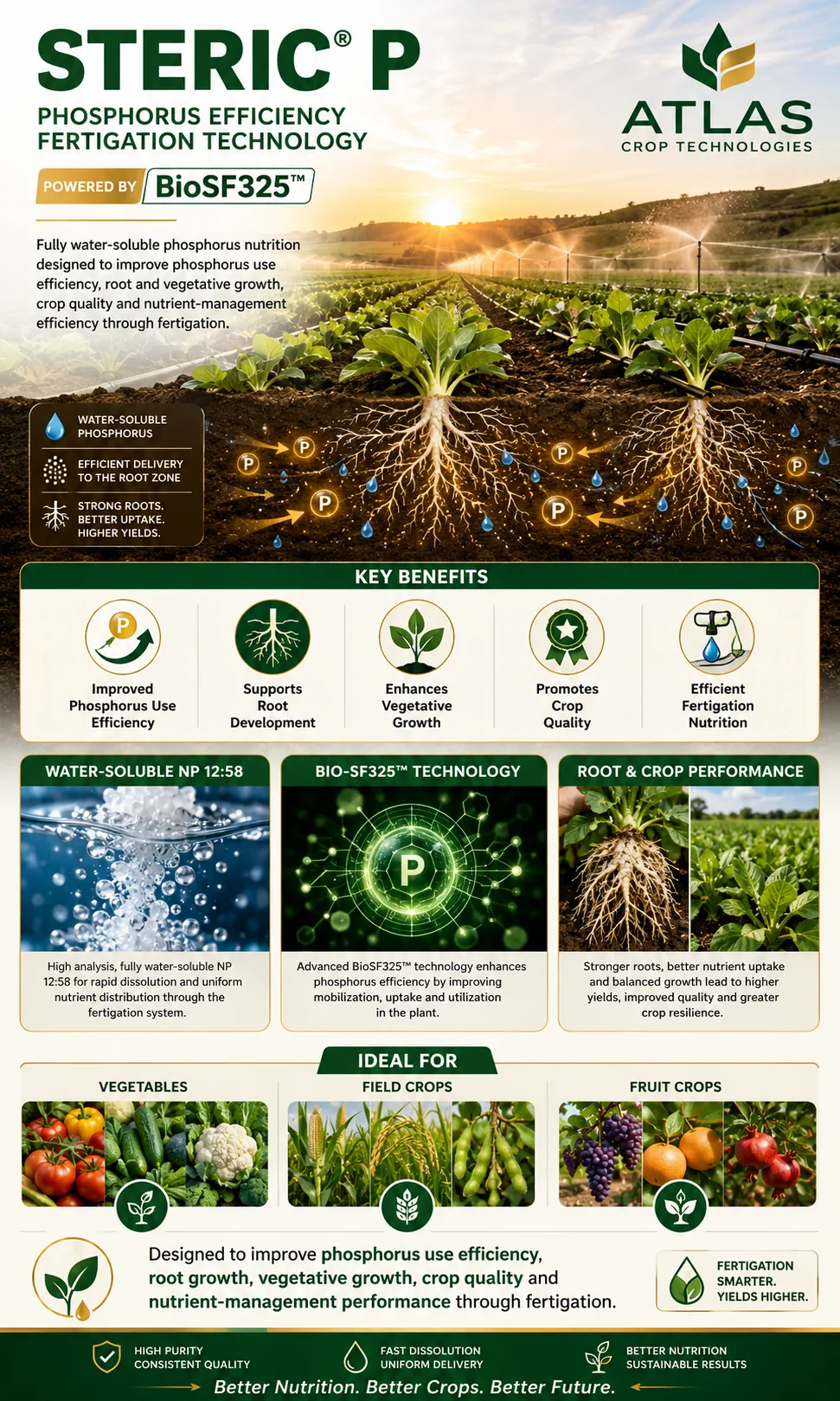
A fully water-soluble phosphorus nutrition technology containing BioSF325™ to improve phosphorus use efficiency, support stronger root and vegetative growth and contribute to improved fruit or seed quality.
Steric® P combines a high-phosphorus NP 12:58 formulation with BioSF325™ technology, whose four key components are designed to work synergistically within the plant to improve how efficiently phosphorus nutrition is used.
Current European Verdesian guidance specifies fertigation application only and explicitly states not to use Steric® P as a foliar treatment. Registration, analysis, rates and approved uses can vary by market.
Phosphorus is essential to crop development, but applying phosphorus does not automatically mean that every unit supplied will be used with equal efficiency by the plant.
Steric® P is designed around that challenge. Rather than focusing solely on the amount of phosphorus applied, the technology is positioned around improving phosphorus nutrient use efficiency within the plant.
The product contains BioSF325™ technology, described by Verdesian as a four-component system whose components act synergistically. Combined with a fully water-soluble NP 12:58 nutrient formulation, Steric® P is designed for phosphorus delivery through fertigation systems.
Published European product information links the technology with improved phosphorus use efficiency, stronger root and vegetative growth and better fruit or seed quality. This makes it relevant to fertigation programs seeking to improve both phosphorus nutrition and the efficiency with which applied phosphorus is used by the crop.
Phosphorus participates in fundamental plant processes associated with energy transfer, metabolism, root development, reproductive development and the formation of new tissues.
Phosphorus is incorporated into compounds involved in cellular energy transfer, making adequate phosphorus nutrition important during periods of active plant growth.
Phosphorus nutrition is closely associated with early root development, which supports access to soil water and other nutrients.
Efficient phosphorus nutrition contributes to the metabolic activity needed to establish and sustain productive vegetative growth.
Steric® P is also positioned around reproductive-stage use where phosphorus management can support fruit setting, seed development and crop-quality objectives.
Phosphorus can be present in the nutrient program without every applied unit contributing equally to crop growth. Efficiency depends on nutrient chemistry, irrigation management, root activity, crop demand and many environmental variables.
Steric® P is positioned around improving phosphorus nutrient use efficiency within the plant. Published European Verdesian information reports up to 37% improved phosphorus nutrient use efficiency compared with standard phosphate fertiliser.
Verdesian links this improved efficiency with proven increases in root and vegetative growth together with improved fruit or seed quality.
These performance figures should be viewed as product-research references rather than guarantees. Actual response depends on crop, phosphorus status, irrigation system, soil or substrate, water chemistry, climate and the wider nutrition program.
Published Verdesian information describes BioSF325™ as having four key components that drive nutrient use efficiency. The manufacturer emphasizes their combined, synergistic action rather than describing them as isolated technologies.
BioSF325™ is presented as a four-component technology platform rather than a single-action nutrient additive.
The four components are described as working synergistically within the plant to support nutrient-use efficiency.
In Steric® P, BioSF325™ is specifically positioned around improving the efficiency with which phosphorus nutrition is used.
Published positioning connects improved nutrient efficiency with stronger root and vegetative growth and improved fruit or seed quality.
Public European product information identifies BioSF325™ as a technology with four synergistic components but does not provide a complete public breakdown of those proprietary components on the general product page. This page therefore does not attempt to infer or invent undisclosed composition details.
Current European Verdesian information identifies the Steric® P formulation as NP 12:58.
The product combines this high-phosphorus nutrient analysis with BioSF325™ technology to provide both phosphorus nutrition and the associated nutrient-efficiency positioning.
Published European product information states that Steric® P uses high-efficiency pure food-grade monoammonium phosphate as the source of P₂O₅.
The manufacturer also highlights very low detectable phosphite levels in this food-grade MAP source as relevant to residue-management considerations for export crops.
Steric® P is described as a completely water-soluble dry formulation, supporting dissolution before introduction into fertigation systems.
Current Verdesian positioning highlights a low salt index as part of the product's crop-safety profile when used according to approved directions.
Monoammonium phosphate, commonly abbreviated MAP, is a concentrated source of phosphorus combined with nitrogen and is widely used in water-soluble crop-nutrition programs.
Steric® P uses a food-grade MAP source and combines it with BioSF325™ rather than relying on nutrient analysis alone as the basis for its phosphorus-efficiency positioning.
In a fertigation system, complete dissolution, compatibility with other fertilisers, water chemistry and injection management are all important because the product must move through tanks, injectors, distribution lines and emitters before reaching the crop root zone.
Current European product guidance states that Steric® P can be applied to most crops through fertigation systems.
The dry product should be dissolved before introduction and the dissolved solution added into the fertigation program according to the current label.
Current European Verdesian guidance explicitly instructs users not to apply Steric® P as a foliar treatment.
This restriction is important because application routes are formulation- and registration-specific and should not be inferred simply because other crop-nutrition products may have foliar uses.
Always use the current product label, irrigation-system instructions and local fertigation guidance. The workflow below provides general program context rather than replacing approved directions.
Determine the crop, growth stage, phosphorus requirement, current fertigation recipe and intended role of Steric® P.
Prepare Steric® P as a fully dissolved solution using suitable water and an appropriate mixing vessel.
Published guidance recommends adding the dissolved solution to a partially filled tank and continuing filling while maintaining agitation where possible.
Use a calibrated fertigation system so the nutrient solution is delivered evenly through the intended irrigation zone.
Current European guidance states that Steric® P can replace phosphorus normally supplied through acid fertilisers in an appropriately designed fertigation program.
Up to 3 : 1Published guidance states that up to three units of phosphorus from acid fertiliser may be replaced by one phosphorus unit from Steric® P.
Steric® P can also be used alongside existing phosphorus nutrition where the objective is to obtain the BioSF325™-associated nutrient- efficiency and crop-development effect.
2–11 kgCurrent European product guidance lists 2 to 11 kg at planting, pre-flowering or early flowering depending on crop for the described biostimulant effect.
Exact rate and timing are crop-specific. Use the current local label.
Early phosphorus nutrition can be important when the crop is developing its root system and establishing the foundation for subsequent growth.
Published Steric® P guidance includes pre-flowering use among timing options for the described biostimulant effect, depending on crop.
European product guidance also includes early flowering, with positioning around improved fruit setting and crop-quality objectives.
Strong roots support water and nutrient capture, while an actively growing canopy supplies the photosynthetic energy and assimilates needed to sustain continued root development.
Published Verdesian positioning associates the improved phosphorus use efficiency delivered by Steric® P with proven increases in root and vegetative growth.
This connection is agronomically important because phosphorus demand is not isolated to one plant organ. Efficient phosphorus nutrition contributes to integrated crop development above and below ground.
Published European product guidance positions the 2–11 kg biostimulant program at planting, pre-flowering or early flowering depending on crop to support improved fruit setting and crop quality.
Actual fruit set and quality remain influenced by pollination, environmental conditions, crop load, water management, other nutrients, pests, disease and cultivar characteristics.
Verdesian's broader Steric® P positioning links improved phosphorus nutrient use efficiency with fruit or seed quality.
A phosphorus-efficiency program should therefore be evaluated in the context of the crop's reproductive nutrient demand and complete fertility strategy.
Current European Verdesian information describes Steric® P as compatible with most other fertilisers.
Fertigation compatibility is still influenced by concentration, water quality, pH, temperature, mixing sequence and the chemical form of other nutrients present in the stock solution.
When combining concentrated fertilisers, visual solubility alone is not always sufficient. Precipitation may develop over time or after dilution, especially where calcium, sulphate, phosphate or highly concentrated nutrient solutions interact.
Practical recommendation: if a particular fertiliser combination has not previously been used, conduct an appropriate small-scale compatibility check and consult current technical guidance before preparing a commercial tank.
Current European Verdesian information reports good mixing compatibility between Steric® P and calcium nitrate.
The manufacturer gives an example in which 12.5 kg calcium nitrate and 2.5 kg Steric® P were mixed in 80 litres of water with no precipitation observed after 24 hours.
This is a published example, not universal compatibility assurance. Water chemistry and product formulations can alter the result.
Current European product guidance states that Steric® P should not be tank mixed with:
This restriction should be treated as an important part of fertigation-program planning.
Water pH, hardness, bicarbonates, salinity and dissolved minerals can influence nutrient solubility and compatibility.
Published guidance recommends agitation where possible when preparing the dissolved Steric® P solution in a tank.
Proper injector calibration helps ensure the nutrient solution is delivered consistently across the intended irrigation zone.
Clean, functioning emitters are essential because even a well-prepared nutrient solution cannot compensate for uneven water distribution.
Current European Verdesian information states that Steric® P can be applied to most crops through fertigation. Crop-specific rates, timings and registrations must still be confirmed locally.
Fertigated vegetable programs can use precise phosphorus timing across establishment, vegetative and reproductive crop stages where approved.
Steric® P positioning around pre-flowering, early flowering, fruit set and quality can be relevant to appropriate fertigated fruit crops.
Perennial fertigation systems can integrate phosphorus according to crop stage, nutrient demand and local product approval.
Fully water-soluble nutrient products can fit controlled irrigation programs where the water source, substrate and complete fertiliser recipe are carefully managed.
Current European Verdesian information highlights very low detectable phosphite levels associated with the food-grade MAP used in Steric® P.
The manufacturer specifically positions this as relevant to reducing the risk of unexpected residue-limit issues when crops are destined for export markets.
Residue limits, input restrictions and buyer specifications vary by destination market and crop.
Export-oriented production programs should always verify current product registrations, buyer requirements and maximum-residue-limit considerations independently of general product information.
Steric® P is specifically designed to improve phosphorus use efficiency rather than simply increasing the amount of phosphorus applied.
Published European product information describes the potential to use fewer phosphorus units compared with standard phosphate fertigation regimes when the program is appropriately designed.
Verdesian notes that reduced fertiliser volumes may also translate into less packaging and lower associated logistics requirements.
Improved nutrient efficiency can contribute to more resource-efficient fertiliser management, but actual environmental impact depends on total nutrient rates, irrigation management, crop uptake, soil conditions, drainage, runoff risk and other production practices.
Start with crop requirements, soil or substrate analysis, irrigation water and existing phosphorus inputs.
Decide whether Steric® P will replace part of the conventional acid phosphorus program or be used alongside existing nutrition for its described biostimulant effect.
Monitor crop growth, root development, nutrient analysis, fruit or seed quality and fertigation-system performance where practical.
Match nutrient chemistry and formulation to the crop, irrigation system and complete fertiliser program.
Base phosphorus quantities on crop need and the locally approved Steric® P program rather than generalized assumptions.
Coordinate application with crop development, phosphorus demand and appropriate irrigation scheduling.
Use the fertigation system to deliver dissolved nutrient solution uniformly into the active crop root zone.
| Attribute | Published reference information |
|---|---|
| Product | Steric® P. |
| Technology | BioSF325™. |
| BioSF325™ positioning | Four key components described as working synergistically within the plant to drive nutrient use efficiency. |
| Nutrient analysis | NP 12:58. |
| Phosphorus source | High-efficiency pure food-grade MAP. |
| Physical formulation | 100% water-soluble dry formulation. |
| Current European application route | Fertigation only. |
| Foliar use | Current European guidance explicitly states not to apply Steric® P as a foliar treatment. |
| Crop scope | Most crops via fertigation, subject to current local registration. |
| Phosphorus use efficiency | Published product positioning reports up to 37% improved phosphorus nutrient use efficiency compared with standard phosphate fertilisers. |
| Phosphorus-unit positioning | Published information describes up to 67% fewer phosphorus units through fertigation compared with standard phosphate fertiliser regimes. |
| Replacement reference | European guidance states that up to three units of phosphorus from acid fertiliser can be replaced by one phosphorus unit from Steric® P. |
| Biostimulant-effect reference rate | 2–11 kg at planting, pre-flowering or early flowering depending on crop; current local label applies. |
| Root & vegetative development | Improved phosphorus use efficiency is positioned around increased root and vegetative growth. |
| Quality positioning | Improved fruit or seed quality and, in timing guidance, improved fruit setting and crop quality. |
| Salt index | Described as low for crop-safety positioning. |
| Compatibility | Described as compatible with most other fertilisers. |
| Calcium nitrate | Published example reports good compatibility and no precipitation after 24 hours in the stated test mixture. |
| Do not tank mix with | Ammonium thiosulphate or potassium thiosulphate. |
| European reference pack size | 10 kg. |
The table summarizes current publicly available European Verdesian product information. Product labels and country registrations remain authoritative.
Where the program aims to improve the effectiveness of phosphorus nutrition rather than relying solely on higher phosphorus input.
Steric® P is specifically designed for dissolved application through fertigation systems under current European guidance.
Published product positioning associates Steric® P with increased root development through improved phosphorus nutrient use efficiency.
Pre-flowering and early-flowering programs may be relevant where fruit set, seed development or crop quality is a key objective.
Published guidance provides phosphorus-replacement options that can be evaluated within professionally designed fertility programs.
The food-grade MAP source and very low detectable phosphite positioning may be relevant when managing crop-input programs for export markets.
Providing program details allows Atlas Crop Technologies to route your enquiry to the appropriate regional or technical contact.
Discuss phosphorus efficiency, crop timing, fertigation design and integration with existing crop nutrition.
Review product dissolution, injector requirements, compatibility, water chemistry and practical nutrient-system integration.
Explore market availability, product positioning, commercial packs, technical documentation and regional opportunities.
Evaluate Steric® P within complete phosphorus-efficiency and irrigation-based nutrient-management programs.
Different products address different nutrient, application and crop development objectives. Always select technologies according to the locally approved use and complete crop program.
A zinc-containing seed treatment formulated to support rapid germination, emergence and early crop establishment, especially where zinc nutrition may be limiting.
View Product → FoliarA patented foliar nutrient-management complex positioned around nutrient uptake, utilization and enhanced root development.
View Product → Seed TreatmentA biostimulant seed treatment developed to support rapid seedling development, root growth, nutrient use efficiency and early nitrogen utilization.
View Product →Tell us about your crop, phosphorus program, fertigation system, irrigation water, market or distribution requirement. Our team will route your enquiry to the appropriate regional contact.
The answers below provide general product and agronomic context. Always use the current approved product label as the authoritative source for legal use directions.
Steric® P is a fully water-soluble phosphorus nutrition product containing BioSF325™ technology.
Current European Verdesian information identifies the formulation as NP 12:58 and positions it around improved phosphorus use efficiency, root and vegetative growth and fruit or seed quality.
Steric® P combines phosphorus nutrition with BioSF325™ technology. Its published formulation provides NP 12:58, while BioSF325™ is positioned around improving nutrient use efficiency.
European product guidance also describes a specific use program for obtaining the associated biostimulant effect.
BioSF325™ is the technology contained in Steric® P. Verdesian describes it as having four key components that work synergistically within the plant to drive nutrient use efficiency.
In Steric® P, the technology is specifically positioned around more efficient phosphorus use.
Current public European product information states that BioSF325™ contains four key components but does not provide a full public breakdown of the proprietary component composition on the general product page.
This page therefore does not infer or invent undisclosed formulation details.
Current European Verdesian information identifies Steric® P as an NP 12:58 formulation.
Always confirm the analysis printed on the locally supplied product because formulations and registrations can vary by market.
Current European product information states that Steric® P uses high-efficiency pure food-grade monoammonium phosphate, or MAP, as its source of P₂O₅.
Yes. Published European product information describes Steric® P as a 100% water-soluble dry formulation.
The product should be completely dissolved before it is introduced into the fertigation program.
Current European guidance specifies application through fertigation.
The dissolved solution should be introduced into the irrigation-based nutrient-delivery program according to the approved local label.
Current European Verdesian guidance explicitly states: do not apply Steric® P as a foliar treatment.
Always follow the application route stated on the current product label supplied in your market.
Fertiliser formulations are designed around particular concentrations, delivery systems and crop-contact patterns. A product designed for fertigation should not automatically be assumed suitable for direct foliar contact.
Current European Verdesian product guidance states that Steric® P can be applied to most crops through fertigation.
The exact legal crop list, rate and timing must be confirmed on the current local label.
Published European Verdesian information reports up to 37% improved phosphorus nutrient use efficiency within the plant compared with standard phosphate fertilisers.
This is a published performance reference rather than a guaranteed outcome in every crop or environment.
In practical crop-nutrition terms, phosphorus use efficiency relates to how effectively phosphorus supplied to the crop contributes to plant nutrition and productive crop growth.
Steric® P is positioned around improving that efficiency within the plant rather than relying solely on increasing applied phosphorus.
Current European product information describes the possibility of delivering up to 67% fewer phosphorus units through fertigation compared with standard phosphate fertiliser regimes.
This should not be used as a universal reduction rule. Phosphorus decisions require crop-specific calculations and confirmation against the current product label.
Published European application guidance states that, when Steric® P is being used as a phosphorus replacement for acid fertiliser, up to three phosphorus units from acid fertiliser can be replaced by one phosphorus unit from Steric® P.
This must be incorporated into a professionally designed nutrient program rather than applied as a general rule independent of crop demand.
Current European guidance lists 2 to 11 kg Steric® P at planting, pre-flowering or early flowering depending on crop when the objective is the described biostimulant effect.
Exact rate and timing must be taken from the current crop-specific label.
Published European guidance references planting, pre-flowering and early-flowering timing depending on crop for the described biostimulant program.
Other phosphorus-replacement programs should follow the fertigation schedule and current approved label.
Published Verdesian information associates improved phosphorus use efficiency from Steric® P with increased root growth.
Root response remains influenced by water availability, oxygen, temperature, substrate or soil structure, salinity, pH and overall plant nutrition.
Increased vegetative growth is included in current European Verdesian product positioning for Steric® P.
Actual growth depends on the entire crop-production environment.
Current Verdesian product information associates Steric® P with improved fruit or seed quality.
European biostimulant-effect guidance also references improved fruit setting and crop quality when used at appropriate crop stages.
Published European product information describes Steric® P as compatible with most other fertilisers.
Compatibility should still be verified for the exact products, concentrations and irrigation water used in the intended program.
Published Verdesian information reports good mixing compatibility with calcium nitrate.
One cited example combined 12.5 kg calcium nitrate with 2.5 kg Steric® P in 80 litres of water, with no precipitation reported after 24 hours.
Water chemistry and actual product concentrations can change compatibility, so this example should not replace local testing.
Current European guidance states that Steric® P should not be tank mixed with:
Current European guidance states that Steric® P should only be applied dissolved, preferably through fertigation systems.
The dissolved solution should be added to a partially filled tank, the tank then filled further, and agitation used where possible to ensure thorough mixing.
Water pH, hardness, bicarbonates, calcium, magnesium, salinity and other dissolved minerals can influence fertiliser solubility and compatibility.
Water analysis can therefore be useful when designing concentrated fertigation-stock solutions.
Current European Verdesian positioning describes Steric® P as having a low salt index, which is included within the product's crop-safety positioning.
Concentration and crop sensitivity still matter, so the current application directions must be followed.
Current Verdesian product information describes Steric® P as using pure food-grade MAP and highlights very low detectable phosphite levels.
The manufacturer positions this as relevant to reducing unexpected residue-limit concerns in export-oriented crop programs.
No. Phosphate and phosphite are chemically different phosphorus forms. Steric® P is positioned as a phosphate nutrition product based on MAP.
Verdesian specifically highlights very low detectable phosphite in the food-grade MAP used for Steric® P.
Verdesian positions improved phosphorus-use efficiency and reduced fertiliser volume around potential resource-efficiency benefits, including fewer applied nutrient units, less packaging and lower logistics requirements.
Actual environmental outcomes depend on the total nutrient program, irrigation management, crop uptake, drainage and local production conditions.
Not automatically. Steric® P can be used as a phosphorus-replacement component or alongside conventional phosphorus fertilisers depending on crop requirements and the approved program.
The complete phosphorus requirement should be determined using agronomic analysis rather than assuming full replacement.
No agricultural input can guarantee a particular yield. Steric® P is positioned around phosphorus use efficiency, growth and crop quality, but final performance depends on genetics, climate, irrigation, fertility, pests, disease and season-long management.
Current European Verdesian product information lists a 10 kg pack size for Steric® P.
Packaging and commercial availability can differ by country.
No. Registration, nutrient analysis, claims, crop uses, rates, application timing and packaging can differ between markets.
Contact Atlas Crop Technologies for current country-specific information.
Include your country, crop, crop stage, soil or substrate, irrigation system, water analysis if available, current phosphorus source and rate, other fertigation products and the agronomic objective you would like to discuss.
Use the contact form on this page or email contact@fertilizercoatingproducts.com .
Include your company, country, crop or market, approximate volume requirement and the nature of your commercial or distribution enquiry.
Trademark Notice: All products featured on this website are registered trademarks of Verdesian Life Sciences.