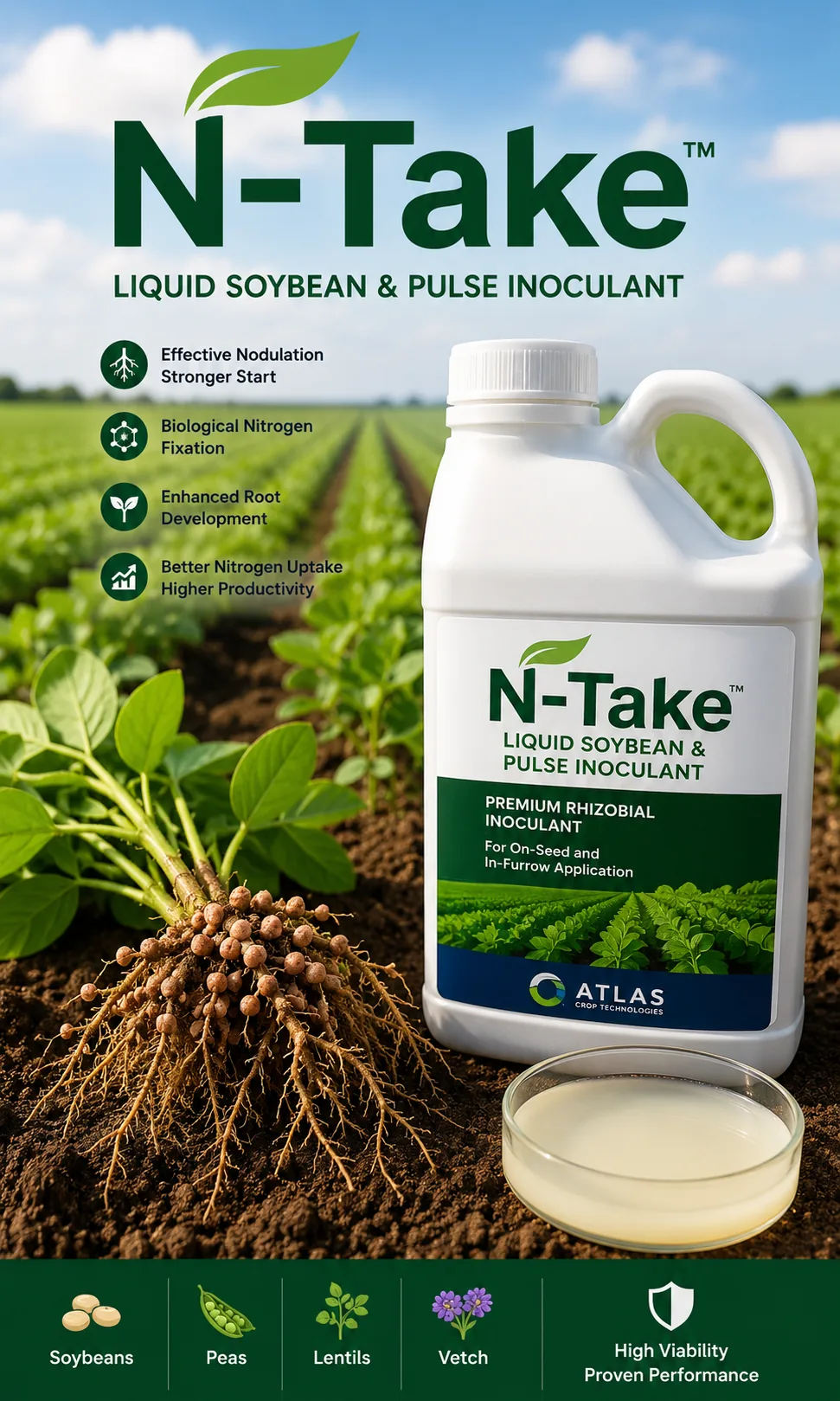
N-Take™
A premium liquid soybean and pulse inoculant designed to place high populations of beneficial nitrogen-fixing bacteria close to the developing root system, supporting effective nodulation, biological nitrogen fixation, nitrogen uptake and productive crop growth.
N-Take™ is engineered for commercial seed-treatment and label-approved in-furrow programs. Its low-volume liquid format is positioned to deliver a high bacterial population while helping maintain practical seed flow and reduce bridging or clumping during planting.
N-Take™ formulations, rhizobial strains, viable-cell counts, registered crops, rates, application methods and compatible seed treatments vary by country and SKU. Always use the current approved local label.
Putting effective nitrogen-fixing biology close to the root
Legume crops have a unique ability to form symbiotic relationships with compatible rhizobial bacteria.
When successful, these bacteria infect young roots and stimulate the development of specialised structures called nodules.
Inside functional nodules, rhizobia can convert atmospheric nitrogen gas into biologically useful nitrogen that contributes to crop nutrition.
N-Take™ is designed to improve the probability that adequate numbers of effective rhizobia are positioned near emerging legume roots when infection and nodulation begin.
Technical positioning
Turning atmospheric nitrogen into crop nutrition
The atmosphere contains abundant nitrogen, but plants cannot use atmospheric N₂ directly without biological or industrial conversion.
Rhizobia reach the emerging root
Compatible rhizobial bacteria must survive near the seed and developing root long enough to initiate infection.
Root recognition begins
The legume and compatible bacteria exchange biochemical signals that help initiate the symbiotic relationship.
Root infection occurs
Rhizobia enter susceptible root tissue through a highly regulated infection process.
Nodules develop
The crop forms specialised root structures that house the symbiotic bacteria.
Nitrogen fixation begins
Within effective nodules, microbial nitrogenase enzymes convert atmospheric nitrogen gas into reduced nitrogen compounds.
Nitrogen supports plant growth
Fixed nitrogen can enter amino acids, proteins and other nitrogen-containing plant compounds.
A biological exchange between crop and microorganism
Biological nitrogen fixation is not a one-way process.
The rhizobia provide biologically fixed nitrogen to the plant, while the crop supplies photosynthetically derived carbon compounds and a specialised protected nodule environment to the bacteria.
Effective fixation therefore depends on both partners being healthy and on the crop having sufficient energy, water and supporting mineral nutrition.
Successful nodulation requires several pieces
Not every rhizobium nodulates every legume
Rhizobial inoculation is biologically crop-specific.
Soybean, pea, lentil, vetch and other legumes are not automatically inoculated by the same bacterial strain or formulation.
Commercial inoculants are therefore formulated around compatible host–microorganism relationships and registered crop uses.
The correct N-Take™ SKU must be selected for the intended crop and market.
Crop availability differs by region
Always confirm that the specific N-Take™ formulation is registered and biologically appropriate for the target legume.
High bacterial population per seed
Verdesian positions N-Take™ as a high-powered liquid inoculant delivering a large population of nitrogen-fixing bacteria to seed.
The agronomic logic is straightforward: inoculation seeks to put enough viable, compatible bacteria close to emerging roots to improve the probability of timely infection and nodulation.
Actual viable-cell guarantees are product-, formulation-, manufacturing-date- and market-specific and should be taken from the current label rather than inferred from general marketing statements.
Count alone is not the whole story
More nodules are useful only when they are effective
Nodule number, location, size and biological activity all help describe the quality of the legume–rhizobia relationship.
Nodule number
Adequate nodule formation indicates successful infection, but nodule count alone does not confirm nitrogen-fixation activity.
Nodule location
Nodules near the crown or primary root can provide useful information about early infection, while lateral-root nodules may reflect later rhizobial encounters.
Nodule size
Larger nodules can be visually prominent, but size should be interpreted together with internal colour and crop performance.
Internal colour
Active nodules commonly develop pink or reddish internal tissue associated with leghemoglobin, whereas inactive nodules may appear pale, white, greenish or deteriorated.
Why active nodules often look pink inside
Nitrogenase, the enzyme complex responsible for biological nitrogen fixation, is highly sensitive to oxygen.
At the same time, rhizobia require respiration to generate the energy needed for fixation.
Legume nodules manage this challenge partly through leghemoglobin, an oxygen-binding compound that helps regulate oxygen availability.
Leghemoglobin is responsible for the characteristic pink-to-red appearance commonly seen when an actively fixing nodule is cut open.
Inspect nodules carefully
On-seed inoculation
Applying inoculant directly to seed is one of the most direct ways of positioning rhizobia close to the emerging root.
Current Verdesian information lists N-Take™ for seed-applied use in registered formulations.
Uniform coverage is important because uneven treatment can leave some seeds with fewer viable bacteria than intended.
The time between inoculation and planting must also remain within the current label's allowed on-seed survival interval, especially where additional chemical seed treatments are present.
Before treating seed
Low-volume treatment and planter flow
Current manufacturer positioning highlights N-Take™ as a low-rate liquid inoculant.
Lower liquid loading can be operationally useful because excessive moisture on seed may contribute to stickiness, bridging or clumping in seed-treatment, storage and planting systems.
Verdesian specifically positions N-Take™ as helping avoid seed bridging and clumping while remaining easy to mix and apply.
Practical handling objectives
Current soybean seed-treatment guidance
The current Verdesian European N-Take™ soybean page lists:
This rate applies to the referenced European soybean product and should not automatically be transferred to pulse formulations or products supplied in other markets.
Rates are formulation-specific
Current North American manufacturer information lists a different rate for its US soybean N-Take™ formulation.
That difference demonstrates why inoculant rates must always be taken from the current product label rather than converted from another country's page.
A different liquid volume may reflect a different bacterial concentration, formulation or registration.
In-furrow inoculation
Current manufacturer information states that N-Take™ can also be mixed with water and applied in-furrow for relevant registered formulations.
In-furrow application can be useful where the grower wants to place living rhizobia into the seed environment during planting rather than relying exclusively on pretreated seed.
The objective remains the same: bring a viable population of compatible bacteria close enough to emerging roots for timely infection.
Keep inoculant close to the seed
Verdesian specifically states that in-furrow N-Take™ should be positioned as close to the seed as possible.
This recommendation reflects the slow movement of rhizobia through soil.
Moist soil supports successful establishment
Rhizobia are living microorganisms and remain biologically sensitive to their environment.
Current manufacturer guidance recommends planting N-Take™-treated seed into moist soil.
Moisture supports survival near the germinating seed and provides conditions in which developing roots and bacteria can interact.
Heat and drought can reduce viability
Verdesian warns that extended periods of hot, dry soil can have detrimental effects on rhizobial viability.
Where irrigation is available and agronomically appropriate, the manufacturer recommends irrigating promptly, beginning with seed planted first.
Planting into extremely hot, dry, saline or otherwise hostile conditions can reduce both rhizobial survival and crop establishment.
Protect living bacteria from avoidable stress
Heat
Excessive temperatures can reduce the survival of biological inoculants.
Direct sunlight
Do not unnecessarily expose inoculant or freshly treated seed to intense sun or hot equipment surfaces.
Desiccation
Drying conditions can reduce survival of rhizobia before successful root infection.
Storage
Store N-Take™ according to the exact temperature and shelf-life instructions on the current label.
Chemical exposure
Certain seed-treatment chemistries can adversely affect living rhizobia, particularly during prolonged contact.
Time
The interval between treatment and planting can influence the viable bacterial population remaining on seed.
Living inoculants require compatibility planning
Modern legume seed may carry fungicides, insecticides, micronutrients, polymers, colourants and other treatment components.
A combination that is physically compatible is not necessarily biologically compatible with living rhizobia.
Product chemistry, concentration, treatment order, seed moisture, storage temperature and time before planting can all influence survival.
Confirm the complete seed-treatment package
Verdesian specifically advises users to consult current compatibility information for seed treatments used with N-Take™.
Why inoculate even where legumes were grown before?
Previous legume production may leave compatible rhizobia in the soil, but soil populations can vary substantially across fields and seasons.
Population density, strain effectiveness and survival can be influenced by soil pH, drought, flooding, crop rotation, salinity, temperature and years since the host crop was last grown.
Commercial inoculation is therefore used as a relatively direct way to place a known inoculant population near each planted seed.
Situations where inoculation deserves particular attention
Soil pH affects both crop and rhizobia
Legume nodulation does not occur independently of soil chemistry.
Strong soil acidity or alkalinity can influence root growth, rhizobial survival, nutrient availability and the efficiency of the symbiotic relationship.
Where soil pH is outside the agronomically appropriate range for the crop, correcting the underlying soil condition is generally more effective than expecting inoculation alone to compensate.
Review more than pH
Biological nitrogen fixation still requires balanced fertility
Rhizobial inoculation can support nitrogen supply, but legumes still require the other essential nutrients needed for roots, nodules, photosynthesis and reproductive growth.
Phosphorus
Phosphorus supports energy transfer, root development and many metabolic processes associated with active growth.
Potassium
Potassium contributes to water regulation, enzyme activation and transport processes.
Sulphur
Sulphur is needed for specific amino acids and proteins and can interact strongly with nitrogen nutrition.
Molybdenum
Molybdenum is associated with key nitrogen-metabolism enzymes and is particularly relevant to biological nitrogen fixation.
Iron
Iron participates in electron-transfer proteins and biological processes important to nodule metabolism.
Other micronutrients
Boron, manganese, zinc and other elements remain essential according to crop demand and soil supply.
Inoculation and nitrogen fertiliser are not interchangeable concepts
Effective inoculation is intended to establish biological nitrogen fixation rather than simply applying mineral nitrogen.
In well-nodulated legumes, biological fixation can provide a major share of crop nitrogen demand.
However, the appropriate role of starter nitrogen, soil mineral nitrogen or supplemental nitrogen varies with crop, yield potential, soil, environmental conditions and local research.
Avoid universal nitrogen-replacement claims
Nitrogen recommendations for soybean and pulse crops should follow locally validated agronomy, soil conditions and applicable nutrient management guidance.
Soil nitrogen can influence nodulation behaviour
Biological nitrogen fixation requires substantial energy from the crop.
When readily available mineral nitrogen is abundant, some legumes may reduce investment in nodulation or nitrogen fixation because direct uptake can be energetically less costly.
This relationship is one reason legume nitrogen programs should be crop-specific rather than based on assumptions from non-legume crops.
Consider existing nitrogen supply
Why root mass matters in an inoculated legume crop
More root surface
Larger root systems create more surface area for water and mineral nutrient uptake.
More infection opportunities
Young actively growing roots provide sites at which compatible rhizobia can initiate nodulation.
Greater soil exploration
Deeper and wider root systems can explore a larger volume of soil.
Better access to water
Root distribution influences the crop's ability to extract water from different soil depths.
Supporting nutrients
Roots must acquire phosphorus, potassium, sulphur and micronutrients needed to sustain growth and fixation.
Crop resilience
Strong rooting can broaden the crop's access to resources but cannot eliminate severe drought, flooding or compaction.
Inoculation cannot overcome severe physical restrictions
Compaction, hardpans, crusting and poor soil structure can restrict root growth regardless of rhizobial quality.
Poor root development can indirectly limit nodulation because there is less active root tissue available for infection and less soil volume explored for supporting nutrients and water.
Check field conditions
Diagnosing poor nodulation
A weak-looking legume crop does not automatically mean the inoculant failed. Use a systematic diagnosis.
Verify inoculation
Confirm the correct product, rate, crop and seed lot were treated.
Review storage records
Determine whether inoculant experienced excessive heat, freezing, sunlight or other storage deviations.
Check chemical compatibility
Review fungicides, insecticides, micronutrients and treatment intervals that may have influenced survival.
Review planting conditions
Hot, dry or excessively wet soils can interfere with bacterial survival and infection.
Inspect root systems
Carefully dig representative plants and inspect roots and nodules.
Review soil constraints
Soil pH, compaction, salinity, disease and nutrient deficiency may contribute to poor crop performance.
How to inspect nodulation
Nodulation should be assessed using representative plants from multiple locations rather than a single plant from the field edge.
Plants should be carefully excavated with a spade or shovel because nodules can detach easily when plants are pulled from dry or firm soil.
Soil can then be gently washed away so crown and lateral-root nodules remain visible.
Useful scouting observations
Commercial inoculation requires accurate application
Calibrate treatment equipment
Verify actual inoculant delivery against seed throughput.
Maintain uniform flow
Changes in seed flow or liquid delivery can result in uneven treatment.
Measure accurately
Small-volume liquid products require careful metering to avoid under- or over-application.
Avoid unnecessary drying stress
Treated seed should be handled and planted according to product survival and storage instructions.
Maintain hygiene
Clean treatment systems help prevent contamination and inconsistent dosing.
Record treatment lots
Document seed lot, inoculant lot, date, rate and other treatment products.
In-furrow equipment considerations
Current Verdesian information states that N-Take™ can work with in-furrow application planting equipment for applicable formulations.
Flow, dilution, filtration, nozzle or tube placement and row-to-row uniformity should be checked before planting.
Biological inoculants should also be protected from prolonged exposure to high temperatures in tanks, pumps, hoses or planter systems.
Verify delivery before the field
Treat N-Take™ as a living biological product
Biological inoculants require different handling from conventional mineral fertilisers.
Product viability can decline when storage falls outside the manufacturer's specified conditions.
Always check the container label for storage temperature, expiration or use-by information and protection requirements.
Protect bacterial viability
Measuring inoculant performance
Emergence
Record stand establishment so later comparisons are not confused by differences in plant population.
Nodulation
Compare nodule number, position and internal colour at suitable crop stages.
Root development
Evaluate representative root mass, branching and soil exploration.
Crop colour
Leaf colour can provide supporting context but should not be used alone to diagnose nitrogen fixation.
Tissue nitrogen
Plant analysis may provide useful information on crop nitrogen status when interpreted at the appropriate growth stage.
Final yield
Well-designed treated and untreated comparisons can help determine whether biological differences translated into economic crop response.
Avoid common inoculation mistakes
Using the wrong crop inoculant
Rhizobial compatibility is crop-specific. Always confirm the correct formulation for the target legume.
Using the wrong market rate
N-Take™ rates differ among regional formulations. Use the current local label.
Exposing inoculant to heat
Biological products can lose viability when stored or handled outside recommended temperature conditions.
Assuming chemical compatibility
Physical compatibility with a seed treatment does not guarantee rhizobial survival.
Treating too far ahead of planting
Do not exceed the approved interval between inoculation and planting.
Planting into hostile soil conditions
Prolonged hot, dry conditions can reduce bacterial survival and infection success.
Positioning in-furrow too far from seed
Rhizobia move slowly in soil, so manufacturer guidance emphasises placement close to seed.
Diagnosing nodulation by crop colour alone
Dig plants and inspect roots and nodules before concluding that inoculation was unsuccessful.
Information that helps us evaluate N-Take™ for your program
Country
Determines formulation, registration, rate and crop availability.
Crop
Specify soybean, pea, lentil, vetch or other intended registered legume.
Seed quantity
Provide kilograms or tonnes of seed to calculate treatment requirement.
Seed-treatment package
List fungicides, insecticides, polymers, micronutrients and other biologicals already applied or planned.
Application route
Identify commercial on-seed, on-farm seed treatment or in-furrow use.
Treatment-to-planting interval
Indicate whether seed will be planted immediately or stored after treatment.
Soil conditions
Include pH, texture, moisture and known salinity or drainage issues.
Field history
Identify whether the crop has previously been grown in the field and how recently.
Commercial requirement
For distributors, include annual seed volume, crop segment, treatment infrastructure and target market.
N-Take™ product profile
Explore related technologies
Combine biological inoculation with foliar and fertiliser efficiency technologies according to crop requirements and local registration.
Nutri-Phite® PGA
A stabilized-phosphite foliar biostimulant positioned to support plant metabolism, nitrogen uptake, root development and efficient crop growth.
View Product → Granular NitrogenNutriSphere-N®
A nitrogen fertiliser enhancer for urea-based fertilisers designed to improve nitrogen retention and reduce common nitrogen-loss pathways.
View Product → Liquid NitrogenNutriSphere-NL®
A nitrogen-management technology for liquid nitrogen fertilisers such as UAN, developed to improve nitrogen efficiency and limit loss risk.
View Product →Build a reliable legume inoculation program
Tell us your country, crop, seed quantity, current seed-treatment package, application method, planting schedule and expected soil conditions. Atlas Crop Technologies can help evaluate N-Take™ availability and technical fit for your market.
Frequently Asked Questions
Product-specific answers reflect current manufacturer positioning where identified. General biological explanations are provided for agronomic context. Always use the current local N-Take™ label.
N-Take™ is a premium liquid legume inoculant designed to deliver nitrogen-fixing bacteria close to developing roots to support nodulation, biological nitrogen fixation, nitrogen uptake and crop growth.
A rhizobial inoculant is a biological product containing live bacteria selected for compatibility with particular legumes. The bacteria colonise developing roots and can initiate nodule formation, where biological nitrogen fixation occurs.
Biological nitrogen fixation is the microbial conversion of atmospheric nitrogen gas into reduced nitrogen compounds that can enter biological metabolism. Compatible rhizobia perform this process inside functional legume nodules.
Nodules are specialised root structures that create a controlled environment for symbiotic rhizobia. They enable nitrogen fixation while regulating oxygen around the oxygen-sensitive nitrogenase system.
Verdesian positions N-Take™ as delivering a high population of nitrogen-fixing bacteria to each treated seed. A strong viable population increases the opportunity for compatible bacteria to encounter young roots and initiate nodulation.
Do not assume so. Legume–rhizobia compatibility is crop-specific, and N-Take™ formulations or SKUs can differ by host crop and market.
The current European Verdesian page is soybean-focused. Current North American manufacturer information additionally lists N-Take™ formulations for pea, vetch and lentil. Local registration determines actual availability.
No such substitution should be assumed. Use only the crop-specific formulation identified by the current manufacturer label for the intended legume.
Yes. Current manufacturer information lists seed application for registered N-Take™ formulations. Use the exact local application rate and observe compatibility and planting-interval requirements.
Yes, where registered. Current manufacturer information states that N-Take™ can be mixed with water for in-furrow use and should be positioned close to seed.
Verdesian notes that rhizobia migrate slowly through soil. Close placement improves the probability that viable bacteria encounter developing roots during the early infection period.
Current Verdesian European information lists 104 mL of N-Take™ per 45.5 kg of soybean seed. Always verify the current local label because other market formulations use different rates.
Product formulations, bacterial concentrations and registrations can differ by market. Different liquid rates should therefore not be assumed to represent the same formulation.
Current Verdesian Europe information states that a case of the referenced N-Take™ soybean product treats approximately 4,535 kg of seed.
Verdesian positions the low-rate liquid formulation as helping minimise seed bridging and clumping while still delivering a high bacterial population.
Bridging occurs when seed does not flow freely and forms an arch or blockage in a hopper or handling system. Excessive moisture, tackiness or seed-treatment loading can contribute to poor flow.
Rhizobia are living bacteria. Current manufacturer guidance recommends moist planting conditions because prolonged hot, dry soil can negatively affect rhizobial viability.
Where irrigation is available and appropriate, current manufacturer guidance recommends timely irrigation when hot, dry conditions threaten rhizobial survival. Follow local crop and irrigation recommendations.
Excessive heat can reduce viability of living inoculant microorganisms. Store and handle N-Take™ within the exact temperature limits stated on the current label.
Biological products and freshly inoculated seed should generally be protected from unnecessary heat and direct sunlight according to label instructions because those conditions can reduce microbial survival.
Compatibility depends on the exact fungicide active ingredients, formulations and contact time. Verdesian recommends checking its current seed-treatment compatibility guidance.
Potentially, but compatibility must be confirmed for the exact product combination. Living rhizobia may respond differently to different seed-treatment chemistries.
Only if the current product label and seed-treatment compatibility information allow that interval. On-seed survival can be affected by formulation, chemicals, temperature and storage conditions.
Previous soybean production may leave compatible rhizobia in the soil, but population and effectiveness can vary. Inoculation is used as a direct way to place a known bacterial population close to newly planted seed. Follow local agronomic recommendations.
Fields without a history of the host legume may have limited populations of compatible rhizobia, making crop-appropriate inoculation particularly important to evaluate.
Yes. Soil pH can influence rhizobial survival, crop root growth and nutrient availability. Severe pH limitations should be corrected through appropriate soil-management practices.
Drought can reduce bacterial survival, root infection, nodule development and later nitrogen-fixation activity. Current manufacturer guidance specifically warns against prolonged hot, dry soil conditions.
Severe waterlogging can reduce root oxygen and impair root and nodule function. Inoculation cannot compensate for prolonged saturated soil conditions.
Carefully dig representative plants, preserve the roots, wash them gently and cut several nodules open. Active nodules often show pink-to-red internal tissue associated with leghemoglobin, although interpretation depends on crop stage.
Not necessarily. Nodule effectiveness, location, size and activity matter as well as total number. A large number of inactive nodules is not equivalent to effective nitrogen fixation.
Leghemoglobin is an oxygen-binding protein found in active legume nodules. It helps regulate oxygen so bacterial respiration can continue while protecting the oxygen-sensitive nitrogenase system.
No universal replacement claim should be assumed. Effective biological nitrogen fixation can provide substantial nitrogen to legumes, but crop nitrogen management should follow locally validated recommendations.
High levels of readily available mineral nitrogen can reduce the crop's biological incentive to invest energy in nodulation and fixation. The effect is crop- and environment-dependent.
Legumes still require balanced phosphorus, potassium, sulphur and micronutrient nutrition. Molybdenum and iron have particular biochemical relevance to nitrogen-fixation and nitrogen-metabolism systems.
No. Inoculation is designed to support nodulation and nitrogen fixation, but yield depends on genetics, soil, weather, nutrition, water, pests, disease, plant population and many other management factors.
Use a well-planned treated and untreated comparison where agronomically appropriate, maintain equivalent seed population and fertility, and measure emergence, nodulation, root development, crop nitrogen status and final yield.
No. Crop registrations, formulations, rhizobial strains, viable-cell guarantees, rates, packaging and directions can vary significantly between markets.
Include your country, crop, seed quantity, seed variety, current fungicide and insecticide treatment, intended inoculation method, treatment-to-planting interval, planting date, soil pH and expected soil moisture conditions.
Include your company, country, crop segment, annual treated-seed volume, treatment infrastructure, intended customer base and seasonal product requirement.
N-Take™ is a biological inoculant containing living microorganisms. Product effectiveness depends not only on correct application rate but also on the survival and biological compatibility of the microorganisms.
Formulation, rhizobial species and strains, viable-cell guarantees, crop registrations, application rates, seed-treatment compatibility, on-seed survival intervals, in-furrow directions, storage temperature, shelf life, pack size and permitted claims can vary by country and SKU.
The European rate of 104 mL per 45.5 kg soybean seed and the manufacturer-listed treatment capacity of approximately 4,535 kg seed per case refer to the current European soybean product page and should not automatically be transferred to products supplied in other markets.
The current North American manufacturer portfolio additionally lists N-Take™ formulations for soybean, pea, vetch and lentil. This does not establish registration for those crops in every country.
Manufacturer statements relating to high bacterial population, nodulation, nitrogen uptake, reduced bridging or clumping and crop performance describe manufacturer product positioning and do not guarantee a specific response in an individual field.
Rhizobia are living bacteria. Exposure to excessive heat, desiccation, incompatible seed-treatment chemistry, prolonged on-seed storage or hostile planting conditions can reduce viable bacterial populations.
Current manufacturer guidance recommends planting into moist soil and positioning in-furrow inoculant close to seed because rhizobia migrate slowly through soil. Extended hot, dry soil conditions can adversely affect rhizobial viability.
N-Take™ should not be described as a universal replacement for all nitrogen fertiliser. Biological nitrogen fixation can be a major nitrogen source for well-nodulated legumes, but nitrogen management should follow crop-specific, locally validated agronomic recommendations.
Likewise, successful inoculation does not replace balanced phosphorus, potassium, sulphur, micronutrient, water, soil-pH, disease, pest or root-zone management.
Always read and follow the current approved product label and manufacturer technical directions. Consult a qualified agronomist, inoculant specialist, seed-treatment professional or Atlas Crop Technologies representative for crop-specific rates, compatibility, application, handling or local registration guidance.