LYRA®
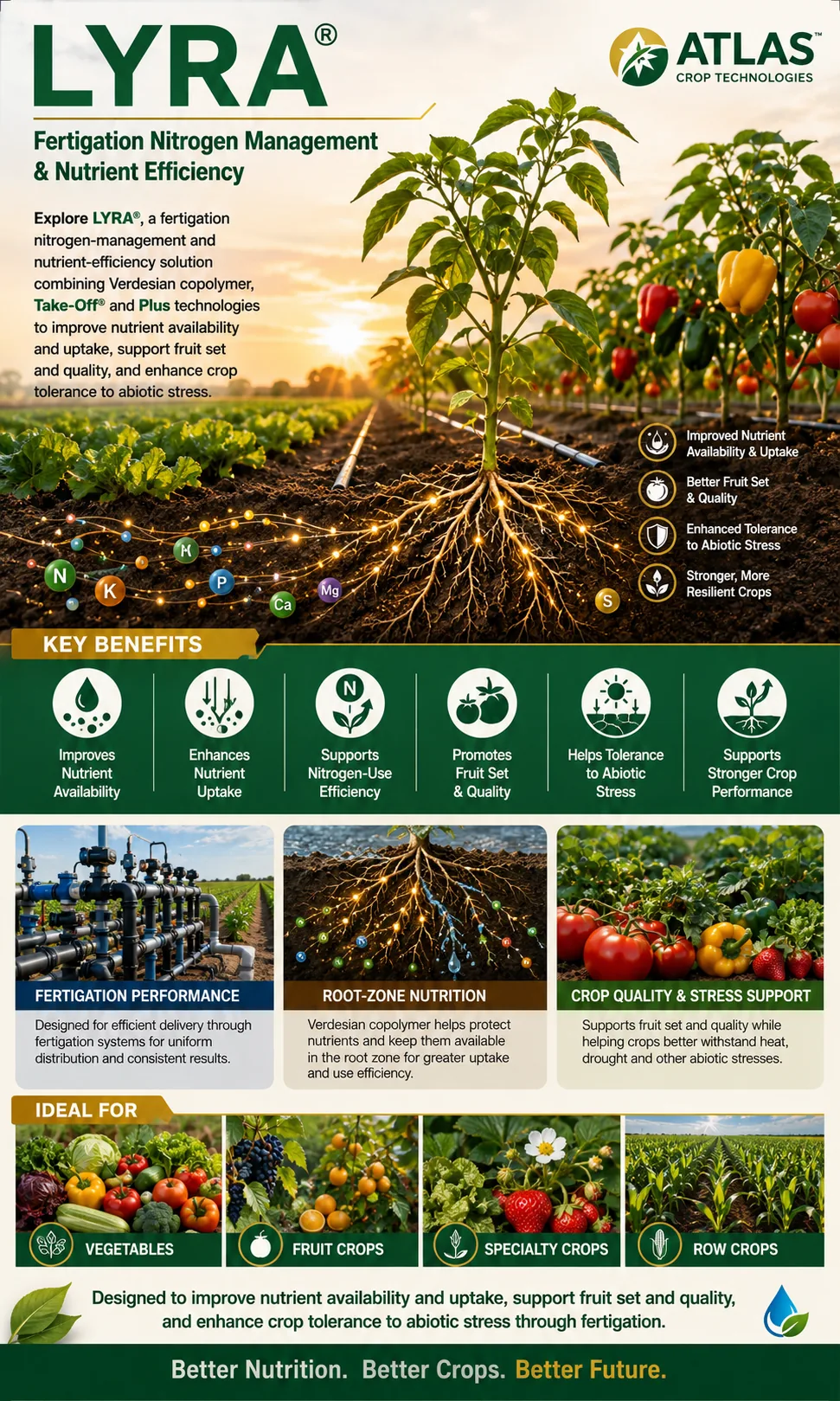
A nitrogen-management solution formulated for fertigation in specialty and row crops, combining Verdesian copolymer, Take-Off® and Plus technologies to improve nutrient availability and uptake while supporting fruit set, fruit quality and crop tolerance to abiotic stress.
LYRA® is designed to be applied in conjunction with fertigated nitrogen. Verdesian reports significant yield benefits in product trials across multiple crops and geographies and positions the technology around more effective use of applied nutrition.
Exact rates, crops, timings, nitrogen programs, compatibility, registration and packaging vary by market. Always follow the current approved local LYRA® label and irrigation-management guidance.
Improving the efficiency of fertigated crop nutrition
Fertigation combines irrigation and fertiliser delivery so water and nutrients can be supplied through the same distribution system.
This creates important opportunities for precise nutrient timing, but performance still depends on nutrient availability, root activity, water distribution, soil or substrate chemistry and crop demand.
LYRA® is positioned by Verdesian as a fertigation nitrogen-management tool designed to improve nutrient availability and uptake while helping crops respond more effectively under abiotic stress.
Current manufacturer positioning
Three Verdesian technologies in one fertigation solution
Current Verdesian product information states that LYRA® combines its copolymer, Take-Off® and Plus technologies.
Verdesian Copolymer
LYRA® incorporates Verdesian copolymer technology within its nitrogen-management platform.
The manufacturer does not require this page to assign an unsupported universal chemical composition or concentration to the market-specific LYRA® formulation.
Take-Off®
Take-Off® is an established Verdesian nutrient-use-efficiency technology used across multiple crop-nutrition products.
Within LYRA®, it forms part of the manufacturer's combined fertigation approach to nutrient acquisition and crop performance.
Plus Technology
Verdesian lists Plus technology as the third component of the LYRA® platform.
Exact chemistry and market-specific formulation should be taken from the current product label, SDS or technical data supplied for the target country.
Dual mode of action
Verdesian's current European portfolio describes LYRA® as a fertigation enhancer with a dual mode of action.
That positioning centres on two broad crop objectives:
Nutrition and stress are connected
Nutrient uptake can decline when environmental stress restricts root growth, transpiration, membrane function or crop metabolism.
Likewise, poorly nourished crops may have less capacity to maintain productive growth when conditions become challenging.
LYRA® is therefore positioned at the intersection of nutrient efficiency and crop stress management.
Improved nutrient availability
Verdesian lists improved nutrient availability among LYRA®'s core product benefits.
In fertigation systems, applied nutrients enter a dynamic root-zone environment where pH, moisture, mineral surfaces, organic matter, salinity and microbial processes affect nutrient behaviour.
Increasing the fraction of applied nutrition that remains accessible to roots can support a more efficient fertiliser program.
Availability depends on
Improved nutrient uptake
Root interception
Growing roots encounter nutrients directly as they occupy new soil or substrate volume.
Mass flow
Dissolved nutrients can move toward active roots with irrigation water and crop transpiration.
Diffusion
Nutrients can move toward roots along concentration gradients, particularly over short distances.
Root membranes
Plant transport systems regulate final nutrient entry into root cells.
Root health
Healthy, oxygenated roots acquire nutrients more effectively than diseased or waterlogged roots.
Crop demand
Uptake patterns change as crop growth and reproductive demand evolve.
More value from fertigated nitrogen
LYRA® is explicitly positioned by Verdesian as a nitrogen-management solution.
In practical agronomy, nitrogen-use efficiency describes how effectively supplied nitrogen contributes to productive crop biomass, yield or quality rather than remaining unused or being lost from the system.
LYRA® is intended to be used alongside fertigated nitrogen—not as a source that replaces nitrogen itself.
Efficiency depends on
LYRA® does not create nitrogen
Improved nitrogen-use efficiency should not be interpreted as nitrogen creation.
Crop nitrogen demand still needs to be supplied from fertiliser, mineralised organic matter, biological sources, irrigation water or other recognised nitrogen inputs.
Do not automatically reduce nitrogen rate
Any change in nitrogen rate should be supported by the current LYRA® label, local field validation, crop demand, soil or substrate nitrogen supply and qualified agronomic recommendations.
Why irrigation management matters as much as product selection
Water carries the treatment
LYRA® and fertigated nutrients can only reach areas receiving irrigation water.
Uniformity determines distribution
Non-uniform irrigation creates non-uniform fertiliser and product distribution.
Timing controls root-zone position
Injection timing within the irrigation cycle influences where nutrients move in the wetting zone.
Excess water can move nitrogen deeper
Over-irrigation may carry nitrate below the most active root zone.
Too little water limits movement
Insufficient irrigation may restrict nutrient distribution within the rooting volume.
System maintenance matters
Filters, emitters, injectors, pressure and flow should all operate correctly before fertigation.
Drip and micro-irrigation fertigation
Many specialty-crop fertigation programs use drip or micro-irrigation because these systems can deliver water and nutrients directly into a defined root-zone volume.
Exact LYRA® use in any system must still follow the approved label and compatibility guidance.
Before injection
A fertigation treatment cannot overcome poor hydraulic uniformity
Fertigation distributes products through water.
If some emitters deliver substantially more or less water than others, those plants can also receive different nutrient and LYRA® quantities.
Irrigation-system evaluation is therefore an important part of fertigation quality control.
Inspect
Water chemistry influences fertigation chemistry
pH
Water pH can influence nutrient solubility and the chemistry of the fertigated solution.
Bicarbonate
High alkalinity can influence root-zone pH and interact with calcium, magnesium and phosphorus chemistry.
Hardness
Calcium and magnesium concentrations can matter in concentrated fertiliser mixtures.
Electrical conductivity
EC provides a useful indicator of total dissolved salt concentration.
Sodium & chloride
Excess concentrations can contribute to crop salinity or ion-specific stress.
Iron & suspended solids
These can contribute to irrigation-system clogging under certain conditions.
Fertigation increases nutrient concentration—but also salt load
Most mineral fertilisers contribute dissolved ions to irrigation water.
Excessively concentrated fertigation can raise root-zone electrical conductivity and make water uptake more difficult for the crop.
LYRA® should therefore be integrated with a nutrient concentration appropriate for crop tolerance, irrigation-water quality and substrate or soil.
Useful salinity indicators
Enhanced abiotic-stress tolerance
Verdesian lists enhanced abiotic-stress tolerance among LYRA®'s principal product benefits.
Drought
Water deficit reduces cell expansion, nutrient transport, photosynthesis and root activity.
Heat
High temperature can disrupt membranes, reproductive processes and photosynthetic performance.
Salinity
Excess salts reduce the crop's ability to acquire water and can produce ion-specific toxicity.
Cold
Low temperature can restrict metabolism, root growth and nutrient uptake.
Waterlogging
Saturated root zones can reduce oxygen availability and impair root respiration.
Osmotic stress
High dissolved-solute concentrations can increase the energetic cost of water uptake.
Stress tolerance is not stress elimination
A crop described as having enhanced tolerance may maintain function better under some challenging conditions.
That should not be interpreted as immunity to severe drought, heat, salinity, frost or waterlogging.
Continue core agronomic practices
Optimised fruit set
Verdesian lists optimisation of fruit set among LYRA®'s product benefits.
Fruit set is the transition from successful flowering and fertilisation toward sustained early fruit growth.
Water availability, temperature, pollination, carbohydrate supply, nutrient status and plant hormonal balance can all influence this stage.
Performance also depends on
Fruit quality
Verdesian specifically lists optimised fruit quality as a LYRA® benefit.
Fruit size
Cell division and expansion depend on water, carbohydrates and balanced nutrition.
Soluble solids
Sugar accumulation depends on photosynthesis, transport and crop maturity.
Colour
Pigment development responds to genetics, light, temperature and nutrition.
Firmness
Cell-wall development and water balance contribute to textural quality.
Uniformity
Consistent flowering, fruit set and water supply can improve harvest uniformity.
Marketable yield
Commercial quality should be measured by pack-out or crop-specific grading.
Specialty crops
Verdesian states that LYRA® is formulated for specialty-crop and row-crop fertigation applications. Exact registered crops remain label-specific.
Vegetable systems
High-value vegetable production often uses frequent irrigation and split nutrient applications to match rapid crop demand.
Fruit crops
Fertigation can support nutrient supply through flowering, fruit set, expansion and quality development.
Vines
Drip-irrigated vine systems can coordinate water and nutrient supply with phenological development.
Tree crops
Perennial root systems require careful spatial and seasonal nutrient management.
Berries
Irrigation water quality and root-zone salinity can be particularly important in sensitive berry crops.
Protected cultivation
Greenhouse and substrate systems often use precise EC, pH and drainage management.
Row crops
Current Verdesian information also positions LYRA® for row-crop fertigation.
Fertigated row crops can receive nitrogen in smaller, more frequent applications timed to major periods of crop demand.
Exact approved crops, rates and timings remain market- and label-specific.
Consider
Nitrogen form influences root-zone behaviour
Nitrate
Nitrate is highly plant-available but relatively mobile in many soils.
Ammonium
Ammonium interacts more strongly with negatively charged soil surfaces and can acidify the rhizosphere during plant uptake.
Urea
Urea must hydrolyse before its nitrogen fully enters ammonium- and nitrate-based soil pathways.
Mixed sources
Many fertigation programs use combinations of nitrogen forms to match crop, water and fertiliser-management needs.
Manage the risk of nitrate movement below the root zone
Nitrate is mobile in soil water.
Excess irrigation or rainfall can move nitrate below active roots, particularly in coarse-textured soils or shallow-rooted crops.
Split fertigation applications can help align nitrogen delivery with crop uptake, but irrigation management remains critical.
Watch
Synchronise nutrient delivery with crop demand
Early root development
Young crops have smaller root systems and may benefit from precise, accessible nutrition.
Rapid canopy expansion
Nitrogen demand frequently rises as leaf area and biomass accumulate.
Reproductive transition
Water and nutrient balance can influence flowering and early reproductive development.
Early fruit development
Carbon, water and nutrient supply support retained fruit development.
Fruit / yield expansion
Crop nutrient demand often remains high during active biomass accumulation.
Quality management
Late-season nitrogen should be managed carefully because excessive vegetative nutrition can conflict with crop-specific quality targets.
Injection timing influences product placement
In a fertigation event, products can be injected at different points within the irrigation cycle.
The optimal sequence depends on irrigation design, crop, root depth, soil texture, system volume and label instructions.
Sufficient post-injection water is generally needed to move material through the lines and into the intended wetting zone without excessive deep movement.
Know your system
Evaluate the complete injection mixture
Fertigation tanks can contain nitrogen fertilisers, phosphorus, potassium, magnesium, micronutrients, acids and other products.
Compatibility depends on concentration, pH, temperature, water chemistry and order of addition.
Exact LYRA® compatibility must therefore follow the current manufacturer label and technical guidance.
Watch for
Concentration can change compatibility
Two products that remain compatible after dilution may still be incompatible when mixed together as concentrated stock solutions.
High local concentrations of calcium, phosphate, sulphate or other ions can create precipitates.
Do not combine concentrated fertilisers or LYRA® with incompatible materials unless the current product guidance specifically permits it.
Protect the irrigation system
Small-scale compatibility testing
Where all labels allow a proposed mixture but physical compatibility is uncertain, a small proportional test using the actual irrigation water can help identify obvious precipitation or separation.
Reproduce the intended concentration and order of addition.
Physical stability is not full compatibility
Current labels and manufacturer technical guidance remain controlling.
Soil texture changes fertigation behaviour
Sandy soil
Water and nitrate can move rapidly, often favouring smaller, more-frequent irrigation and nutrient applications.
Loam
Intermediate water-holding capacity may provide a wider management window.
Clay soil
Water moves more slowly and poor drainage can create oxygen stress when irrigation is excessive.
Soilless substrate
Substrate volume, air-filled porosity and drainage fraction become especially important in intensive fertigation systems.
Nutrient uptake depends on living, active roots
LYRA® is positioned around nutrient availability and uptake, but severe physical or biological root damage can still restrict crop response.
Root-zone oxygen, moisture, temperature, disease and compaction all influence nutrient-acquisition capacity.
Root constraints
Soil and substrate analysis
Fertigation programs should be built from an understanding of the nutrient and chemical environment surrounding roots.
Soil or substrate testing can help determine background nutrient status and identify constraints that may affect LYRA® program response.
Consider
Tissue analysis helps measure nutrient uptake
Soil analysis describes nutrient supply potential, while tissue analysis measures the nutrient concentration present in crop tissues.
This makes tissue testing particularly relevant when improved nutrient uptake is one of the main LYRA® program objectives.
Use consistent protocols
Plant-sap analysis
Some high-value fertigation programs use plant-sap analysis alongside conventional tissue testing for more frequent nutritional monitoring.
Interpretation methods and sufficiency targets differ from standard dry-tissue analysis and should not be mixed without appropriate expertise.
Combine multiple indicators
Yield benefits across crops and geographies
Verdesian states that LYRA®, when applied in conjunction with fertigated nitrogen, has produced significant yield benefits in product trials across many crops and geographies.
The current public product text retrieved does not provide one universal numeric yield-response percentage suitable for use across all crops.
Field response remains variable
Yield response depends on baseline fertility, irrigation, crop, variety, environment, nutrient program, application timing and the presence or absence of actual yield-limiting constraints.
Measure LYRA® in the context of the complete fertigation program
Tissue nitrogen
Compare crop-stage-appropriate tissue nitrogen where nitrogen uptake is a primary objective.
Root-zone nitrate
Soil or solution nitrate measurements can help evaluate nitrogen distribution.
Crop vigour
Track biomass, canopy development or crop-specific growth indices.
Fruit set
In fruiting crops, quantify retained flowers or developing fruit using a consistent method.
Yield
Compare treated and untreated zones using properly designed field trials.
Quality
Measure crop-specific traits such as size, Brix, firmness, grade or marketable pack-out.
Use comparable irrigation zones
Because LYRA® is delivered through irrigation, treated and untreated comparisons should ideally use hydraulically comparable zones.
Differences in pressure, emitter rate, soil type or irrigation scheduling can otherwise be confused with product response.
Trial details
LYRA® fits within 4R nitrogen management
Nitrogen-use-efficiency technologies are most effective when the core nitrogen program is already built around crop demand and good irrigation management.
Right source · rate · time · place
Nutrient efficiency and irrigation efficiency should be managed together
Nitrogen and water are closely linked in fertigation.
Excess water can move mobile nutrients beyond active roots, while insufficient water can restrict nutrient transport and crop uptake.
Improving nutrient-use efficiency therefore requires attention to both fertiliser management and water management.
Aim to
Maintain product integrity and irrigation-system safety
Keep original identification
Maintain product name, label and lot information for traceability.
Follow storage instructions
Use the current LYRA® label and SDS for storage-temperature and environmental requirements.
Use clean transfer equipment
Prevent contamination of stock tanks, injectors and measuring vessels.
Use appropriate PPE
Follow current SDS and workplace-safety requirements.
Protect drains and waterways
Handle spills according to the SDS and local environmental regulations.
Maintain application records
Record field, crop, rate, nitrogen source, irrigation volume, date and product lot.
Avoid common LYRA® fertigation-program mistakes
Inventing a universal rate
Use only the current locally approved LYRA® application rate.
Automatically reducing nitrogen
Improved NUE does not create a universal nitrogen-rate credit.
Ignoring irrigation uniformity
Uneven water distribution means uneven fertigation distribution.
Over-irrigating after injection
Excessive water can move nitrate and other mobile nutrients below active roots.
Under-flushing the system
Insufficient flushing may leave product concentrated in lines or prevent complete field distribution.
Ignoring water chemistry
Hardness, alkalinity, salinity and pH can affect fertigation performance.
Mixing incompatible concentrates
Concentrated fertiliser combinations can precipitate even when diluted forms appear compatible.
Using LYRA® as drought replacement
Stress-tolerance positioning does not eliminate the need for adequate irrigation.
Using LYRA® as salinity correction
Severe salinity still requires water-quality, leaching and soil-management strategies.
Ignoring root disease
Nutrient availability cannot fully compensate for severely damaged roots.
Assuming fruit-quality guarantees
Manufacturer benefit positioning should not be turned into a guaranteed size, Brix or pack-out response.
Assuming identical registration across EMEA
Confirm the current local LYRA® label before recommendation or sale.
Information that helps us evaluate a LYRA® program
Country
Determines current registration, label and formulation.
Crop
Identify crop, variety, planting system and yield target.
Growth stage
Helps align nitrogen and LYRA® timing with crop demand.
Irrigation system
Drip, micro-irrigation, pivot or another labelled fertigation system.
Water analysis
Include pH, EC, alkalinity, hardness, sodium and chloride where available.
Nitrogen source
Identify nitrate-, ammonium-, urea- or mixed-N fertiliser.
Nitrogen rate
Provide total seasonal and per-fertigation N rates.
LYRA® rate
Provide the locally approved rate being considered.
Injection schedule
Include irrigation duration, injection duration and flushing time.
Soil / substrate
Include texture, pH, EC and rooting depth.
Stress condition
Describe drought, salinity, heat or other abiotic challenge if relevant.
Commercial area
Include treated hectares and expected annual product requirement.
LYRA® product profile
Explore related technologies
Magnum
A foliar nutrient complex developed to improve nutrient management, root development and crop quality.
View Product → FoliarMagnum S
A Nutriphite® foliar nutrient complex supporting root development, nutrient uptake and crop establishment.
View Product → FoliarMagnumPGA
A dual-biostimulant nutrient complex intended to support carbon metabolism, nitrogen uptake, rooting and productive crop growth.
View Product →Build a more precise LYRA® fertigation program
Tell us your country, crop, irrigation system, water analysis, nitrogen source, seasonal nitrogen rate, fertigation schedule, soil or substrate conditions, abiotic-stress challenge and commercial area. Atlas Crop Technologies can help evaluate where LYRA® may fit within your nitrogen and irrigation strategy.
Frequently Asked Questions
Manufacturer-specific information is identified where relevant. General answers provide fertigation and crop-nutrition context. The current approved local LYRA® label always takes precedence.
LYRA® is a Verdesian nitrogen-management solution formulated for fertigation in specialty and row crops.
Verdesian states that LYRA® combines its copolymer, Take-Off® and Plus technologies.
The manufacturer lists improved nutrient availability and uptake, optimised fruit set and fruit quality, and enhanced abiotic-stress tolerance.
Yes. Verdesian's European portfolio describes LYRA® as a fertigation enhancer with a dual mode of action for improved nitrogen-use efficiency and reduced abiotic stress.
Current manufacturer positioning lists fertigation as the application method.
Yes. Verdesian describes LYRA® as being applied in conjunction with fertigated nitrogen.
No. LYRA® is a nitrogen-management technology and does not create nitrogen or eliminate crop nitrogen requirements.
Do not make an automatic nitrogen reduction. Any change should be supported by the current label and locally validated agronomy.
Verdesian broadly positions LYRA® for specialty and row crops. Exact crop approval must follow the current local label.
Use the application rate on the current approved local LYRA® label. A single universal EMEA rate is not assumed on this page.
Because rates can vary by market, crop, formulation and registration, and the current manufacturer information retrieved does not support one universal EMEA rate.
Yes. Improved nutrient availability is one of Verdesian's listed product benefits.
Yes. Improved nutrient uptake is one of the principal manufacturer-listed product benefits.
Nutrient availability refers to the fraction of nutrient in the root environment that can potentially be accessed and absorbed by the crop.
Yes. Because LYRA® is delivered by fertigation, uneven irrigation can produce uneven product and nutrient distribution.
LYRA® is positioned for fertigation, but use in a specific drip or micro-irrigation system must comply with the current label and system compatibility guidance.
pH, EC, hardness, bicarbonates, sodium, chloride and other dissolved ions can affect nutrient chemistry, salinity and irrigation-system performance.
Yes. High calcium, magnesium or alkalinity can affect the compatibility of concentrated fertiliser solutions and root-zone chemistry.
Yes. Excessive soluble salts can restrict crop water uptake and increase salinity stress.
No such universal claim should be assumed. Severe salinity still requires appropriate irrigation, drainage, water-quality and soil-management practices.
Verdesian lists enhanced abiotic-stress tolerance among the product's benefits.
Abiotic stress refers to non-biological environmental stresses such as drought, heat, salinity, cold and waterlogging.
No. Enhanced tolerance should not be interpreted as immunity to severe water deficit. Adequate irrigation remains essential.
Verdesian lists optimised fruit set as a product benefit. Actual fruit set still depends on crop, pollination, weather, nutrition and water status.
Verdesian lists optimised fruit quality among LYRA®'s benefits. The exact quality response depends on crop and production conditions.
No. Manufacturer positioning around fruit quality should not be converted into a guaranteed increase in fruit size or marketable grade.
No. Verdesian reports significant yield benefits across product trials, but actual field response depends on crop, nutrition, water, weather and overall management.
Universal compatibility should not be assumed. Check the current LYRA® label and all fertiliser compatibility guidance before mixing.
Yes. High concentrations of incompatible ions can form precipitates even when the final diluted irrigation water would otherwise remain stable.
Where labels permit a mixture, a small proportional test using the actual irrigation water may help detect obvious physical incompatibility, but it does not replace manufacturer guidance.
Appropriate flushing is generally part of good fertigation practice, but the exact duration should be based on system hydraulics and the current label.
Yes. Excess water can move nitrate below active roots and reduce recovery of applied nitrogen.
Suitability depends on the local label and crop. Sandy soils generally require particular attention to irrigation frequency and nitrate-leaching risk.
Do not assume this without market-specific label support. In soilless systems, EC, pH, drainage fraction and compatibility require precise management.
Yes where practical. Soil or substrate analysis provides useful information on nutrient supply, pH and salinity.
Tissue analysis can be especially useful when improved nutrient uptake is a program objective.
Use comparable irrigation zones and record product rate, nitrogen rate, irrigation volume, crop stage, tissue nutrient status, yield and relevant quality measurements.
LYRA® appears in Verdesian's current European product portfolio and its European labels / SDS library.
No universal availability should be assumed. Registration, formulation, rates and commercial availability can differ by market.
Use the pack specification supplied for your market. This page does not assert a universal EMEA pack size without a current reliable market-specific source.
Include country, crop, growth stage, irrigation system, water analysis, nitrogen source and rate, LYRA® label rate, injection schedule, soil or substrate data and any abiotic-stress issue.
Include your company, country, target crops, irrigated area, expected annual requirement, season and distribution structure.
Current Verdesian information identifies LYRA® as a nitrogen-management solution formulated for fertigation applications in specialty and row crops.
Verdesian states that LYRA® comprises its copolymer, Take-Off® and Plus technologies and that these technology platforms have produced reliable results across multiple existing Verdesian products.
The manufacturer states that LYRA® is applied in conjunction with fertigated nitrogen and has produced significant yield benefits in product trials across multiple crops and geographies.
Current manufacturer-listed product benefits are improved nutrient availability and uptake, optimised fruit set and fruit quality, and enhanced abiotic-stress tolerance.
Verdesian's current European portfolio describes LYRA® as a fertigation enhancer with a dual mode of action for improved nitrogen-use efficiency and reduced abiotic stress within the crop.
Manufacturer statements concerning yield, fruit set, fruit quality, nutrient uptake and abiotic-stress tolerance should not be interpreted as guaranteed responses in every field or crop.
LYRA® does not create nitrogen and should not automatically be used to reduce an otherwise agronomically justified nitrogen rate. Nitrogen management should remain based on crop demand, realistic yield target, soil or substrate nitrogen supply, irrigation regime and locally validated recommendations.
Fertigation performance depends on irrigation uniformity, injector calibration, nutrient source, nitrogen form, injection timing, soil or substrate characteristics, water quality, root distribution and crop demand.
Abiotic-stress tolerance does not mean immunity to drought, heat, salinity, cold or waterlogging. Irrigation, drainage, salinity management and other direct measures remain necessary.
Fruit-set and quality outcomes are influenced by genetics, pollination, crop load, temperature, water status, nutrition, light and crop protection in addition to any product treatment.
Exact LYRA® formulation, guaranteed analysis, application rate, crop uses, timings, irrigation-system directions, compatibility, pack size, registration and permitted claims may vary by jurisdiction.
LYRA® appears in the current Verdesian European product portfolio and labels / SDS library, but this does not establish identical registration or commercial availability throughout Europe, the Middle East and Africa.
Always read and follow the current approved local LYRA® label and Safety Data Sheet. Consult a qualified agronomist, fertigation specialist or Atlas Crop Technologies representative for crop-specific rate, nitrogen integration, irrigation timing, compatibility and water-quality guidance.